Gen X Childhood Fashion Trends: The 70s and 80s Kids’ Wardrobe, Dated Honestly
Gen X childhood fashion trends start with a date check, because the generation’s childhood is shorter and earlier than most nostalgia lists admit.
Gen X was born between 1965 and 1980, so its school years run from the early 1970s into the very start of the 1990s.
This page covers childhood only, and says so on purpose. Most pages filed under this keyword describe teenagers: grunge, logo mania and slip dresses. Those belong to Gen X adolescence, and they sit outside the boundary held here.
Childhood here means roughly ages 4 to 12. The wardrobe that follows is the elementary and middle school wardrobe: what kids wore to class, to picture day, to the playground and to Saturday morning television.
Every trend carries its year and its source. Prices print as dated strands, disagreements between sources print unmerged, and a closing section corrects the items most often misfiled into the wrong decade.
The walk runs the way a kid lived it. First the 1970s catalog wardrobe, then the 1980s school wardrobe by clothes, shoes, accessories and hair, then the catalogs and malls behind it.
The Era, Honestly: Who Gen X Is and When Their Childhood Actually Was
The birth years are the Pew Research Center range. The range runs 1965 to 1980, carried in the Generation X reference entry and set out in the Pew Research Center report on Generation X, and every date on this page hangs off those sixteen years.
The oldest Gen X kids started school around 1970. A child born in 1965 entered elementary school in the early 1970s, wearing the catalog wardrobe of that decade: bell bottoms, corduroys and Sears denim.
The youngest Gen X kids finished elementary school around 1992. A child born in 1980 was 11 or 12 in the early 1990s, which is why a thin, clearly labelled early 90s edge closes the wardrobe sections.
The shared core sits between those edges. The late 1970s and the 1980s are the years every Gen X cohort passed through at school age, so coverage weights 1977 to 1989 heaviest.
|
Birth years |
Elementary school years |
Wardrobe layer on this page |
|---|---|---|
|
1965 to 1971 |
About 1970 to 1983 |
The 1970s catalog wardrobe, then early 80s |
|
1972 to 1976 |
About 1977 to 1988 |
The shared core: late 70s into the full 80s |
|
1977 to 1980 |
About 1982 to 1992 |
The 1980s core, plus the labelled early 90s edge |
The teen boundary matters because the search results blur it. PureWow’s own framing describes Gen X coming of age from about 1980 to 1995, which is adolescence and young adulthood, a different wardrobe from the one searched here.
A 1991 trend cannot be a childhood trend for the whole generation. Someone born in 1965 was 26 in 1991. Dating each item against the birth range is the simple test the misfiled section applies throughout.
School age is also a sizing fact. Childhood fashion means kids’ sizes, prices and stores, which is why a premium teen sneaker never shares a paragraph here with an elementary staple unless the skew is labelled.
The 1970s Wardrobe: Catalog Kids
Garanimals, Toughskins and Bell Bottoms
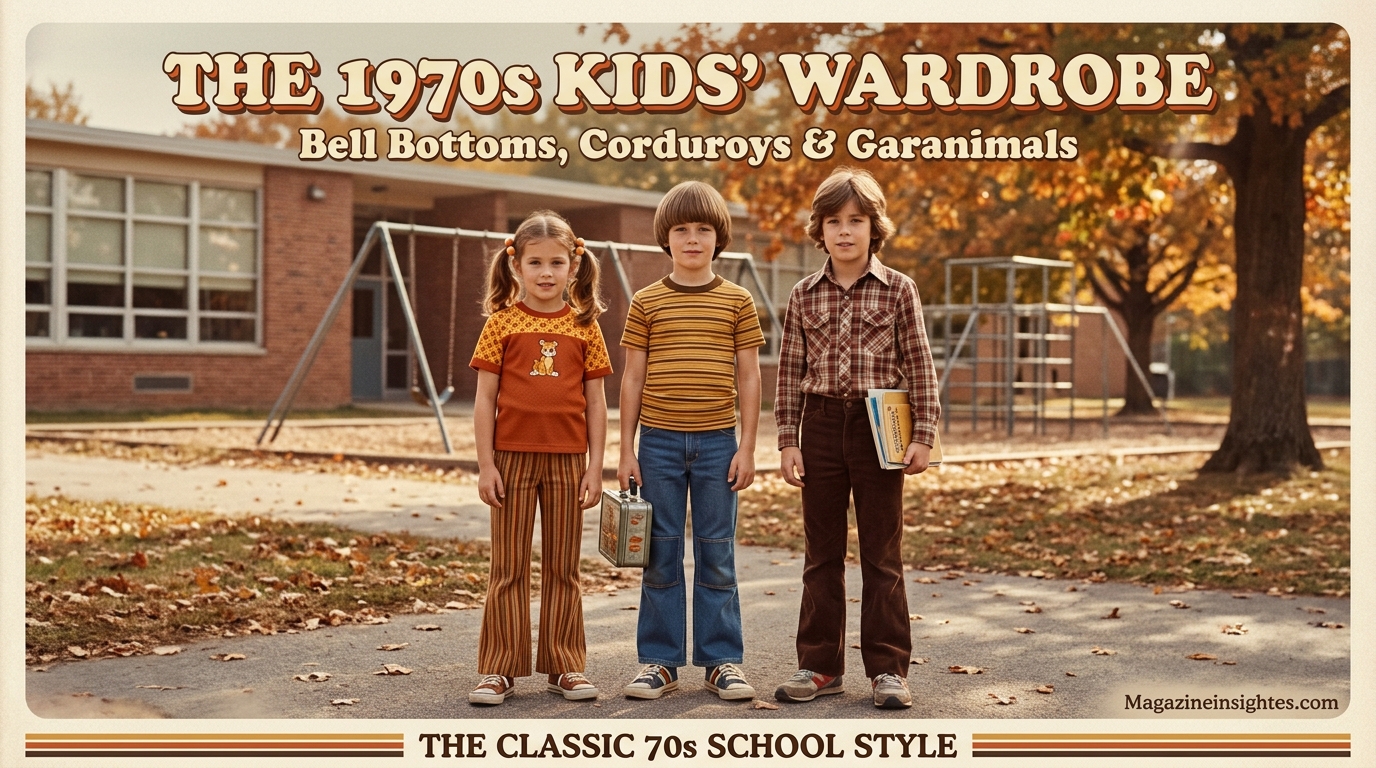
Garanimals opened the decade’s system in 1972. Garan Incorporated created the mix and match separates line that year, and the company history strand names Sears, JCPenney, Macy’s and Woolworth’s as its outlets, per the Free Dictionary encyclopedia entry on the brand.
The animal hang tags were the mechanism. Each top and bottom carried a matching animal tag, so a young child could dress without reading sizes or guessing combinations, and one purchase produced several outfits.
Toughskins were the jeans of the same system. Sears sold the hard wearing denim with reinforced knees, and the Tinybeans list of things only 70s kids wore remembers them for surviving the playground season after season.
Bell bottoms and flares set the silhouette. Click Americana’s evidence base, the Click Americana 1973 JCPenney catalog pages, shows girls’ flares, plaid and gingham across nearly 200 catalog styles from a single year.
The palette ran earthy and synthetic. Browns, rusts, oranges and avocado tones in polyester, corduroy and plaid flannel dominate the catalog pages, a long way from the neon that arrives a decade later.
Iron-on patches and letters were the personalization layer. Patches repaired knees and decorated jeans at once, and iron-on letters let a kid wear a name or a joke before licensed printing took over.
Picture Day Corduroys and 70s Hair
Picture day corduroys are the decade’s school photo anchor. The Tinybeans strand remembers special corduroys in earth tones kept for the photograph, the outfit by which many families still date a childhood.
Tube socks with stripes, worn high with shorts, were everyday kit. The same list carries them beside the cords, along with sweatbands and streamer barrettes, the small accessories that filled out a 70s school outfit.
Underoos turned underwear into licensed merchandise in the late 1970s. The character sets paired a printed top with matching briefs, an early sign of the cartoon licensing that would cover the whole 80s wardrobe.
Moon boots and ponchos handled the cold and the rain. Both sit in the Tinybeans layer of the wardrobe: heavy, practical and bought through the same catalogs as everything else in this section.
The Dorothy Hamill wedge dates to after the 1976 Olympics. The Skool Days fashion index carries the wedge by her name, and feathered hair ran beside it through the late 1970s for older elementary and middle school girls.
The 1980s Wardrobe: Clothes
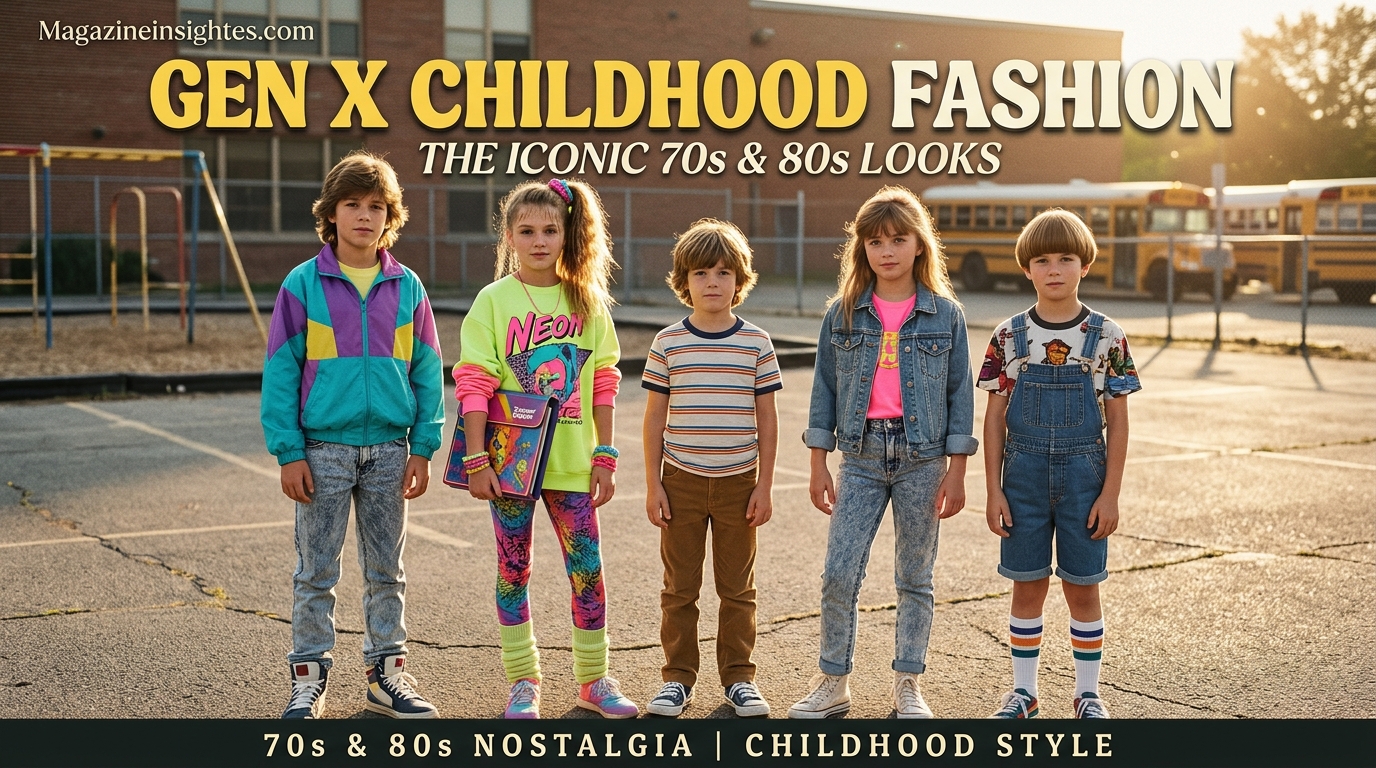
Neon, Acid Wash and Character Tees
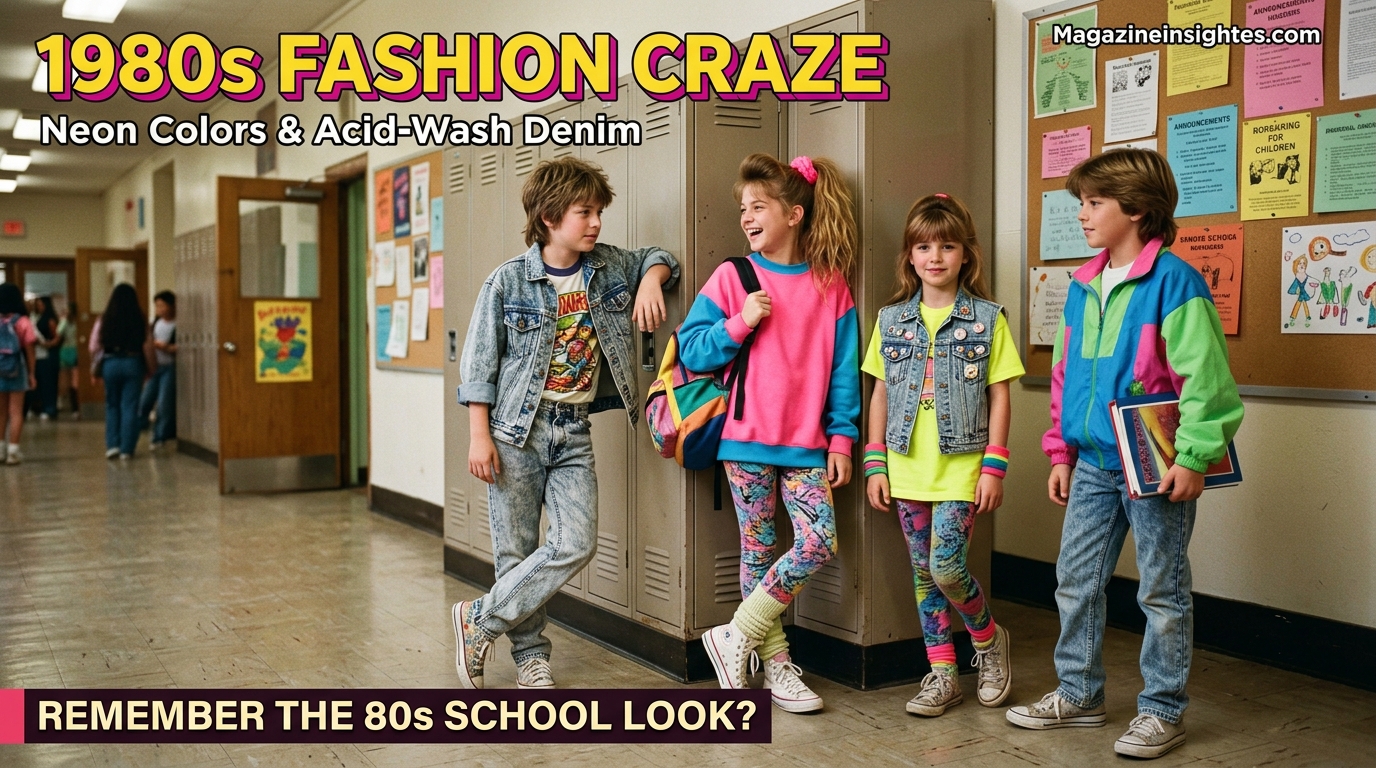
Neon and color blocking mark the mid 1980s turn. Vintage-Retro and Our Everyday Life both place the bright palette in the decade’s middle years, when the earth tones of the catalog era gave way to electric color.
Acid wash denim peaked in the mid to late 1980s. Glam and YourTango date the mottled finish to that window, and the kids’ version came as jeans, jackets and matching sets rather than single statement pieces.
Stonewash was the softer sibling. Where acid wash bleached denim into patterns, stonewash simply faded it, and both finishes sat in the same school wardrobes by the late 1980s.
Licensed character tees were the default top. Vintage-Retro calls out Star Wars shirts directly, and its account of boys’ fashion runs on cartoon, movie, sports team and video game tees as the standard school top.
The characters arrived through Saturday morning television. The same cartoons a kid watched before school sold the shirt the kid wore to school, a licensing loop the culture section below takes apart.
D.A.R.E. tees joined the rotation late in the decade. The program launched in 1983 on the JenX67 cultural artifacts strand, and the shirts became elementary school wear gradually as the program spread, not in a single season.
Designer jeans reached kids’ sizes in the same years. Guess and Calvin Klein children’s lines are called out by the Strawberry Jam Kids decade history, with OshKosh B’gosh overalls holding the younger kid default beside them.
The preppy layer ran in parallel. Izod and Polo shirts and matching polo and shorts sets appear in the C3 Teachers blueprint’s picture sets, a catalog friendly version of the 1980 handbook look, scaled down for kids.
Parachute Pants, Leg Warmers and Oversized Sweatshirts
Parachute pants came in two dated waves. Breakdance culture carried the nylon version early in the decade, and Our Everyday Life credits MC Hammer with popularizing the baggier version in the late 1980s; the two are not one trend.
Leg warmers crossed over from the dance studio. Fame in 1980 and Flashdance in 1983 popularized them for the mainstream on the Glam and Grunge strands, and kids wore them over leggings and jeans.
The oversized sweatshirt was the era’s comfort uniform. Worn big, sometimes off one shoulder in the Flashdance strand, it layered over leggings and jeans from the mid 1980s onward, per Vintage-Retro and the C3 blueprint.
Leggings under big tops completed the girls’ school silhouette. Our Everyday Life and Vintage-Retro both carry the pairing, with jelly bracelets and banana clips finishing it in the accessories layer below.
None of this layer needs a teen item to complete it. The clothes above are the elementary and middle school record; the shoulder pads and slip dresses of adult lists belong outside it.
The 1980s Wardrobe: Shoes and Accessories
Jelly Shoes, High-Tops and Sneaker Status
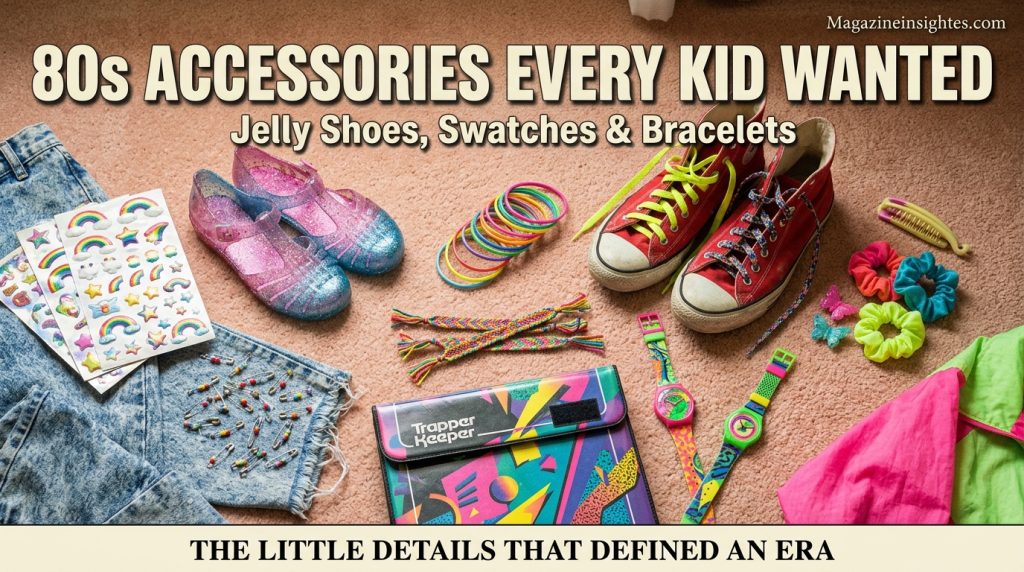
Jelly shoes are the decade’s most precisely datable kids’ shoe. The record in the jelly shoes entry runs: the Jelly Shoes company founded in Paris in 1980, Grendene of Brazil contracted as manufacturer in 1982, and the US craze following the 1982 Knoxville World’s Fair.
A department store order carried them nationwide. The same entry records a 1983 Bloomingdale’s order of 2,400 pairs, and by the mid 1980s the glitter PVC versions in Our Everyday Life’s account were an elementary school staple.
The price made them a kids’ shoe, not a teen trophy. HowStuffWorks gives US prices around 10 to 20 dollars, word credited here; cheap, waterproof PVC is why they spread so fast, blisters and all.
Canvas high-tops were the everyday alternative. Our Everyday Life names Converse Chuck Taylor high-tops for both sexes, and bright tennis shoes with colored laces were the kids’ version of sneaker personalization.
Sneaker status starts here, with the skew labelled. The Arden Zan lifestyle strand dates the Reebok Freestyle to 1982 and the Air Jordan 1 to 1985 at 65 dollars; both mattered most to older kids and teens, and this page prints them that way.
Swatch Watches, Slap Bracelets and the Trapper Keeper
Swatch launched its first collection on March 1, 1983, in Zurich. The Owl and Twig strand and the Threadcurve price list agree on the 1983 US arrival at about 30 dollars, a price low enough to collect rather than merely own.
Kids wore multiples and swapped them. Stacked Swatches were a schoolyard currency, and the Grunge and Mental Floss strand puts Swatch sales at 105 million dollars by 1985, the one popularity figure this page prints for the watch.
Slap bracelets carry two dates, and they never merge. YourTango credits Wisconsin teacher Stuart Anders with the 1983 invention; the mass craze and the school bans belong to the very late 1980s and 1990 to 1991, a full school era later.
The Trapper Keeper was school gear worn like fashion. Mead test marketed the binder in Wichita, Kansas, in August 1978, and the Trapper Keeper entry records the 4.85 dollar suggested price for that test launch.
Its second price strand carries its own year. Threadcurve’s price list gives about 10 dollars in 1983, by which time the cover design, not the rings inside, was the status signal a kid chose at back to school.
Members Only jackets debuted in 1980, priced as two strands. Grunge, citing Mental Floss, gives a 55 dollar launch price; Threadcurve gives about 45 dollars in the 1980s. Both print here labelled, and the jacket itself skewed older, coveted by middle schoolers more than worn by young children.
Jelly bracelets and friendship pieces filled the recess economy. Jelly bracelets stacked in multiples through the early and mid 1980s, with Madonna’s 1983 to 1984 look as the usual popularization strand, and friendship pins on sneaker laces and woven friendship bracelets ran beside them at mid decade.
Charm necklaces and sticker albums traded at the same level. Nostalgia Notebook’s account places both in the mid 1980s schoolyard, accessories as social currency rather than outfit structure.
|
Item |
Year attached |
Price strand |
Source strand |
|---|---|---|---|
|
Trapper Keeper binder |
1978 test launch |
$4.85 suggested |
Wikipedia entry |
|
Trapper Keeper binder |
1983 |
About $10 |
Threadcurve price list |
|
Swatch watch |
1983 US launch |
About $30 |
Owl and Twig; Threadcurve |
|
Members Only jacket |
1980 launch |
$55 launch figure |
Grunge, citing Mental Floss |
|
Members Only jacket |
1980s |
About $45 |
Threadcurve price list |
|
Air Jordan 1 |
1985 |
$65 launch |
Arden Zan lifestyle strand |
|
Hypercolor shirt |
1991 |
About $20 to $24 |
Smithsonian and Wikipedia strands |
Read the table as strands, not as a price list. Two items appear twice because their sources disagree; a single merged figure would be tidier and wrong.
Hair: Wedges, Feathers, Crimps and Side Ponytails
The wedge began the story in the late 1970s. Dorothy Hamill’s post 1976 cut gave elementary and middle school girls a short, structured option, and it photographs clearly in the era’s school pictures.
Feathered hair bridged both decades. Feathering framed the face in the late 1970s and stayed in middle school yearbooks well into the 1980s, the longest lived style in this section.
Crimped hair is the mid to late 1980s marker. The zigzag texture, worn loose or pulled up, separates an 80s school photo from a 70s one at a glance.
The side ponytail sat high and off center. Worn with a scrunchie or a banana clip by the late 1980s, it is the hairstyle decade party guides reach for first, and it belongs to the older elementary years.
Banana clips and scrunchies are late decade items. Mama Cheaps files scrunchies among 80s and 90s kid accessories; this page keeps both at the decade’s end rather than spreading them across it.
Big bangs closed the decade. Teased, sprayed front volume belongs to the late 1980s and the early 90s edge, worn by the oldest elementary and middle school girls in the cohort.
Boys’ hair stayed simpler on the record. Short back and sides, bowl cuts and feathered tops fill the catalog evidence, with no named boys’ cut carrying the decade the way the wedge carries the 70s.
Where It Came From: Catalogs, Malls and Hand Me Downs
The catalog was the wardrobe’s first store. Sears and JCPenney catalogs put the season’s kids’ clothes in the home months before school started, and the 1973 JCPenney pages in the Click Americana archive show the system at work.
The Wish Book was the Christmas edition of that system. Sears’ holiday catalog is remembered as the book kids circled for months; this page prints that ritual as memory, not measurement.
Back to school was the fashion season. The Trapper Keeper strands, the layaway habit and the August catalog drops all point the same way: the year’s wardrobe decisions concentrated in late summer, not spread across the year.
The mall took over the branded layer in the 1980s. Glam and the Creative Quill account frame Gen X as mall kids; the framing is attributed colour here, not data.
Mall stores sold the names the catalogs could not. Licensed tees, designer kids’ jeans and sneaker releases sat in mall shops, which is why the 80s wardrobe carries more brands than the private label 70s one.
Hand me downs were the second wardrobe. Clothes passed down siblings and cousins as a matter of course, and durability brands like Toughskins were bought with that second wearer in mind.
Iron-on patches were the repair economy. A patched knee extended a pair of jeans through another school year and another child, and the patch doubled as decoration, which is why it appears in both the 70s wardrobe and this one.
Layaway and back to school sales set the budget rhythm. They explain the one purchase, many outfits logic behind systems like Garanimals.
What Chose the Clothes: Cartoons, Movies, MTV and Latchkey Afternoons
Saturday morning cartoons chose the prints. Vintage-Retro ties boys’ tees directly to cartoons, sports and video games, and the mechanism is simple: television put the same characters on every kid’s chest in the same season.
Licensing made the loop commercial. A character’s owner licensed the image, a maker printed it, and a store sold it within the same school year, which is why the tees date so tightly to their shows.
Movies set the bigger silhouettes. Star Wars tees anchor the late 1970s layer, and Our Everyday Life carries Michael Jackson’s cropped leather jacket and the Hammer pants effect in the 1980s layer, each an influence strand rather than a measured effect.
The screen to street pipeline is the same mechanism everywhere. Magazine Insightes has traced it for another cinema in the guide to how Indian films shape fashion and trends, and the Gen X version ran slower, through catalogs and mall stores rather than next day replicas.
MTV launched in 1981 and changed the input. PureWow credits the channel with bringing Boy George and Cyndi Lauper’s looks into kids’ homes; children were not the target audience, but older siblings and music video rotation reached them anyway.
Run-DMC and Adidas mark the music tribe line. The Arden Zan strand carries the pairing as a tribe marker of the late 1980s, the point where a sneaker choice started announcing a music allegiance for older kids.
Latchkey independence is the strongest sourced explanation for the volume. The independence finding sits in the C3 Teachers and Library of Congress 80s culture blueprint, which ties bolder 1980s children’s fashion to a culture of increasing childhood independence, and Glam’s latchkey framing agrees.
Kids choosing their own clothes explains the accessories. Stacked bracelets, swapped watches and charm necklaces are self dressing at age nine: small, cheap, tradable and entirely the wearer’s call.
The Early 90s Edge, Labelled: Hypercolor and the Last Gen X Kids
This section is the edge, and it stays labelled. Everything here belongs to 1990 to 1992 and to the youngest Gen X kids only; for anyone born before the mid 1970s, these were adult or teen years, not childhood.
Hypercolor is the edge’s defining item, and it is not an 80s trend. Generra launched the heat sensitive shirts in January 1991, as the Hypercolor entry and the Mental Floss history of the Hypercolor fad both date them.
The fad burned fast and bright. The Smithsonian strand, word credited here, records 50 million dollars sold between February and May 1991 at about 20 to 24 dollars a shirt, and Generra bankrupt in 1992.
The wearers were middle and high schoolers. A shirt that changed color with body heat was a 1991 schoolyard item for the youngest Gen X cohort and a teen item for everyone else, which is exactly the edge case this section exists to hold.
Umbros and snap away warm up pants sit on the same edge. Competitor lists place them with the youngest kids of the window; this page prints them as edge items without a launch claim, because no dated strand supports one.
The edge closes the wardrobe, it does not extend it. Nothing after 1992 belongs to a Gen X childhood, and the next section explains where the famous 90s items actually live.
Often Misfiled: Trends That Are Not Gen X Childhood
This section corrects the field’s filing errors. Each item below ranks somewhere for this keyword, and each belongs elsewhere: a later decade, an older age group, or a revival rack.
|
Misfiled item |
Where it actually belongs |
|---|---|
|
Hypercolor shirts |
Launched January 1991; the labelled early 90s edge at most |
|
JNCO jeans |
1990s teen fashion, as YourTango itself concedes |
|
Grunge, flannel, slip dresses |
1991 to 1994 teen and adult fashion |
|
Tommy Hilfiger, FUBU, Nautica logo mania |
A 1990s teen layer |
|
One strap overalls, wallet chains |
1990s hip hop teen trends |
|
Apple Bottoms |
Launched in the early 2000s; no Gen X childhood at all |
|
Z. Cavaricci pants |
Late 1980s teen and young adult brand, slid down age without evidence |
|
Lisa Frank Trapper Keepers |
The loud peak straddles the late 80s and 90s; late decade edge at most |
JNCO is the clearest case. YourTango lists the jeans among Gen X trends and concedes the 1990s in the same breath; a wide leg teen jean of that decade cannot dress a 1985 elementary schooler.
Grunge fails the birth year test. Flannel and slip dresses run 1991 to 1994, when the oldest Gen Xers were in their late twenties and only the very youngest met the look as teenagers.
The Reebok Pump fails the universality test, not the date test. It launched in 1989 with a teen and athlete skew at a premium price; the strands support wanted by sneaker kids, never worn by every kid.
Revival products fail the object test. A jelly shoe manufactured in 2026 is a revival product, however faithful the mold; the Wear It Now section labels every modern version that way.
Wear It Now: Decade Parties, Halloween and the 2026 Revival
The recreate layer is the article’s secondary job. About a quarter of the intent behind this keyword wants an outfit built, for a decade party, Halloween or a dress up day, and the dated wardrobe above is the pattern book.
Build an 80s school outfit in five choices:
- Top: a licensed style character tee, or a plain neon tee where licensing is not an option
- Bottom: acid wash jeans, or leggings under an oversized sweatshirt
- Feet: canvas high-tops with colored laces, or jelly shoes for the younger kid look
- Accessories: jelly bracelets stacked, a banana clip or side ponytail, friendship pins on the laces
- Carry: a Trapper Keeper or a binder with a period style cover design
Build a 70s outfit the same way. Bell bottoms or earth tone corduroys, a plaid shirt, tube socks showing above the shoes, and an iron-on patch on one knee place a kid in the catalog decade instantly.
Halloween rewards the dated version. A costume built from the dated strands reads as a specific school year, and the misfiled table above is the checklist of what to leave out.
The 2026 revival is real, and it is a revival. Jelly shoes, wide leg denim and character tees are back in stores as modern products; the comeback framing in the current fashion trends 2026 guide shows how today’s versions sit inside the current trend cycle.
Vintage buying starts with the dated names. Trapper Keeper, Toughskins and Garanimals search better than decade words, because sellers list by brand, and kids’ sizes in genuine deadstock are scarcer than adult sizes.
Dating a vintage piece is a label check. Union labels, single stitch tee construction, PVC and catalog private label names separate a genuine 80s kids’ item from a later reproduction.
Deadstock means unworn old stock, not a style name. The premium genuine deadstock kids’ pieces carry is for the unworn condition, not the decade alone.
Frequently Asked Questions
1. What years are Gen X, and what years was a Gen X childhood?
Gen X means born 1965 to 1980, on the Pew Research Center range. A Gen X childhood therefore runs from about 1970 to about 1992, with the shared school years in the late 1970s and the 1980s.
2. What did Gen X kids wear in the 1980s?
The 80s school wardrobe was bright, branded and layered. Character tees, acid wash denim, oversized sweatshirts, leggings, jelly shoes, high-top sneakers and Swatch watches make up the core, each dated inside this page.
3. What did Gen X kids wear in the 1970s?
The 70s wardrobe came from catalogs and leaned earth toned. Garanimals matching sets, Sears Toughskins jeans, bell bottoms, corduroys, plaid and gingham, tube socks and Underoos character sets define the layer.
4. What is the difference between Gen X childhood fashion and Gen X teen fashion?
Childhood fashion is what kids aged about 4 to 12 wore to school. Teen fashion covers the later years: grunge, JNCO jeans and logo mania belong to Gen X adolescence, not to elementary school.
5. Were jelly shoes really popular with kids, or just teens?
Jelly shoes were a genuine elementary school staple by the mid 1980s. The PVC sandals reached the US in the early 1980s and were priced for kids, at about 10 to 20 dollars on the HowStuffWorks strand.
6. When did jelly shoes come to the United States?
Jelly shoes arrived through the 1982 Knoxville World’s Fair. The Jelly Shoes company was founded in Paris in 1980, Grendene began manufacturing in 1982, and a 1983 Bloomingdale’s order carried the craze nationwide.
7. What were jelly shoes made of?
Jelly shoes were molded PVC plastic. The soft, flexible plastic came in clear, glitter and bright candy versions, which is why they were cheap, waterproof and famous for giving kids blisters.
8. When did the Members Only jacket come out, and how much did it cost?
The Members Only jacket debuted in 1980, and its price prints as two strands. Grunge, citing Mental Floss, gives 55 dollars at launch, while the Threadcurve price list gives about 45 dollars; neither figure is merged into one.
9. When did Swatch watches launch, and why did kids wear more than one?
Swatch launched its first collection on March 1, 1983, in Zurich. US strands price the watches at about 30 dollars, cheap enough that kids wore two or three at once and swapped them like trading cards.
10. Is a Trapper Keeper fashion or a school supply?
It is a school supply that behaved like fashion. The Mead binder’s cover design was the status signal in the hallway, so it sits in this article as school gear carried and chosen like a fashion item.
11. When was the Trapper Keeper invented?
The Trapper Keeper was test marketed in Wichita, Kansas, in August 1978. Its suggested price was 4.85 dollars for the binder, and it became a back to school staple through the 1980s.
12. Were Trapper Keepers really banned or just the slap bracelets?
The slap bracelets drew the famous bans, not the binders. Slap bracelets were invented in 1983 and their mass craze ran from the late 1980s into 1991, when schools restricted them as distractions and occasional hazards.
13. When were slap bracelets popular, and why did schools ban them?
The slap bracelet craze belongs to the late 1980s and 1990 to 1991. Schools banned them at that peak because the metal strip inside could snap or cut, so bans and craze share dates.
14. What are Toughskins, and why do Gen X kids remember them?
Toughskins were Sears’ hard wearing kids’ jeans with reinforced knees. Gen X kids remember them because they survived the playground, carried a toughness reputation, and arrived through the Sears catalog like most of the era’s wardrobe.
15. What are Garanimals, and how did the animal tags work?
Garanimals were mix and match separates created in 1972 by Garan Incorporated. Each piece carried an animal hang tag, and a child matched the animals to build an outfit without adult help.
16. What are Underoos?
Underoos were character underwear sets for kids, a late 1970s staple. Each set paired a top and briefs printed with a superhero or cartoon character, turning an everyday layer into licensed merchandise.
17. Why did 80s kids wear leg warmers?
Leg warmers crossed from dance studios into schoolyards around 1980 to 1983. Fame in 1980 and Flashdance in 1983 popularized them for the mainstream, and kids wore them over leggings and jeans.
18. Did kids actually wear parachute pants, or only MC Hammer fans?
Kids did wear parachute pants, in two waves. Breakdance culture carried the nylon version early in the decade, and MC Hammer popularized the baggier version in the late 1980s, per the Our Everyday Life strand.
19. What is acid wash, and when did kids start wearing it?
Acid wash is denim treated for a mottled, faded finish. Kids started wearing it at its mid to late 1980s peak, in jeans, jackets and matching sets, per the Glam and Vintage-Retro strands.
20. What did Gen X girls wear to school in the 80s?
Girls layered oversized sweatshirts and leggings with neon color. Jelly shoes, jelly bracelets, banana clips and side ponytails finished the school look, with character tees and acid wash denim underneath the layers.
21. What did Gen X boys wear to school in the 80s?
Boys defaulted to licensed character and novelty tees. Star Wars, cartoon, sports and video game shirts sat over jeans or parachute pants, with high-top sneakers and colored laces as the footwear strand.
22. What did kids wear for school picture day in the 70s and 80s?
Picture day meant the best catalog outfit a family owned. In the 70s that was earth tone corduroys on the Tinybeans strand; in the 80s it was a clean character free top, brushed hair and the good shoes.
23. What shoes did Gen X kids wear?
The everyday rotation was jelly shoes, canvas high-tops and bright tennis shoes. Converse Chuck Taylor high-tops served both sexes, and colored laces were the cheap personalization every kid could afford.
24. When did sneakers become a status item for kids?
Sneakers became an identity item in the mid 1980s. The Reebok Freestyle launched in 1982 and the Air Jordan 1 in 1985 at 65 dollars, though both strands skew teen rather than elementary.
25. Did kids wear designer jeans in the 80s?
Yes, designer jeans reached kids’ sizes in the 1980s. Guess and Calvin Klein children’s lines are called out in decade histories of kids’ clothing, and OshKosh B’gosh overalls remained the younger kid default beside them.
26. What hairstyles did Gen X kids have?
Kids wore wedges, feathers, crimps and big bangs. The Dorothy Hamill wedge dates to after the 1976 Olympics, feathered hair ran through both decades, and crimped hair with side ponytails and banana clips closed the 80s.
27. How did MTV change what kids wore, if kids were not its target audience?
MTV put musicians’ looks inside kids’ homes from its 1981 launch. PureWow credits the channel with carrying Boy George and Cyndi Lauper’s styles to young viewers, even though children were never its target audience.
28. Where did Gen X kids’ clothes come from before the internet?
Clothes came from catalogs, department stores and the mall. Sears and JCPenney catalogs set the wardrobe, mall stores handled the branded pieces, and hand me downs plus iron on patches stretched everything further.
29. What was the Sears Wish Book, and why did it matter for kids’ fashion?
The Wish Book was Sears’ big Christmas catalog, remembered as the season’s wardrobe menu. Kids circled outfits and toys in it for months, and its pages are why catalog evidence anchors the 70s section of this article.
30. What is a Hypercolor shirt, and is it an 80s or 90s trend?
Hypercolor is a 1990s trend, launched in January 1991. Generra’s heat sensitive shirts sold 50 million dollars’ worth between February and May 1991, and only the youngest Gen X kids met them before middle school.
31. Is grunge a Gen X childhood trend?
No, grunge is not a Gen X childhood trend. Flannel, slip dresses and the grunge look belong to 1991 to 1994 teen and adult fashion; the youngest Gen Xers met it as teenagers.
32. Are JNCO jeans Gen X childhood fashion?
No, JNCO jeans are 1990s teen fashion. Even YourTango, which lists them among Gen X trends, concedes the decade, and no elementary school strand supports them as childhood wear.
33. What is the youngest Gen X childhood, and what did those kids wear in the early 90s?
The youngest Gen X kids were born around 1980 and finished elementary school near 1992. Their edge wardrobe adds Hypercolor shirts and early logo sportswear, labelled as the edge on this page rather than blended into the 80s core.
34. What is the difference between 70s and 80s kids’ fashion?
The 70s layer is earth toned, catalog bought and built for durability. The 80s layer is bright, branded and screen driven, with licensed characters, neon color and accessories doing the work that plain polyester did before.
35. Why were 80s kids’ clothes so bright and neon?
Neon was the decade’s technology and mood showing at once. Synthetic dyes, music video color and a louder kids’ market met in the mid 1980s, and the C3 Teachers blueprint ties the brightness to growing childhood independence.
36. How do I dress my kid in an accurate 80s outfit for a decade party?
Build it from the school day, not the costume rack. A character tee, acid wash jeans, high-tops, a jelly bracelet stack and a Trapper Keeper give an accurate core outfit; skip the teen items like JNCO and grunge flannel.
37. Which Gen X childhood trends have come back in 2026?
Jelly shoes, wide leg denim shapes and retro character tees lead the revival strands. Modern versions are revival products made now, labelled as revivals on this page rather than presented as era originals.
38. Where can I buy vintage 80s kids’ clothes today?
Vintage marketplaces, resale shops and deadstock sellers are the main routes. Search by the dated names on this page, Trapper Keeper, Toughskins and Garanimals, and expect kids’ sizes to be scarcer than adult ones.
39. How can I tell if a vintage kids’ item is really from the 80s?
Check the label, the materials and the construction against the decade. Union labels, single stitch tees, PVC jellies and catalog brand names like Toughskins date a piece better than a seller’s decade claim.
40. What did the latchkey kid reality have to do with kids’ fashion?
Latchkey kids dressed, shopped and chose with less adult supervision. The C3 Teachers blueprint ties bolder 1980s children’s fashion to that independence, and Glam’s latchkey framing agrees, which is why the 80s wardrobe is louder than the 70s one.
41. What was on a Gen X kid’s feet in winter?
Moon boots were the winter strand in the 70s layer. The Tinybeans list pairs them with ponchos and sweatbands, and snow gear generally followed the catalog wardrobe: heavy, earth toned and bought to be handed down.
42. Why do Gen X parents feel so strongly about these clothes now?
The clothes were the era’s daily evidence, worn in public every school day. School photos preserve them exactly as worn, and Gen X parents now dress their own kids inside the revival, which keeps the memory physical rather than abstract.
Conclusion
Gen X childhood fashion trends reward a dated reading. Once each trend carries its year, the wardrobe separates cleanly into the 70s catalog layer, the 80s school layer and the labelled early 90s edge.
The misfiled items are the tell. A list that calls Hypercolor an 80s staple or JNCO a childhood trend is guessing, and the dates on this page are the check against that guesswork.
Start with one outfit, built by the school day rules. A character tee, acid wash jeans, high-tops and a Trapper Keeper under one arm recreates the core 80s school look without a single teen item.
More generation and style explainers gather on the Magazine Insightes home page as this shelf grows. Send in a school photo if you write about your own: the picture day cords and jelly shoes in it are the primary sources this topic runs on.