Can You Have Two Health Insurances? Dual Coverage Explained

Can you have two health insurances at the same time? Yes, you can, and about 43 million people in the United States already do.
One plan pays first as the primary plan, and the other pays second as the secondary plan, under rules called coordination of benefits.
The two plans never pay more than 100 percent of the bill together, so dual coverage fills gaps instead of paying you twice.
Readers will find the short answer first, then the coordination of benefits rules, the complete primary and secondary table, the cost math, the HSA traps, and the verdict on when dual coverage pays off.
The content here is general information only, not insurance advice or financial advice, and readers should check their own plan documents and talk to a licensed broker before enrolling.
The Short Answer: Yes, You Can Have Two Health Insurances
Yes, you can have two health insurance plans at the same time, and no federal law stops you from being covered by two plans at once.
According to data from the United States Census Bureau, about 43.1 million people (13.1 percent) were covered by more than one type of health insurance in 2021, up from 12.6 percent in 2020.
Dual coverage is common for married couples, for children of two parents, for students under 26, and for retirees with Medicare and a second plan, and insurers have standard rules for handling it.
The MetLife guide to having two health insurances gives the same answer, with the Census Bureau figures and a scenario table for primary and secondary coverage.
What Is Dual Health Insurance Coverage?
Dual health insurance coverage means a person is covered under two health insurance plans at the same time, and each plan has its own premium, deductible, and network.
The two plans do not pay the same bill twice, because the plans follow rules about which plan pays what, known as coordination of benefits.
When a claim is filed, the primary plan pays whatever it is responsible for under the terms of the plan.
Then the secondary plan pays whatever it covers that the primary plan has not already paid.
The FAIR Health guide to having more than one health plan explains coordination of benefits in plain language, with a decision framework based on savings versus costs.
Common Situations Where People Have Two Plans
A married person has health insurance from their own employer and is also on their spouse’s insurance plan, which is the most common dual coverage situation.
A student younger than 26 has a health insurance plan from their school or job and is also covered on their parent’s plan, under the Affordable Care Act dependent rule.
A child of divorced or separated parents is covered on both of their parents’ plans, with the birthday rule or a court order deciding which plan pays first.
Someone 65 or older has Medicare and is also covered by an employer plan, a retiree plan, or a Medigap policy, because Original Medicare has no cap on out-of-pocket costs.
A person supplements a private health insurance plan with a government program such as Medicaid or Medicare, or a military family has TRICARE plus another plan.
The guide to whether you need health insurance covers the basics of choosing a first plan, which helps readers decide whether a second plan is worth adding.
How Dual Health Insurance Coverage Works

Dual health insurance coverage works through coordination of benefits, or COB, which is the set of rules that decides which plan pays first and which plan pays second.
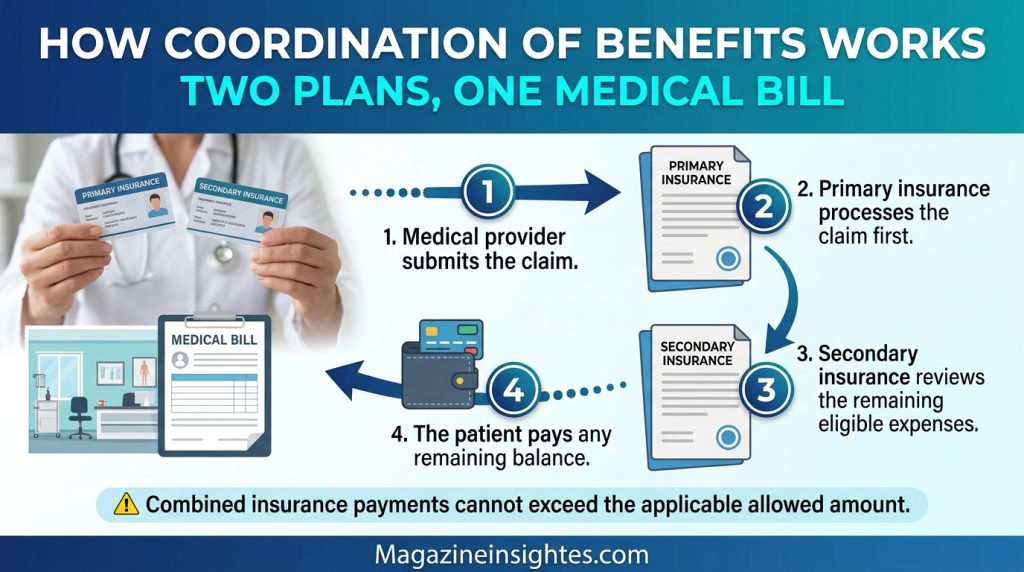
The primary plan processes the claim first, paying the medical bills the way it normally would, as if the secondary plan did not exist.
Only after the primary insurer pays the claim does it get submitted to the secondary plan, which then pays some or all of the remaining costs.
The health insurance companies, not the insured person, decide which plan is primary and which is secondary, following the COB model guidelines developed by the National Association of Insurance Commissioners.
What Is Coordination of Benefits?
Coordination of benefits is the process that determines which insurance plan will pay first when a person has two plans, and how the remaining costs are shared.
The rules vary by state and by insurer, but the general idea is the same everywhere: one plan is primary, the other is secondary, and the total never exceeds 100 percent of the allowed amount.
The healthinsurance.org guide to having two health insurance plans explains coordination of benefits with a worked example, showing exactly how the primary and secondary plans split a claim.
Primary Insurance vs Secondary Insurance
Primary insurance is the plan that pays first for medical bills, up to its coverage limits, and it acts as if the secondary plan did not exist.
Secondary insurance is the plan that pays after the primary insurance, covering some or all of the costs the primary plan did not pay, such as the deductible, the copay, or the coinsurance.
You do not get to choose which plan is primary and which is secondary, because COB sets the rules based on the situation, and the rules decide the order of coverage for each plan.
| Feature | Primary insurance | Secondary insurance |
|---|---|---|
| Pays | First | Second, after the primary plan |
| Coverage | Pays up to its own limits | Pays what is left, up to its own limits |
| Decision | Set by COB rules | Set by COB rules |
| Typical example | Your own employer plan | Your spouse’s employer plan |
| Deductible | Your deductible applies | Its deductible still applies |
| What it covers | Covered services under its terms | Covered services the primary did not pay |
The 100 Percent Rule: You Never Get Paid Twice
Having two health insurance plans does not mean you get paid twice for the same doctor visit, because the combined benefits will never surpass the total cost of the visit.
The most a person can get from the two plans combined is 100 percent of their medical expenses.
The plans will never pay the doctor or the patient more than 100 percent of the cost of a service.
If the secondary plan’s coverage would have paid more than the remaining balance, the payment is reduced so the total does not exceed the allowed amount.
This rule exists to prevent double payment, and it is the reason coordination of benefits rules exist in the first place.
Which Plan Pays First? The Complete Primary and Secondary Rules Table
The complete primary and secondary rules table below covers the most common situations, and no single competitor page puts all of them in one place.
Readers should find their own situation in the table first, then read the section below it for the details that apply to them.
| Situation | Primary insurance | Secondary insurance |
|---|---|---|
| You have your own employer plan and you are a dependent on your spouse’s plan | Your employer plan | Your spouse’s employer plan |
| Your spouse has their own employer plan and is a dependent on your plan | Your spouse’s employer plan | Your employer plan |
| A child is covered by both married parents | Parent whose birthday falls earlier in the calendar year | Other parent’s plan |
| A child is covered by divorced parents with a court order | Parent the court order names | Other parent’s plan |
| A child is covered by divorced parents with no court order | Custodial parent’s plan | Non-custodial parent’s plan |
| A child has their own plan and is also on a parent’s plan | The child’s own plan | The parent’s plan |
| You have Medicare and an employer plan, employer has 20 or more employees | Employer plan | Medicare |
| You have Medicare and an employer plan, employer has fewer than 20 employees | Medicare | Employer plan |
| You have Medicaid and any other health plan | The other health plan | Medicaid, always |
| You have TRICARE and another health plan | The other health plan | TRICARE |
| You have TRICARE and Medicaid | TRICARE | Medicaid |
| You are a federal employee with FEHB and another plan | One FEHB plan only, dual FEHB enrollment is banned | Non-FEHB private plan may be secondary |
| You have a student plan and a parent’s plan | Your student plan | Your parent’s plan |
Your Own Employer Plan vs Your Spouse’s Plan
If you are covered under your own employer plan and you are also covered under your spouse’s plan, your own plan is primary and your spouse’s plan is secondary.
The same rule applies in reverse for your spouse, because their own employer plan is primary for them and your plan is secondary for them.
Determining which health plan is primary is straightforward in this case.
If you are covered under an employer plan, that plan is primary, and if you are also covered under a spouse’s plan, that plan is secondary.
Children Covered by Both Parents: The Birthday Rule
The birthday rule determines which parent’s health plan is primary when a child is covered by both parents, and it designates the plan of the parent whose birthday falls earliest in the year as primary.
Only the month and day matter, not the birth year, so a parent born on March 5 has primary coverage over a parent born on October 12, no matter which parent is older.
If both parents have the same birthday, the primary plan is the one that has been in effect longer.
The parent who has been covered under their plan since 2006 beats the parent covered since 2014.
The birthday rule comes from the National Association of Insurance Commissioners coordination of benefits model regulation, which most states have adopted into their own insurance codes.
Verywell Health explains the birthday rule with worked examples, including the same-birthday tiebreaker.
The page returned a 402 error to a live check, so it is named here in plain text only and not linked.
Children of Divorced or Separated Parents
The birthday rule applies only when parents are married or living together, and divorced or separated parents follow a different hierarchy.
If a court order requires one parent to provide health coverage, that parent’s plan is automatically primary, regardless of the parents’ birthdays.
If the parents share joint custody and the court order does not assign responsibility for health expenses, the birthday rule applies as usual.
When no court order addresses health coverage at all, the order is the custodial parent’s plan first, then the custodial parent’s spouse, then the non-custodial parent, then the non-custodial parent’s spouse.
The custodial parent is the parent the child lives with more than half the year, and this hierarchy makes sure the parent most directly responsible for day-to-day care has the primary coverage.
Court Orders and QMCSOs
A divorce decree or a Qualified Medical Child Support Order, known as a QMCSO, overrides both the birthday rule and the custody-based hierarchy, so the court order wins over every other rule.
A QMCSO is a court or administrative order that requires a parent to provide health coverage for a child, and insurers must follow it even when it conflicts with the birthday rule.
Parents should tell both insurers about any court order or QMCSO, because the insurers cannot apply the right rule until they know the order exists.
Medicare and Employer Insurance: The 20-Employee Rule
If you have Medicare in addition to an employer-sponsored plan, the primary and secondary designation depends on the size of the employer.
If the employer has 20 or more employees, the employer’s plan is primary and Medicare is secondary, so the employer plan pays first.
If the employer has fewer than 20 employees, Medicare is primary and the employer plan is secondary, so Medicare pays first.
For disability cases, the threshold is 100 employees instead of 20, with Medicare primary when the employer has 100 or fewer employees and the private insurer primary when the employer has more than 100 employees.
Medicaid: Always the Payer of Last Resort
If you have other health coverage in addition to Medicaid, the other coverage will always be primary and Medicaid is always secondary, in every double-coverage situation.
Medicaid is the payer of last resort by law, which means it only pays after every other plan has paid what it owes.
This rule matters for dual eligible beneficiaries, who have both Medicare and Medicaid, because Medicare pays first and Medicaid covers some or all of what Medicare does not.
TRICARE and Other Insurance
TRICARE is considered secondary to all other health insurance, except when the other plan is Medicaid, in which case TRICARE is primary and Medicaid is secondary.
Military families with TRICARE and a civilian employer plan should tell both insurers, because the employer plan pays first and TRICARE covers the remainder.
Federal Employees: The FEHB Dual Enrollment Ban
Federal employees enrolled in the Federal Employees Health Benefits program generally cannot have dual enrollment, meaning a family member cannot receive benefits under more than one FEHB plan at the same time.
A child can still be covered by one FEHB plan and one non-FEHB private plan.
Two FEHB enrollments covering the same child are not permitted except in narrow circumstances where the child would otherwise lose coverage entirely.
This is the one clear exception to the general rule that dual coverage is allowed, and federal employees should check the FEHB program handbook before enrolling a family member in a second FEHB plan.
How a Claim Works With Two Health Insurance Plans

A claim with two health insurance plans follows a fixed order, and the order matters more than the number of plans.
The doctor or hospital files the claim with the primary plan first, and the primary plan pays what it owes under its own terms.
The claim is then sent to the secondary plan with the explanation of benefits from the primary plan, which shows what the primary plan paid and what is left.
The secondary plan processes the claim as if the primary plan did not exist, then adjusts the payout based on the explanation of benefits, so it never pays more than the remaining balance.
Step by Step: Filing a Claim With Two Plans
Step 1: Tell both insurers that you have two plans, because the coordination of benefits rules cannot work until both plans know about each other.
Step 2: Give your provider both insurance cards, so the provider files the claim with the primary plan first.
Step 3: Wait for the primary plan to process the claim, and read the explanation of benefits, which shows what the primary plan paid and what you still owe.
Step 4: Let the claim go to the secondary plan, either automatically through the provider or by filing it yourself with the primary explanation of benefits attached.
Step 5: Check the secondary explanation of benefits, and confirm that the total paid by both plans does not exceed the allowed amount for the service.
Step 6: Pay any remaining balance yourself, if both plans together still leave a balance, because dual coverage reduces out-of-pocket costs but does not always eliminate them.
Worked Example: A Claim With Two Plans
The healthinsurance.org worked example uses a person named Clarissa with two policies, and it shows how the math works in practice.
Clarissa’s primary plan, provided by her employer, has a $3,000 deductible and 80/20 coinsurance up to a maximum out-of-pocket limit of $10,000, which means she pays 20 percent after the deductible.
Clarissa’s secondary plan covers her as the spouse on her husband’s employer plan.
It has a $5,000 deductible and 70/30 coinsurance up to a maximum out-of-pocket limit of $8,000, which means she pays 30 percent after that deductible.
The secondary plan begins by processing the claim as if the primary plan did not exist, then adjusts the payout based on the explanation of benefits from the primary plan.
In the example, the secondary plan pays up to $4,600.
If its coverage had been more generous and would have paid more than $4,600, the payment would have been reduced so it did not exceed that amount.
| Item | Primary plan (own employer) | Secondary plan (spouse’s employer) |
|---|---|---|
| Deductible | $3,000 | $5,000 |
| Coinsurance | 80/20 | 70/30 |
| Out-of-pocket maximum | $10,000 | $8,000 |
| Secondary payout in example | Not applicable | Up to $4,600 |
| Key rule | Pays first | Reduced so total does not exceed allowed amount |
The example shows that the secondary plan helps, but the help is limited, because the secondary plan’s own deductible still applies and the total payment is capped at the allowed amount.
Worked Example: A High-Cost Year
Dual coverage helps most in a high-cost year, such as a planned surgery or a pregnancy, when a second plan picks up part of a large out-of-pocket bill.
In a healthy year, dual coverage rarely pays for itself, because the second premium costs more than the small amount the secondary plan pays.
In a surgery year, the primary plan may leave a $5,000 balance after its deductible and coinsurance, and the secondary plan may cover most of that balance, saving more than the second premium cost.
The same logic applies to a pregnancy year, when prenatal care, delivery, and hospital costs add up to a large total that two plans can split.
Readers should compare the second premium against the expected out-of-pocket costs for the year, not against the premium alone, because the value of dual coverage depends on how much care they expect to use.
How Much Does Dual Health Insurance Cost?
Dual health insurance costs more in premiums and deductibles than a single plan, and the extra cost is the first thing readers should calculate.
You will still be responsible for two premiums and two deductibles, even though you have two plans, and the two deductibles do not combine into one.
The TriNet guide to having two health insurances at once states the trade-off plainly.
The secondary plan may cover the copays, deductibles, and coinsurance of the first plan, but the disadvantages include separate premiums, separate deductibles, complicated filing, and reimbursement delays.
Two Premiums, Two Deductibles, Two Out-of-Pocket Maximums
Each plan charges its own monthly premium, so a second plan adds a second monthly bill, even in months when no care is used.
Each plan has its own deductible, so a person with two plans must meet both deductibles before either plan pays in full, although the secondary plan may help with the primary deductible.
Each plan has its own out-of-pocket maximum, and the 2027 out-of-pocket maximums reach $12,000 per person and $24,000 per family, according to FC Insurance Solutions.
Two plans mean two sets of paperwork and two customer service lines, and the administrative burden is a real cost that readers should weigh alongside the money.
Total Yearly Cost: One Plan vs Two Plans vs Split Coverage
The cheapest option is not always obvious, and it can change every year, because premiums, deductibles, networks, and employer contributions all shift at open enrollment.
Smart Premium Guide compares three options for married couples: everyone on one plan, each spouse on their own plan, or a split where the children go on the cheaper or better plan.
In their illustrative example, each spouse on their own plan costs $2,580 a year in premiums, while both on one plan costs $7,440 a year.
The one plan adds a $100 monthly spousal surcharge on top of a $520 monthly premium.
Splitting saves about $2,640 in a typical year in their example, although the trade-off is two separate out-of-pocket maximums, which can cost about $2,360 more in a disastrous year when both plans hit their limits.
| Option | Premium cost | Deductibles | Best when |
|---|---|---|---|
| Both spouses on one plan | Highest, plus possible spousal surcharge | One family deductible | One employer subsidizes family coverage generously |
| Each spouse on their own plan | Lowest, two employee-only premiums | Two separate deductibles | Both employers pay most of the employee-only premium |
| Split: kids on the cheaper or better plan | Middle, depends on child premiums | Two separate deductibles | Plans differ in pediatric networks or child premiums |
| Dual coverage: each on both plans | Highest, two premiums per person | Two deductibles per person | High-cost year, planned surgery, pregnancy |
Readers should compare total yearly cost, not just the monthly premium, because premiums plus likely out-of-pocket spending is the number that matters.
The Spousal Surcharge
Some employers add a spousal surcharge, an extra monthly charge to cover a spouse who has access to their own employer plan, and the surcharge can be $100 a month or more.
Certain employers limit spouse coverage entirely, refusing to cover a spouse who is eligible for their own employer plan, so readers should check the plan documents before enrolling.
The surcharge is one of the reasons dual coverage can cost more than it saves, and it is a question readers should ask human resources before open enrollment ends.
Is Dual Health Insurance Worth It?
There is no one-size-fits-all answer to whether dual health insurance is worth it, because the answer depends on the policies, the premiums, and how much care the person expects to use.
Having two plans can help keep out-of-pocket costs lower than they would otherwise be, but the specifics vary by plan, and the secondary policy may not reduce out-of-pocket costs as much as expected.
Depending on the coverage specifics and the cost of paying premiums for both policies, dual coverage might not be worth it, and readers should do the math for their own situation before deciding.
When Dual Coverage Pays Off
Dual coverage pays off when both spouses work for employers that subsidize family coverage generously, because some employers cover the full cost of employee health coverage, including the cost to add family members.
Dual coverage pays off for someone who needs extensive medical care, because the additional premium costs can be more than outweighed by the lower out-of-pocket costs that come with two plans.
Dual coverage pays off when the secondary plan has more generous benefits than the primary plan.
It also pays off when it provides coverage the primary plan does not, such as out-of-network care or alternative therapies like chiropractic care.
Dual coverage pays off in a year with a planned surgery or a pregnancy, when a second plan picks up part of a large out-of-pocket bill that a single plan would leave behind.
Most Original Medicare beneficiaries maintain some type of additional coverage, such as Medigap, Medicaid, or coverage from a current or former employer, because Original Medicare has no cap on out-of-pocket costs.
When Dual Coverage Does Not Pay Off
Dual coverage does not pay off in a healthy year, because the second premium costs more than the small amount the secondary plan pays for routine care.
Dual coverage does not pay off when the secondary plan’s deductible is high and its benefits are narrow, because the secondary plan may pay almost nothing after the primary plan has already paid.
Dual coverage does not pay off when the secondary plan explicitly excludes coverage for services the primary plan does not cover.
Readers should check the secondary plan’s coordination of benefits contract before relying on it.
Dual coverage does not pay off when the two plans have different networks and the reader’s doctors are only in one network, because the secondary plan may not cover out-of-network care at all.
Decision Checklist
Step 1: Add up both premiums for the year, including any spousal surcharge, and write down the total.
Step 2: Add up both deductibles and both out-of-pocket maximums, and note that the secondary deductible still applies.
Step 3: Estimate the care expected for the year, including planned surgery, pregnancy, chronic conditions, and regular prescriptions.
Step 4: Check whether the secondary plan covers services the primary plan does not, such as out-of-network care, chiropractic care, or alternative therapies.
Step 5: Check the HSA and FSA rules below, because a second plan can disqualify a health savings account.
Step 6: Compare the total yearly cost of one plan, two plans, and a split, and choose the option with the lowest total cost for the expected care.
Dual Coverage and HSAs: The Traps
Dual coverage can interfere with health savings account eligibility, and this is the trap that catches the most people, because the rule is not obvious.
The Internal Revenue Service allows some types of coverage in addition to a high-deductible health plan without losing HSA eligibility, but a general-purpose health flexible spending account is not one of them.
The General-Purpose FSA Trap
If one spouse is on an HSA-qualified plan and contributing to an HSA, and the other spouse enrolls in a general-purpose health FSA at their own job.
That FSA can usually reimburse the whole family’s expenses.
That makes the HSA spouse ineligible to contribute for the year, because the FSA counts as disqualifying coverage, even though it belongs to the other spouse.
The fix is usually a limited-purpose FSA that covers only dental and vision, but the choice has to be made on purpose at open enrollment, because a general-purpose FSA cannot be changed mid-year.
The Shared Family HSA Limit
If either spouse has family coverage on an HSA-qualified plan, the two spouses share one family contribution limit, split however they choose.
Two spouses each maxing out a separate family contribution is a common mistake, because the family limit applies once per household, not once per person.
The family HSA limit is $9,000 in 2027, according to Smart Premium Guide, and readers should confirm the current limit with the Internal Revenue Service before contributing.
HDHP as Primary vs HDHP as Secondary
A high-deductible health plan can work as either the primary or the secondary plan, but the HSA rules apply to the household, not to the individual plan.
Readers who want to keep contributing to an HSA should check both plans before enrolling, because a non-HDHP secondary plan with first-dollar coverage can disqualify the HSA.
When in doubt, readers should ask a licensed broker or a tax professional, because an HSA mistake can take a full year to fix.
Dual Coverage and the Health Insurance Marketplace
A person can have a marketplace plan and another health insurance plan at the same time, but the marketplace subsidy rules make the math more complicated.
The marketplace plan is a private plan bought through HealthCare.gov or a state marketplace, and it can serve as either the primary or the secondary plan depending on the other coverage.
Marketplace Subsidy and Dual Coverage
Above 400 percent of the federal poverty level, a person pays full price for a marketplace plan, with no subsidy, which makes a second marketplace plan expensive.
The subsidy cliff sits at $63,840 for one person and $132,000 for a family of four, according to FC Insurance Solutions, and a strong income year can push a household over the cliff.
A marketplace plan can be the better fit when income is low enough for a large tax credit, or when a significant health condition makes the marketplace plan’s benefits valuable.
Readers should check whether their employer plan affects their marketplace subsidy, because an offer of affordable employer coverage can reduce or eliminate the premium tax credit.
Open Enrollment Dates
Open enrollment for the federal marketplace runs from November 1 to January 15, and readers must enroll or change plans inside that window unless they have a qualifying life event.
Qualifying life events include marriage, the birth of a child, a job change, and losing other coverage, and each one opens a special enrollment period.
Employer open enrollment dates vary by employer, so readers with two employer plans should check both enrollment windows before deciding.
Dual Coverage for Children
A child can legally be covered under two health insurance policies at the same time, and this arrangement is common in families where both parents carry employer-sponsored plans.
No federal law prohibits a child from being enrolled on two separate health insurance policies, and insurance companies are accustomed to the arrangement.
When set up correctly, having two plans can reduce out-of-pocket costs for the child, because the secondary plan may pick up expenses the primary plan leaves behind.
Can a Child Have Two Health Insurance Policies?
Yes, a child can have two health insurance policies, and the combined payments from both insurers will never exceed the actual medical bill.
Under the Affordable Care Act, health plans must allow dependent children to remain on a parent’s policy until they turn 26.
A plan cannot deny dependent coverage based on the child’s marital status, student status, employment, financial independence, residency, or eligibility for other coverage.
A child’s enrollment in one parent’s plan does not disqualify them from being added to the other parent’s plan, which is the rule that makes dual coverage for children possible.
The Birthday Rule Explained
The birthday rule is the industry standard for children whose parents are married or living together, and it comes from the National Association of Insurance Commissioners coordination of benefits model regulation.
The plan of the parent whose birthday falls earlier in the calendar year, looking only at month and day and not birth year, is designated as primary, and the other parent’s plan is secondary.
For example, if one parent was born on March 5 and the other on October 12, the March 5 parent’s plan pays first, regardless of which parent is older.
If both parents share the same birthday, the plan that has covered the parent for the longest continuous period becomes primary, which gives providers and insurers a clear hierarchy.
CHIP as an Alternative
If covering children through work is expensive, readers should check the Children’s Health Insurance Program, known as CHIP, because children qualify at higher incomes than adults in most states.
CHIP can serve as a second plan or as a cheaper alternative to adding children to an employer plan, and it is worth checking before open enrollment ends.
Medicare and Medicaid Dual Coverage
Medicare and Medicaid dual coverage is the most common form of government dual coverage, and it follows its own set of rules.
Most Original Medicare beneficiaries maintain some type of additional coverage, because Original Medicare has no cap on out-of-pocket costs and leaves large gaps.
Medicare Plus Employer Insurance
A person who is 65 or older and still working can have Medicare and an employer plan at the same time, and the 20-employee rule decides which plan pays first.
If the employer has 20 or more employees, the employer plan is primary and Medicare is secondary, so the employer plan pays first and Medicare covers the remainder.
If the employer has fewer than 20 employees, Medicare is primary and the employer plan is secondary, so Medicare pays first.
Retirees with a retiree health plan from a former employer also have dual coverage, and the retiree plan usually serves as secondary to Medicare.
Medicare Plus Medigap
Medigap, also called Medicare Supplement Insurance, is a private plan that fills the gaps in Original Medicare, paying some or all of the deductibles, copays, and coinsurance that Medicare leaves behind.
Medigap is the most common second plan for Medicare beneficiaries, and it is designed specifically to work as secondary coverage to Medicare.
Medicare Advantage is a different option that replaces Original Medicare rather than supplementing it, so a person cannot have both Medigap and Medicare Advantage at the same time.
Dual Eligible: Medicare and Medicaid Together
A dual eligible beneficiary is a person who qualifies for both Medicare and Medicaid, usually because of low income, disability, or both.
Medicare pays first and Medicaid pays second for dual eligible beneficiaries, and Medicaid may cover Medicare premiums, deductibles, copays, and services that Medicare does not cover.
Dual eligible beneficiaries should tell every provider about both programs, because the provider must bill Medicare first and Medicaid second to get paid correctly.
Pros and Cons of Having Two Health Insurance Plans
Dual coverage has real benefits and real drawbacks, and the table below puts them side by side so readers can weigh them.
| Pros | Cons |
|---|---|
| Secondary plan may cover expenses the primary plan does not | Two separate premiums to pay every month |
| Lower out-of-pocket costs in high-cost years | Two separate deductibles to meet |
| Broader coverage, including out-of-network care | Two separate out-of-pocket maximums |
| Coverage for services the primary plan excludes | Complicated filing procedures and twice the paperwork |
| Backup coverage if one plan denies a claim | Reimbursement delays while plans coordinate |
| Help with copays, deductibles, and coinsurance | Spousal surcharge may apply |
| Peace of mind in a surgery or pregnancy year | HSA eligibility can be lost through a spouse’s FSA |
| Children get two layers of protection | Network mismatch can leave care uncovered |
The advantage of having two health insurance plans is that they cover more medical costs and out-of-pocket expenses than a single plan.
The primary plan may cover what the second plan does not, and the secondary plan may cover the copays, deductibles, and coinsurance of the first plan.
The disadvantages include paying separate premiums and deductibles, complicated filing procedures, and reimbursement delays, and these costs can outweigh the benefits in a healthy year.
How to Choose a Second Health Insurance Plan
Choosing a second health insurance plan starts with the primary plan’s gaps, because the second plan should fill what the first plan leaves behind.
Step 1: List what the primary plan does not cover well, such as out-of-network care, a narrow network, a high deductible, or excluded services like chiropractic care.
Step 2: Compare the second plan’s network with the primary plan’s network, because a second plan only helps if the reader’s doctors are in its network.
Step 3: Check the plan type, because an HMO, a PPO, and an EPO handle referrals and out-of-network care very differently.
The guide to what HMO means in health insurance explains the HMO rules in full.
Step 4: Add up the total yearly cost, including both premiums, both deductibles, and any spousal surcharge, and compare it with the expected out-of-pocket costs.
Step 5: Check the secondary plan’s coordination of benefits contract, to make sure it does not explicitly exclude coverage for services the primary plan does not cover.
Step 6: Check the HSA and FSA rules, because a second plan can disqualify a health savings account, as explained in the traps section above.
Step 7: Check the insurer before buying a second plan from a private company, because a legitimate company matters more than a low premium.
The Prosper Health review shows how to check whether a health insurance company is legitimate.
How to Drop a Second Health Insurance Plan
Dropping a second health insurance plan is allowed, but the timing matters, because most plans only allow changes during open enrollment or after a qualifying life event.
Step 1: Confirm the open enrollment window for the plan being dropped, or confirm that a qualifying life event, such as marriage, divorce, a job change, or losing other coverage, has occurred.
Step 2: Tell the secondary insurer that the coverage is ending, and get written confirmation of the end date.
Step 3: Tell the primary insurer that the secondary coverage has ended, so the primary plan stops coordinating benefits and processes claims as the only plan.
Step 4: Tell the provider’s billing office, so future claims go to the correct plan and are not delayed by a coordination of benefits hold.
Step 5: Keep the confirmation letters, because a billing dispute months later is much easier to resolve with written proof of when the second plan ended.
Readers should not drop a second plan in the middle of a high-cost year, because the secondary plan may still be covering large balances from earlier claims.
Frequently Asked Questions
Can you have two health insurances?
Yes, you can have two health insurance plans at the same time, and no federal law stops you from being covered by two plans at once.
Can you have two health insurance plans at the same time?
Yes, you can have two health insurance plans at the same time, and about 43.1 million people in the United States did so in 2021, according to the Census Bureau.
Can you have 2 primary insurances?
No, you cannot have two primary insurances for the same claim, because coordination of benefits designates one plan as primary and the other as secondary for every claim.
Can you have three health insurances?
Yes, it is perfectly legal to have more than one health insurance plan, including three, although experts suggest sticking to a maximum of two policies to avoid confusion at claim time.
Can you be covered by two health insurances at once?
Yes, you can be covered by two health insurances at once, and the practice is common for married couples, children of two parents, students under 26, and retirees.
Can you have health insurance from two different companies?
Yes, individuals can have coverage under two different health insurance plans from two different companies, and when the two providers work together to pay the claims of one person, it is called coordination of benefits.
Is it legal to have two health insurance plans?
Yes, having dual coverage is perfectly legal, and no federal law prohibits it, although the Federal Employees Health Benefits program generally bans dual enrollment in two FEHB plans.
Is there a penalty for having two health insurance plans?
No, there is no penalty for having two health insurance plans, but the combined coverage cannot exceed 100 percent of the out-of-pocket costs, and you will pay two premiums and two deductibles.
How many health insurance policies can one person have?
There is no cap on the number of health insurance policies one person can buy, but experts suggest sticking to a maximum of two policies with adequate coverage to avoid confusion at claim settlement.
Can you have two health insurances and get paid twice?
No, you cannot get paid twice for the same doctor visit, because the combined payments from both plans will never exceed 100 percent of the cost of the visit.
How does coordination of benefits work?
Coordination of benefits is the process that decides which plan pays first and which pays second.
The primary plan pays first as if it were the only plan, and the secondary plan pays what is left.
Can you choose which plan is primary and which is secondary?
No, you cannot choose which plan is primary and which is secondary, because the coordination of benefits rules decide the order based on the situation, not on the person’s preference.
Which plan pays first if I have two health insurances?
Your own employer plan pays first, and your spouse’s plan pays second, and the complete rules table above covers every common situation, including children, Medicare, Medicaid, and TRICARE.
Do you have to pay two deductibles with two insurances?
Yes, if both plans have deductibles, you will have to pay both before coverage kicks in, although the secondary plan may help cover the primary plan’s deductible.
Does the secondary plan pay the primary plan’s deductible?
Yes, the secondary plan may cover the copays, deductibles, and coinsurance of the primary plan, up to what it would have paid on its own, but its own deductible still applies.
What is the birthday rule for health insurance?
The birthday rule designates the plan of the parent whose birthday falls earliest in the calendar year as primary for a child covered by both parents, looking only at month and day, not birth year.
Can a child have two health insurance policies?
Yes, a child can legally be covered under two health insurance policies at the same time, and the practice is common when both parents carry employer-sponsored plans.
What happens if parents are divorced and both have health insurance for a child?
If a court order names one parent, that parent’s plan is primary.
If no court order exists, the order is the custodial parent, the custodial parent’s spouse, the non-custodial parent, and then the non-custodial parent’s spouse.
What is a QMCSO?
A Qualified Medical Child Support Order, or QMCSO, is a court or administrative order that requires a parent to provide health coverage for a child.
It overrides both the birthday rule and the custody hierarchy.
Can you have Medicare and employer health insurance at the same time?
Yes, you can have Medicare and employer health insurance at the same time.
If the employer has 20 or more employees the employer plan is primary, while if the employer has fewer than 20 employees Medicare is primary.
Can you have Medicare and Medicaid at the same time?
Yes, a person who qualifies for both is called dual eligible, and Medicare pays first while Medicaid pays second, covering premiums, deductibles, copays, and services Medicare does not cover.
Can you have Medicaid and private health insurance at the same time?
Yes, you can have Medicaid and private health insurance at the same time, and Medicaid is always secondary, because it is the payer of last resort by law.
Can you have two health insurance plans and an HSA?
Yes, but a second plan can disqualify the HSA, because a spouse’s general-purpose health FSA can make the HSA spouse ineligible to contribute for the year, and the family HSA limit is shared.
Does having two health insurance plans affect my taxes?
Having two health insurance plans can affect taxes through HSA eligibility and the premium tax credit, and readers should check the Internal Revenue Service rules or talk to a tax professional before enrolling.
Is dual health insurance worth it?
Dual health insurance is worth it in a high-cost year, for someone who needs extensive care, or when the secondary plan covers services the primary plan does not.
It is usually not worth it in a healthy year when the second premium costs more than the secondary plan pays.
Conclusion
Can you have two health insurances? Yes, you can, and about 43 million people in the United States already do, under rules that decide which plan pays first and which plan pays second.
Dual coverage fills gaps instead of paying twice, because the two plans together never pay more than 100 percent of the bill.
The decision comes down to total yearly cost, not the monthly premium, and readers should add up both premiums, both deductibles, and the expected care for the year before choosing.
Readers with a planned surgery, a pregnancy, or extensive medical care should run the numbers carefully, because that is when a second plan can save more than it costs.
Readers in a healthy year should think twice before paying a second premium, because the secondary plan may pay almost nothing after the primary plan has already paid.
The content here is general information only, not insurance advice or financial advice.
Readers should check their own plan documents, call both insurers, and talk to a licensed broker before enrolling in or dropping a second plan.