What Can You Do With a Masters in Public Health? Careers, Salaries, and the Honest ROI

What can you do with a masters in public health? You can work in population-level roles across government, healthcare, nonprofits, and private industry, from outbreak investigation to health policy to program leadership.
The headline roles are epidemiologist, biostatistician, health policy analyst, health education specialist, environmental health specialist, and health services manager.
Pay varies by occupation, not by degree, from about $52,000 for community health workers to about $124,000 for health services managers, using Bureau of Labor Statistics May 2025 medians.
This guide gives general information only, not admissions or financial advice, and every figure carries its source and date so readers can check it.
Researched on November 18, 2026, from Bureau of Labor Statistics data, accreditation and certification bodies, university career pages, and program research.
Readers considering the degree should verify accreditation in the Council on Education for Public Health directory and tuition on each program’s own page before applying.
The Short Answer: What an MPH Unlocks
An MPH is the standard professional credential for population health work, and it unlocks roles that a bachelor’s degree alone usually cannot reach.
Federal agencies, state health departments, hospitals, research universities, nonprofits, and consulting firms all hire MPH graduates into distinct roles.
The degree matters most where the job posting names a master’s degree as the typical entry education, which is true for epidemiologists and statisticians.
The degree matters least where employers hire bachelor’s graduates into the same roles, which happens in community health and some program coordination work.
Concentration choice is the biggest pay lever inside the degree, since quantitative tracks out-earn generalist tracks by a wide margin.
Data skills are the second pay lever, since employers across sectors name data analysis as a critical skill for new hires.
What an MPH Actually Is
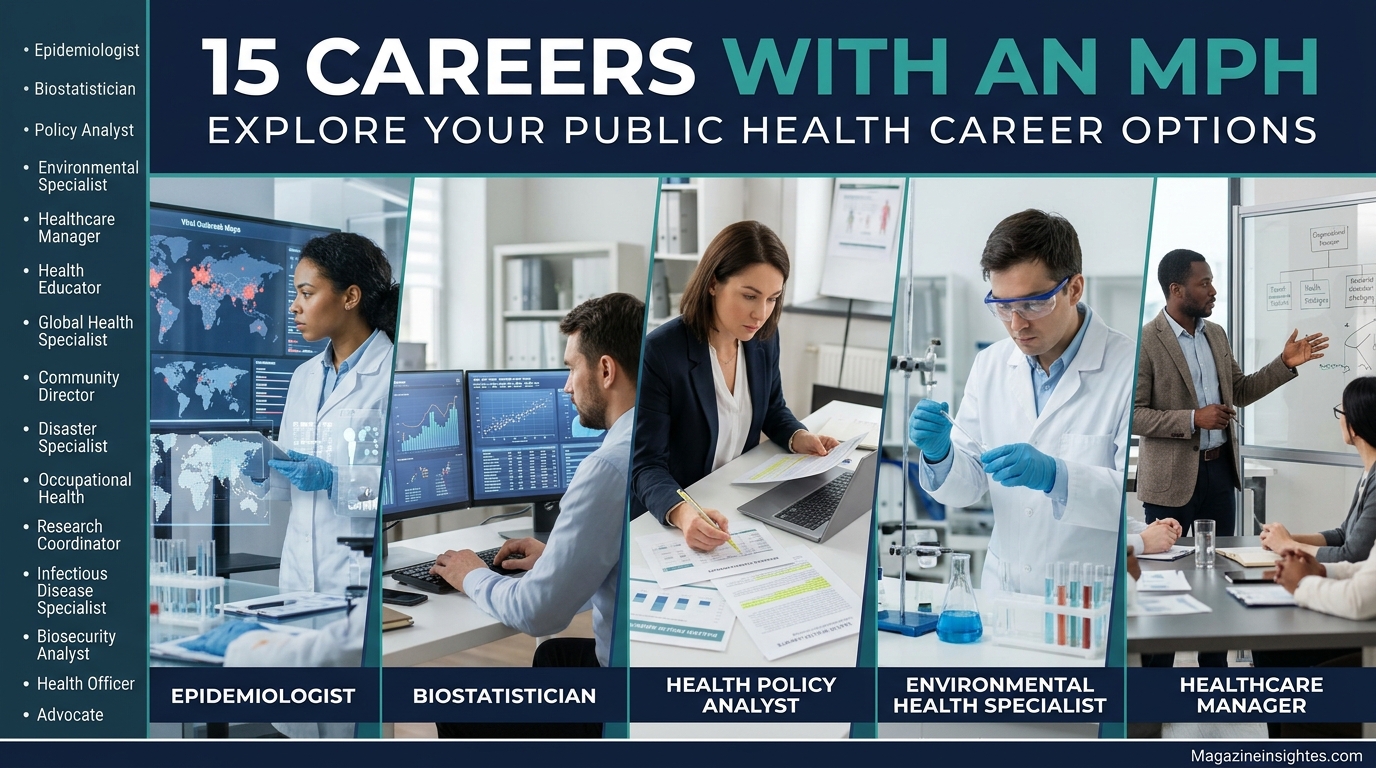
The Master of Public Health is a graduate professional degree focused on improving health at the population level rather than treating individual patients.
It is the first graduate professional degree in the public health field and the most common credential employers recognize.
An MPH is not a medical degree and does not lead to licensure as a physician, a point every program guide states plainly.
Typical programs run 42 to 48 credits, take two years full-time or one year in an accelerated format, and require a supervised practicum and a capstone project.
The Council on Education for Public Health requires at least 42 semester credits and training in five core disciplines for accredited programs.
Of 488 MPH programs tracked by one directory, 414 sit at CEPH-accredited schools and programs, a figure worth checking program by program.
The Five Core Disciplines
Biostatistics covers the methods used to analyze public health data, from study design to statistical modeling to result interpretation.
Epidemiology focuses on tracking disease patterns, investigating outbreaks, identifying risk factors, and designing surveillance systems.
Environmental health sciences examine how physical, chemical, and biological environments affect population health, from air quality to workplace hazards.
Health policy and management address how health systems are organized, funded, regulated, and led, including policy analysis and program administration.
Social and behavioral sciences study how behavior, culture, and social conditions shape health, and how programs change behavior at scale.
Every accredited program builds coursework around these five areas, and concentrations add depth in one of them without dropping the others.
The undergraduate path into this field is covered in what is a health science major, the bachelor’s degree that most directly leads to an MPH.
Concentrations and the Careers They Lead To
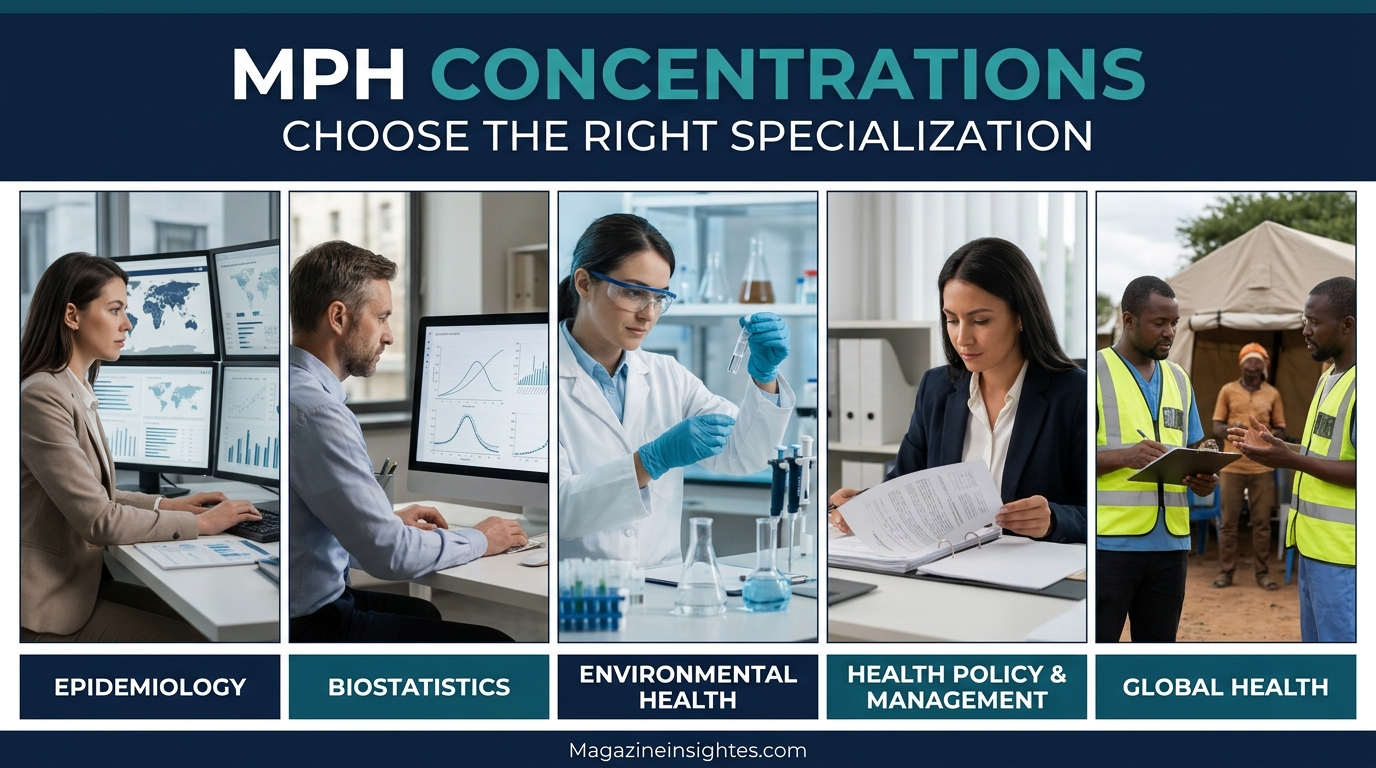
A concentration is a focused area of study within the MPH that tailors coursework, research, and practicum experience to a career goal.
Choosing the right concentration matters more than choosing the right school name, since employers hire for the skills the concentration builds.
| Concentration | Top careers | Typical employers | Pay tier |
|---|---|---|---|
| Epidemiology | Epidemiologist, field epidemiologist, surveillance analyst | CDC, state health departments, research universities | Upper middle |
| Biostatistics | Biostatistician, data scientist, research analyst | Pharma, research universities, federal agencies | Highest |
| Health policy and management | Health policy analyst, health services manager, consultant | Government, hospitals, consulting firms | Highest |
| Environmental and occupational health | Environmental health specialist, industrial hygienist, safety officer | Government, industry, consulting firms | Middle |
| Global health | Global health program officer, NGO program manager | NGOs, foundations, international agencies | Middle |
| Community health and health behavior | Health education specialist, community health program manager | Health departments, nonprofits, hospitals | Lower middle |
| Maternal and child health | MCH program manager, perinatal program coordinator | Health departments, nonprofits, hospitals | Middle |
| Public health nutrition | Public health nutritionist, WIC program manager | Government, nonprofits, schools | Middle |
| Infectious diseases | Infection preventionist, infectious disease epidemiologist | Hospitals, CDC, state laboratories | Upper middle |
Berkeley’s School of Public Health offers ten on-campus concentrations, including infectious diseases and vaccinology and maternal, child, and adolescent health, showing how wide the menu runs.
Some programs offer combined concentrations, such as epidemiology and biostatistics together, for students who want both quantitative tracks.
Global environmental health is an emerging specialization, addressing climate change, international pollution, and environmental justice across borders.
Leadership concentrations exist in MPH and DrPH programs but generally not in MSPH programs, since the MSPH is research-focused.
15 Jobs You Can Do With an MPH
The roles below cover the full range of MPH careers, from data-heavy research to community-facing program work to senior management.
Each role lists duties, employers, and pay context, with salary figures in the comparison table that follows, labelled by source and vintage.
1. Epidemiologist
Epidemiologists track disease patterns, investigate outbreaks, design surveillance systems, and identify risk factors at the population level.
They form the analytical backbone of public health, and the role is often called the backbone of public health research and practice.
Employers include the CDC, state and local health departments, research universities, hospitals, and pharmaceutical companies.
A master’s degree is the typical entry education, and the occupation numbered about 12,300 jobs in 2024, a small field with strong growth.
2. Biostatistician
Biostatisticians apply statistical methods to public health data, designing studies, analyzing clinical trials, and interpreting results for researchers and policymakers.
They work with genetic data, drug treatment assessments, population data, and clinical trial design, using software such as SAS, R, and STATA.
Employers include pharmaceutical companies, research universities, federal agencies, and health technology firms.
The Bureau of Labor Statistics groups biostatisticians with statisticians, so salary figures for the occupation cover both titles together.
3. Medical and Health Services Manager
Health services managers oversee the operations of departments, clinics, facilities, or entire health systems, including budgets, staffing, and compliance.
Common titles include clinic manager, director of case management, resident care director, laboratory manager, and care coordinator.
This is the largest MPH-adjacent occupation, with about 597,000 jobs nationally and roughly 62,100 openings projected each year.
Most new MPH graduates enter at coordinator or analyst levels first, reaching management roles with experience rather than straight from graduation.
4. Health Policy Analyst
Health policy analysts research, evaluate, and shape legislative proposals and regulations affecting healthcare access, quality, and cost.
They work for government agencies, think tanks, advocacy organizations, consulting firms, and health systems, often with a health policy and management concentration.
The role rewards writing, analysis, and stakeholder skills as much as quantitative training, and it leads toward senior advisory positions.
5. Health Education Specialist
Health education specialists design and implement educational programs and campaigns that encourage healthier lifestyles and prevent disease.
They assess community needs, develop curricula, evaluate programs, and coordinate with schools, workplaces, and community organizations.
Employers include health departments, hospitals, nonprofits, schools, and government agencies, with growth near the average for all occupations.
The CHES certification, Certified Health Education Specialist, is a common voluntary credential for this role, separate from the CPH.
6. Environmental Health Specialist
Environmental health specialists identify risks, enforce safety standards, inspect facilities, and advocate for healthier environments.
Their work covers air and water quality, food safety, vector control, hazardous materials, and occupational exposures.
Coursework for the concentration includes toxicology, exposure science, environmental epidemiology, occupational health, and risk assessment.
Registered Environmental Health Specialist credentials exist in many states, with requirements varying by state.
7. Community Health Worker and Program Manager
Community health workers connect residents to services, run outreach programs, and bridge the gap between health systems and neighborhoods.
An MPH qualifies graduates for program management above the frontline role, designing and evaluating the programs community health workers deliver.
Employers prioritize interdisciplinary experience over advanced degrees in community health hiring, per 2024 National Public Health Workforce Survey data cited by one analysis.
This is the lowest-paid tier in the MPH career set, and the degree’s return here depends on reaching management roles.
8. Global Health Program Officer
Global health program officers manage programs addressing infectious disease, malnutrition, and health inequities across national borders.
Employers include nongovernmental organizations, private foundations, international agencies, and government global health programs.
The work requires cultural competency, grant management, and field experience, and the practicum placement often decides the first job.
9. Clinical Research Coordinator
Clinical research coordinators oversee clinical trials, collect and analyze data, monitor participants, and maintain regulatory and ethical compliance.
A bachelor’s degree is the minimum for entry-level roles, and a master’s in public health is commonly required for advancement.
Employers include academic medical centers, pharmaceutical companies, contract research organizations, and federal research institutes.
10. Public Health Consultant
Public health consultants advise organizations on strategy, program design, evaluation, and policy, working across sectors on short engagements.
Consulting is among the highest-paid paths, with one Glassdoor-based guide reporting a $137,000 median, a figure that must be labelled as Glassdoor, not BLS.
Consulting rewards prior experience, and most consultants enter after several years in government or health system roles.
11. Emergency Preparedness Coordinator
Emergency preparedness coordinators plan for disasters, outbreaks, and public health emergencies, running exercises and coordinating responses.
Employers include state and local health departments, hospitals, federal agencies, and emergency management offices.
Pandemic preparedness funding has raised the profile of this role, though many positions remain grant-funded with less stability.
12. Infection Preventionist
Infection preventionists design surveillance and prevention programs in hospitals and long-term care facilities, tracking healthcare-associated infections.
Many hold nursing backgrounds plus an MPH, and the CIC certification, Certification in Infection Control, is the field’s voluntary credential.
The role combines epidemiology methods with clinical settings, making it one of the most direct applications of the degree.
13. Health Data Analyst and Health Informaticist
Health data analysts turn health data into decisions, building dashboards, cleaning datasets, and analyzing claims, survey, and surveillance data.
Health tech and pharmaceutical roles frequently exceed the median at entry, per one university career page, making this a strong first-job path.
Skills in SQL, Python, Tableau, and GIS raise hiring prospects more than any single course title on a transcript.
14. Public Health Nurse Manager
Public health nurses treat patients, administer immunizations, inspect workplaces for health risks, and formulate community health plans.
An MPH moves nurses into management, program design, and policy roles above direct clinical work, though a nursing license remains required for clinical duties.
The combination of a nursing credential and an MPH is one of the strongest pairings in the field for leadership roles.
15. Medical Writer and Health Communications Specialist
Medical writers analyze scientific and medical data to produce resources that communicate complex technical ideas clearly and accurately.
Health communications specialists design campaigns, manage public messaging, and translate research findings for public audiences.
Both roles reward the MPH’s evidence training, and both exist across pharma, agencies, nonprofits, and media organizations.
Salary by Occupation: The BLS Table With Both Vintages
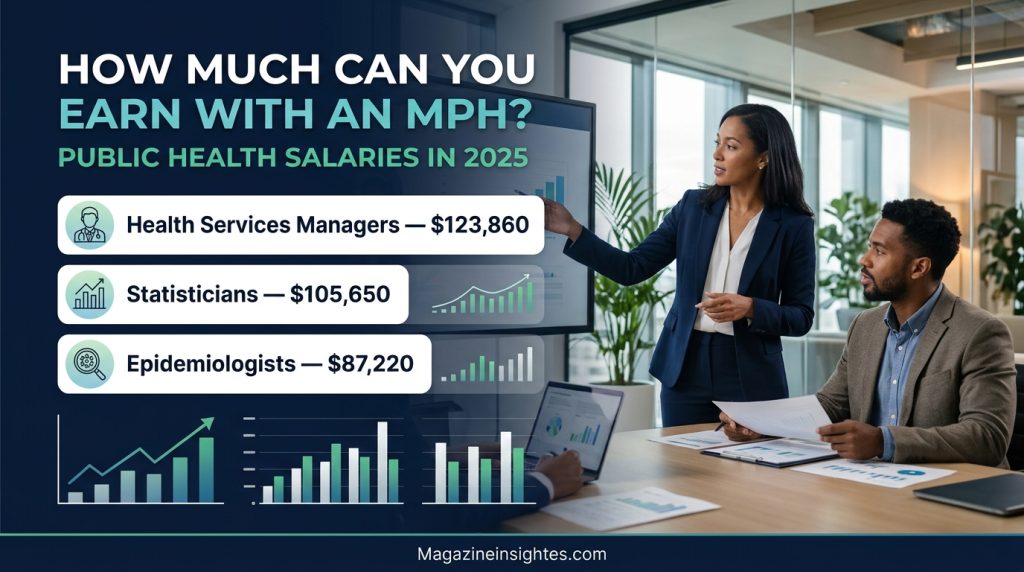
Salary figures in this topic disagree because sources quote different years, and the table below shows both BLS vintages side by side so the disagreement is visible.
The Bureau of Labor Statistics released May 2025 wage estimates on May 15, 2026, superseding the May 2024 estimates most guides still quote.
BLS reports wages by occupation, not by degree, so these medians describe everyone in the occupation, not MPH holders specifically.
| Occupation | Median, May 2024 | Median, May 2025 | Growth 2024-34 | Openings per year |
|---|---|---|---|---|
| Epidemiologists | $83,980 | $87,220 | 16.2% | ~800 |
| Statisticians (incl. biostatisticians) | $104,110 | $105,650 | See note | ~6,100 |
| Medical and health services managers | $117,960 | $123,860 | 23% | ~62,100 |
| Health education specialists | $63,000 | $64,070 | 4% to 7% | ~7,900 |
| Environmental scientists | $80,060 | Not cited | 7% | Not stated |
| Environmental health specialists | Not cited | $82,220 | 7% | Not stated |
| Community health workers | Not cited | $51,850 | Not stated | Not stated |
| Occupational health and safety specialists | $81,140 | Not cited | 6% | Not stated |
| Management analysts | $101,190 | Not cited | Not stated | Not stated |
Growth figures for statisticians vary by definition, with 32 percent, 12 percent, and 8 percent all reported by different sources for overlapping occupation groups.
This guide does not print a single growth figure for statisticians, since the sources define the occupation group differently and merging them would mislead.
Growth figures for health services managers also vary, with 23 percent for 2024-34, 28 and 29 percent in some state guides, and 24 percent for the newer 2025-35 vintage.
The 23 percent figure is the 2024-34 BLS projection used by the most sources, and the others are noted here so readers are not confused when they differ.
The Epidemiologist Figure That Conflicts
One university career page lists an “updated median” of $97,890 for epidemiologists, attributed to May 2025 BLS data, which conflicts with the $87,220 median reported by three other sources.
This guide uses $87,220, since three independent readings of the May 2025 OEWS release agree on it, and treats $97,890 as unverified.
A directory page prints 5 percent growth for epidemiologists, which contradicts the BLS projection of 16.2 percent and should not be trusted.
Readers should check any salary figure on the BLS site directly, since secondary pages copy figures across vintages without updating them.
What New Graduates Actually Earn
New MPH graduates typically enter below the median, near the 10th percentile in government and nonprofit roles, per one university career page.
Hospital systems and consulting often start at or above the median, while health tech and pharmaceutical roles frequently exceed the median at entry.
Entry-level ranges of $50,000 to $65,000 are reported by multiple sources, with mid-career ranges of $80,000 to $120,000 after five to ten years.
A 2026 outcomes survey of 1,847 public health graduates found a median starting salary of $65,000 and a median of $82,000 at five years, with a starting range of $48,000 to $92,000.
That survey is self-reported and is labelled as such, never presented as BLS data, and the $17,000 entry premium over bachelor’s holders widens to $20,000 by year five in the same survey.
A percentile table from a university career page shows the spread clearly, and the UT Southwestern public health career outlook is the clearest published version of it.
Industry Matters More Than the Degree Title
Epidemiologists in scientific research and development earned a median of $130,390, against $99,690 in hospitals, $80,640 in colleges and universities, and $79,640 in state government, per BLS May 2024 data.
The same occupation pays $50,000 more in research than in state government, a spread larger than the difference between most concentrations.
Private sector roles in pharmaceutical companies, consulting, and biotechnology offer compensation at the higher end, per multiple career guides.
Government roles trade pay for stability, benefits, and loan forgiveness eligibility, a trade many graduates choose deliberately.
Healthcare occupations overall will see about 1.9 million openings each year through 2035, per BLS projections cited by a university guide, though most of those openings are not MPH-specific roles.
Where MPH Graduates Work: Four Sectors
MPH graduates work across four broad sectors, each with distinct pay, pace, stability, and mission, and the sector choice shapes a career as much as the concentration.
| Sector | Employers | Pay pattern | Stability | Best for |
|---|---|---|---|---|
| Government | CDC, NIH, state and local health departments | Lower, GS-scale, near 10th percentile at entry | High, with benefits | Mission-driven, stable careers |
| Healthcare systems | Hospitals, health systems, clinics | At or above median at entry | High | Administration and clinical-adjacent roles |
| Nonprofit and global | NGOs, foundations, community organizations | Lower, grant-dependent | Lower, grant-funded | Global health, advocacy, community work |
| Private sector | Pharma, biotech, insurance, consulting | Highest, often above median at entry | Moderate | Data, research, and consulting careers |
Government is the largest traditional employer, encompassing federal entities like the CDC and NIH alongside state and county health departments managing local programs and emergency responses.
The nonprofit sector includes nongovernmental organizations, private foundations, and community-based health organizations, with grant funding shaping job security.
The private sector is a growing area, offering roles in pharmaceuticals, biotechnology, health insurance, and management consulting firms.
Academic institutions hire MPH graduates into research, teaching, and program roles, often as a step toward doctoral study.
Health insurance and payer organizations are a growing employer, and what HMO means in health insurance explains the managed-care model many MPH graduates work inside.
Whether coverage itself is required shapes the policy work MPH graduates do, and do you need health insurance covers the mandate and penalty landscape.
The Degree Ladder: MPH vs MSPH vs MHA vs DrPH vs PhD
Five degrees share the public health field, and choosing the wrong one is the most expensive mistake a prospective student can make.
| Degree | Focus | Length | Credits | Thesis | Career target |
|---|---|---|---|---|---|
| MPH | Professional practice, broad core + concentration | 2 years, 1 year accelerated | 42-48 | Capstone, usually | Practitioner, program, policy roles |
| MSPH | Academic, research-focused | 2 years | 42-60 by program | Often required | Research roles, PhD preparation |
| MHA | Management and business administration | 2 years | 48-61 by program | Rarely | Hospital and health system leadership |
| DrPH | Terminal professional practice doctorate | 3-5 years | 60+ post-master’s | Dissertation or practice project | Senior leadership, health officer roles |
| PhD | Research doctorate, most advanced academic degree | 4-6 years | 60-90+ by program | Dissertation required | Academia, senior research roles |
The MPH is the most popular degree in the field, requiring coursework in all core areas with a specialization in one, per EducationUSA’s degree guide.
The MSPH is more research-focused than the MPH, typically takes two years, may require field work and a thesis, and concentrates most often in epidemiology, biostatistics, and health policy research.
The MHA focuses almost entirely on management and business administration issues and generally does not require coursework in all core public health areas.
If the goal is clinical administration or hospital leadership, the MHA may be the better fit, while policy, research, or population health work points to the MPH.
DrPH applicants must hold an MPH, MSPH, or MS in a related field, plus several years of work experience and demonstrated leadership ability.
Some programs blur the lines, since one university’s MPH requires 42 credits while its MHA and MSPH require 61, and credit counts vary widely by school.
A directory comparison of the degree levels, with the MPH vs MHA distinction explained, is published in the public health degree programs guide, a useful starting point for the ladder.
CEPH Accreditation and the CPH Certification
Two credentials dominate hiring conversations, and they serve different purposes: CEPH accreditation describes the program, while CPH certification describes the graduate.
CEPH Accreditation: The Program Credential
CEPH, the Council on Education for Public Health, is the field’s accrediting body, and its standards define what an accredited MPH must teach.
Employers commonly look for CEPH accreditation because it signals program quality, and for many government and healthcare roles it is effectively expected.
One employer survey found 72 percent of employers prioritize CEPH-accredited degrees, and 74 percent of graduates said accreditation was important or required for their first job.
Accreditation claims in guides are dated snapshots, and readers should confirm current status in the CEPH directory before applying.
The Council’s own site is the authority, and the Council on Education for Public Health publishes its criteria and directory there.
CPH Certification: The Graduate Credential
The CPH, Certified in Public Health, is a voluntary certification offered by the National Board of Public Health Examiners, not a license.
The MPH itself is not a license, and certification such as the CPH signals mastery of core public health knowledge to employers.
Eligibility, format, and preparation details are published by the board, and the National Board of Public Health Examiners is the authority for the exam.
Other voluntary credentials include CHES for health educators, REHS/RS for environmental health specialists, CIH for industrial hygienists, and CIC for infection preventionists.
Certification choice should follow the role, since a CHES helps a health educator more than a CPH, and a CIC helps an infection preventionist most of all.
Federal Pathways: CDC, EIS, and the Commissioned Corps
Federal service is the most structured path for MPH graduates, with fellowships and hiring programs designed specifically for new graduates.
The CDC hires MPH graduates across its centers, into epidemiology, program, policy, communications, and laboratory-adjacent roles.
The Epidemic Intelligence Service is the CDC’s flagship fellowship, a two-year applied epidemiology training program for post-graduate professionals.
The US Public Health Service Commissioned Corps is a uniformed service whose officers serve in federal health agencies, with its own application process.
The Presidential Management Fellows program places advanced-degree graduates into federal leadership-track positions across agencies.
Federal pay follows the General Schedule scale, and MPH graduates typically enter at GS-9 to GS-11 depending on experience and education.
CDC and federal hiring pages change frequently, so this guide names the programs in plain text and readers should visit the agencies’ own sites directly for current postings.
State and local health departments hire the largest share of government MPH graduates, and local postings often move faster than federal ones.
What an MPH Costs and Whether It Pays Off
Tuition is the widest-ranging variable in this decision, with the same credential available at per-credit rates more than tenfold apart.
| Tuition point | Per credit | Program total at 42 credits | Source |
|---|---|---|---|
| Lowest published rate | $205 | About $8,600 | mphprograms.net, 213 programs |
| 25th percentile | $590 | About $24,800 | mphprograms.net, 213 programs |
| Median | $841.50 | About $35,300 | mphprograms.net, 213 programs |
| 75th percentile | $1,268 | About $53,300 | mphprograms.net, 213 programs |
| Highest published rate | $2,824 | About $118,600 | mphprograms.net, 213 programs |
Program totals by sector tell the same story differently, with public in-state tuition typically $15,000 to $30,000 for the full degree and out-of-state $30,000 to $60,000.
Private institutions generally charge $40,000 to $90,000 total, per Research.com, with living costs averaging $12,000 to $20,000 per year on top.
The most expensive example in this research is Johns Hopkins, with nine-month tuition of $69,984 and an estimated total cost of attendance of $131,030 for the eleven-month track in 2026-27.
The cheapest example is UTHealth Houston at $287 per credit for Texas residents, plus an $85 per-credit fee, at a CEPH-accredited program offered on campus, hybrid, and online.
A $287-per-credit program and a $2,539-per-unit program lead to the same credential, per one worth-it analysis, which is why price comparison matters more than prestige for most students.
Average student debt of $40,000 is reported by Research.com, a figure to weigh against the starting salary range of $48,000 to $92,000 in the outcomes survey.
The full cost-versus-pay analysis, with its method stated, is published in the MPH cost versus pay guide, updated November 16, 2026.
When an MPH Pays Off, and When It Does Not
An MPH pays off most when three things line up: the target job typically calls for a master’s degree, the program is priced near or below the median, and some income continues during study.
It is a weaker bet when the target job is usually filled by bachelor’s graduates, or when the program costs several times the typical rate.
One employer survey found 51 percent of hiring managers would hire a skilled bachelor’s graduate into historically master’s-level roles, a finding that should temper ROI expectations.
Nearly 70 percent of graduates from accredited programs secure positions within six months, per Research.com, though the figure is not tied to a named survey in the source.
Master’s holders earn roughly 15 to 30 percent more than bachelor’s holders in public health, per Research.com, a wide range that reflects concentration and sector differences.
A detailed salary guide with the survey method stated is published in the public health master’s salary guide, which labels its figures as survey or BLS throughout.
How to Get In: Admissions, GRE, GPA, and Background
MPH admissions are broader than most graduate programs, since public health values diverse undergraduate backgrounds and lived experience.
Most programs accept bachelor’s degrees in any field, though coursework in statistics, biology, or social science strengthens an application.
Many programs no longer require the GRE, and the test-optional trend accelerated after 2020, though some competitive programs still accept or prefer scores.
GPA expectations vary by program tier, with competitive programs typically expecting 3.0 or above and holistic review weighing experience heavily.
Johns Hopkins requires two years of post-baccalaureate health-related experience for standard MPH applicants, an unusually strict requirement worth noting.
Experience outweighs GPA for 64 percent of employers, per one employer survey, and the same logic applies to admissions committees at practice-focused programs.
Application components typically include transcripts, a statement of purpose, letters of recommendation, a resume, and sometimes a writing sample or interview.
Fall application deadlines cluster between December and March, with spring-start programs offering a second entry point at some schools.
The Practicum: The Experience That Gets the First Job
Most CEPH-accredited programs require a supervised practicum or internship, with reported hours of 120 to 240 in one source and 200 to 400 in another.
The conflict reflects different program requirements, and readers should check the practicum hours on each program’s own page.
Practicum placement often decides the first job, since host organizations hire strong practicum students into open roles.
Students should choose practicum sites for the sector they want to enter, not for convenience, since the placement becomes the strongest resume line.
What to Do With an MPH and No Experience
New graduates without prior health experience face the field’s hardest entry, but several structured paths exist for exactly this situation.
- Target coordinator and analyst titles first. Program coordinator, research analyst, and data analyst roles hire new graduates and lead upward.
- Use the practicum as the first job search. Treat the placement as a months-long interview and ask for the hiring manager’s feedback.
- Build one data skill to hiring standard. SQL, R, or Tableau proficiency, demonstrated with a portfolio project, outweighs a second certificate.
- Apply to fellowships designed for new graduates. CDC fellowships, ORISE placements, and state health department fellowships exist for this purpose.
- Take the CPH exam while the core content is fresh. Certification signals mastery when experience cannot yet do so.
- Volunteer with a community organization. Short-term program work builds the community-health experience employers ask for.
- Network through the state public health association. Local chapters run the job boards and events where health department hiring happens.
- Consider contract and grant-funded roles. Short-term positions build the experience record that permanent roles require.
Skills Employers Ask For Most
Data skills top every employer list, with 68 percent of employers in one survey calling data skills critical for new public health hires.
Statistical software leads the technical list, with SAS, R, STATA, and SPSS named across epidemiology and biostatistics postings.
Program evaluation is the second universal skill, since funders require evidence that programs work before renewing grants.
Writing and communication rank alongside analysis, since policy briefs, grant proposals, and public messaging carry the field’s work.
Community engagement and cultural competency matter most in community health roles, where trust decides whether programs reach people.
Grant management and budget skills open management roles faster than any other non-technical skill set in the field.
Mistakes to Avoid With an MPH Decision
Most MPH regrets come from deciding on the wrong evidence, and a few checks separate a sound choice from an expensive one.
- Choosing a program for prestige over price. The credential is the same at $287 and $2,824 per credit; debt is not.
- Trusting a single salary figure. Check the source and vintage, since May 2024 and May 2025 BLS figures differ and job-board averages differ more.
- Skipping the CEPH check. Confirm accreditation in the CEPH directory, since guides go stale and programs change status.
- Choosing a concentration for pay alone. A quantitative track pays more only if the student completes it well and enjoys the work.
- Ignoring the practicum. The placement is the strongest hiring signal a new graduate has, and a weak one wastes the degree’s best asset.
- Expecting the median on day one. New graduates start near the 10th percentile in government and nonprofit roles, and the median comes with experience.
- Confusing the degree with a license. An MPH is not a medical degree, not a license, and not a guarantee of any specific job.
- Applying to the wrong degree. Hospital leadership points to the MHA, research points to the MSPH or PhD, and senior practice leadership points to the DrPH.
Health topics MPH graduates study at population level include the everyday questions readers ask, such as why Signify Health is calling and how social media affects teens mental health.
Legitimacy review skills are part of the training, and is Prosper Health legit shows the evidence-checking approach the degree teaches.
Frequently Asked Questions
What can you do with a masters in public health?
You can work in population-level roles across government, healthcare, nonprofits, and private industry, including epidemiologist, biostatistician, health policy analyst, and health services manager.
What jobs can you get with an MPH?
The most common jobs are epidemiologist, biostatistician, health policy analyst, health education specialist, environmental health specialist, global health program officer, and health services manager.
What is the highest paying job with an MPH?
Health services managers have the highest BLS median in the MPH career set at $123,860 (May 2025), followed by statisticians at $105,650, with consulting and pharma roles often paying more.
How much do MPH graduates make?
Starting salaries range from $48,000 to $92,000 with a median of $65,000, reaching a median of $82,000 at five years, per a 2026 survey of 1,847 graduates.
Is a masters in public health worth it?
For many people, yes, but not for everyone. It pays off most when the target job requires a master’s, the program is priced near or below the median, and income continues during study.
What is the difference between an MPH and an MHA?
The MPH covers all five core public health disciplines with a population-health focus, while the MHA focuses on management and business administration of health organizations.
What is the difference between an MPH and an MSPH?
The MPH is a professional practice degree, while the MSPH is an academic, research-focused degree that often requires a thesis and better prepares students for a PhD.
What is the difference between an MPH and a DrPH?
The MPH is the entry professional degree, while the DrPH is the terminal professional practice doctorate for senior leadership, requiring an MPH or equivalent plus experience.
Is an MPH a medical degree?
No, an MPH is not a medical degree and does not lead to licensure as a physician; it trains population-level prevention, policy, and program skills.
Do you need an MPH to be an epidemiologist?
A master’s degree is the typical entry education for epidemiologists, per the Bureau of Labor Statistics, and the MPH is the most common route.
Do you need an MPH to work at the CDC?
Many CDC roles require or prefer an MPH, though the agency hires across degree levels, and fellowships such as EIS have their own eligibility rules.
How long does it take to get an MPH?
Most MPH programs take two years full-time, with accelerated options of one year and part-time options of three to four years.
Can you get an MPH online?
Yes, many CEPH-accredited programs offer fully online MPH degrees, with the same core curriculum and a practicum completed locally.
Can you get an MPH with a non-health bachelor’s degree?
Yes, most programs accept bachelor’s degrees in any field, and public health values diverse backgrounds, though statistics or biology coursework helps.
What GPA do you need for an MPH program?
Competitive programs typically expect 3.0 or above, with holistic review weighing experience, recommendations, and the statement of purpose alongside grades.
Do MPH programs require the GRE?
Many programs no longer require the GRE, and the test-optional trend accelerated after 2020, though some competitive programs still accept or prefer scores.
What is CEPH accreditation and why does it matter?
CEPH is the accrediting body for public health programs, and accreditation signals that a program meets national standards, which employers commonly look for.
What is the CPH exam?
The CPH, Certified in Public Health, is a voluntary certification from the National Board of Public Health Examiners that tests core public health knowledge.
Which MPH concentration pays the most?
Biostatistics and health policy and management pay the most, with statisticians at $105,650 and health services managers at $123,860 in BLS May 2025 medians.
What can you do with an MPH in epidemiology?
You can work as an epidemiologist, field epidemiologist, or surveillance analyst at the CDC, state health departments, research universities, or pharmaceutical companies.
What can you do with an MPH in health policy?
You can work as a health policy analyst, consultant, or health services manager in government, think tanks, advocacy organizations, or health systems.
Can you work remotely with an MPH?
Data, policy, consulting, and communications roles offer the most remote options, while field epidemiology, inspections, and community work require in-person presence.
What is the job outlook for epidemiologists?
Employment is projected to grow 16.2 percent from 2024 to 2034, much faster than average, with about 800 openings per year, mostly from replacements.
How much does an MPH cost?
Per-credit rates range from $205 to $2,824 across 213 programs, with a median of $841.50, putting program totals roughly between $8,600 and $118,600 at 42 credits.
What is the Epidemic Intelligence Service?
The Epidemic Intelligence Service is the CDC’s two-year applied epidemiology fellowship, training post-graduate professionals in outbreak investigation and surveillance.
Conclusion
What can you do with a masters in public health? You can build a career protecting population health across government, healthcare, nonprofits, and private industry.
Roles range from data analysis to policy to program leadership, and the degree opens doors a bachelor’s degree alone cannot.
The degree pays off when the target job requires it, the concentration matches the work, the program is priced sensibly, and the practicum builds real experience.
Check the salary source and vintage, verify CEPH accreditation in the directory, and match the degree to the job before enrolling.
Researched November 18, 2026, from Bureau of Labor Statistics data, accreditation and certification bodies, university career pages, and program research, with conflicts shown, not hidden.