Is Prosper Health Legit? A 2026 Review of the Autism Telehealth Provider
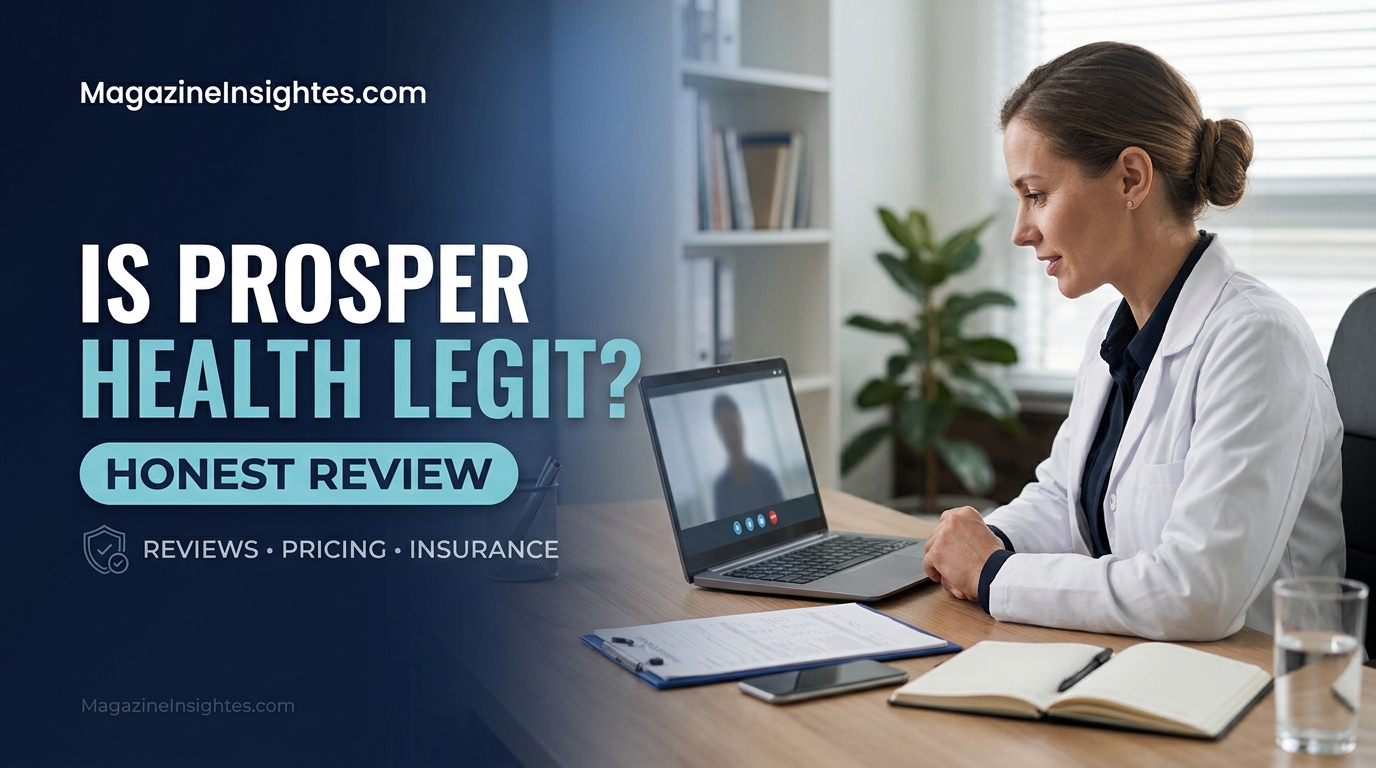
Is Prosper Health legit? Yes, it is a real telehealth provider for autistic adults, with licensed clinicians and real insurance coverage.
This page is general information only, not medical advice, and it does not diagnose, treat, or recommend a specific provider for any person.
Talk to a licensed clinician about your own care, and use this review to check the facts before you book anything.
Short answer first: Prosper Health is legit, but the evidence is thinner than the Trustpilot score suggests, and you should know the limits.
Its Trustpilot score is 4.8 stars from about 1,065 reviews, as seen on November 9, 2026, and its clinicians are licensed.
Its Better Business Bureau profile is new and unrated, its satisfaction figures are self reported, and its main legitimacy page is its own blog.
This review puts the trust evidence, the cost, the insurance list, and the complaints in one place, so you can judge for yourself.
Every fact below carries a source and a date, and every Prosper Health claim is labelled as Prosper Health’s own claim.
What Is Prosper Health?
Prosper Health is a telehealth provider focused exclusively on autistic and neurodivergent adults, per its own site.
It offers adult autism assessment and neurodivergent affirming therapy, and all of its services are provided virtually via telehealth.
It calls itself the first telehealth provider focused exclusively on autistic and neurodivergent adults, and that is its own claim.
The company was in only its first year of operation when it published its legitimacy blog post on November 5, 2024.
That early post said there were limited reviews and testimonials from other sources at the time, and the author investigated the company herself.
The author was 27 when she first found Prosper Health, and she had not yet been diagnosed with autism.
She wrote that she was hesitant, because the company was new and there were few independent reviews to read.
That honesty is useful, because it shows the legitimacy question is not new, and it has been asked since the start.
Who It Serves
Prosper Health serves autistic and neurodivergent adults, including people who have not yet been diagnosed, per its own site.
It focuses on adults, not children, and that focus is the gap it says it fills in mental health care.
Many autistic adults were never identified in childhood, and millions of autistic adults remain undiagnosed, per clinical guides.
About 1 in 45 United States adults is autistic, a modelled estimate of 2.21 percent, per the CDC via clinical guides.
That figure is a modelled estimate, not a count of adults with a confirmed diagnosis, so treat it as an estimate.
About 1 in 31 United States eight year olds was identified as autistic, per the CDC ADDM Network in April 2025.
That figure covers 2022 data across 16 sites, and it is not nationally representative, so do not present it as a national rate.
Women who mask are a large part of the audience, because masking hides autistic traits and delays diagnosis for years.
Masking means hiding autistic traits to fit in, and it is common in women and in late diagnosed adults.
Prosper Health says its therapists specialize in supporting clients through masking, late diagnosis, and autistic burnout.
What Services It Offers
Prosper Health offers two main services: an adult autism assessment, and ongoing neurodivergent affirming therapy, per its own site.
Assessments are conducted by experienced psychologists, and they use trusted, clinically tested assessment tools adapted for telehealth.
Therapy is provided by licensed therapists who have training and experience working with autistic adults, per Prosper Health.
Many Prosper Health therapists are neurodivergent themselves, per the company’s own legitimacy blog post.
Prosper Health also offers a combined Autism and ADHD assessment in a small number of states, per its own site.
It does not offer any standalone ADHD assessments at this time, per its own site, so do not book it for ADHD alone.
No prior diagnosis is needed to begin therapy, per Prosper Health, and that lowers the barrier for people who are still unsure.
Prosper Health is not an emergency provider, per its own blog, so do not use it for a crisis.
Anyone in crisis in the United States can call or text 988, the Suicide and Crisis Lifeline, at any hour.
That number is free, confidential, and staffed around the clock, and it is there for crisis as well as distress.
Who the Clinicians Are
Prosper Health says it has a network of licensed therapists with training and experience working with autistic adults.
Its assessments are done by licensed psychologists in your state who specialize in diagnosing autistic adults, per its own site.
Each psychologist is specifically trained to recognize autism in subtle and difficult to identify cases, per Prosper Health.
The Chief Clinical Officer is Rachel L. Loftin, PhD, per Prosper Health, and she is on faculty at Northwestern University and Yale University.
Dr. Loftin is also on the Editorial Board of the Journal of Autism and Developmental Disorders, per Prosper Health.
Prosper Health says its intervention protocols build on over 30 years of peer reviewed research, developed with Yale and Northwestern faculty.
That claim is Prosper Health’s own, and this page has not independently verified the research behind it.
Check any clinician’s state license before you book, because licensure is state by state, and it is the simplest check you can do.
Ask the provider for the clinician’s full name and license number, and check it on your state licensing board site.
| Service | What it is | Who provides it | Diagnosis needed first |
|---|---|---|---|
| Autism assessment | Full evaluation for an autism diagnosis | Licensed psychologist in your state | No, that is the point of the assessment |
| Autism + ADHD assessment | Combined assessment, small number of states | Licensed psychologist in your state | No |
| Neurodivergent affirming therapy | Ongoing therapy for autistic adults | Licensed therapist, autism specialized | No, therapy does not need a diagnosis |
| Standalone ADHD assessment | Not offered | Not applicable | Not applicable |
This service table comes from Prosper Health’s own site, as seen on November 9, 2026, and it is the company’s own description.
The Trust Evidence: Trustpilot, BBB, and Reviews

Trust is not one number, and this section gives you the three sources that matter: Trustpilot, the Better Business Bureau, and Prosper Health’s own reviews.
Each source has a different weakness, and the verdict only makes sense when you see all three together.
Trustpilot is independent but does not verify specific claims, and its review summary is generated by artificial intelligence.
The Better Business Bureau profile is thin, new, and unrated, and it tells you little about the quality of care.
Prosper Health’s own reviews page is the most positive source, and it is also the least independent, so read it last.
Trustpilot: 4.8 Stars From About 1,065 Reviews
Prosper Health has 4.8 stars on Trustpilot, from 1,065 to 1,067 reviews, as seen on November 9, 2026.
The Trustpilot summary is based on 916 reviews, and it says reviewers overwhelmingly had a great experience with the company.
Customers praise the professional staff for being exceptionally kind, supportive, and knowledgeable throughout the health assessment journey.
People also find the convenient online scheduling process remarkably easy, highly affordable, and well organized when using insurance coverage.
Prosper Health replied to 78 percent of negative reviews, per Trustpilot, which is a sign the company reads complaints.
Re-check the score before you rely on it, because the score changes as new reviews arrive, and this figure is dated November 9, 2026.
Trustpilot says companies cannot offer incentives or pay to hide reviews, and reviews are the opinions of individual users, not of Trustpilot.
Trustpilot also says it does not verify specific claims, because reviewers’ opinions are their own, so a review is not a verified fact.
One review published on November 3, 2026, says the provider just never showed up, and the reviewer had taken time off work.
That review also says support was hard to reach, with a message on an answering machine, and no real help offered.
That is one review, not a pattern on its own, but it matches the complaint themes in the Trustpilot summary below.
Better Business Bureau: Not Accredited, Not Rated
Prosper Health is not BBB accredited, and it is not rated, per the Better Business Bureau profile seen on November 9, 2026.
The BBB file opened on October 9, 2026, and the BBB serves Southeast Florida and the Caribbean for this profile.
The business category is Telemedicine, and the BBB says the business has been in business less than 6 months.
That reason conflicts with the company’s age, because Prosper Health was already operating in 2024, when it published its legitimacy blog.
The BBB file is new, not the company, so do not present the BBB status as proof the company is new.
BBB profiles generally cover a three year reporting period, and the BBB does not verify the accuracy of information provided by third parties.
The BBB does not guarantee the accuracy of any information in Business Profiles, per the BBB’s own disclaimer on the page.
No complaints are listed on the BBB profile seen, so the BBB tells you little about the quality of care.
A not rated BBB profile is not a red flag on its own, and it is not a green flag either.
Use the BBB as one check among several, and give Trustpilot and the clinician license check more weight.
What Clients Praise and What They Complain About
The Trustpilot summary gives the clearest picture of praise and complaints, and this section reports it as a summary, not as verified fact.
Clients praise the staff for being kind, supportive, and knowledgeable, and they praise the easy online scheduling process.
Clients also praise the affordability with insurance, and the well organized process when insurance coverage is used.
Prosper Health’s own reviews page says 97 percent of clients report satisfaction with its services, as seen on November 9, 2026.
It also says over 70 percent of clients report improved quality of life while engaged with Prosper Health.
Both figures are Prosper Health’s own claims, with no method shown, so label them as Prosper Health’s own every time.
Client stories on the reviews page include a woman who tried for months to get diagnosed, and found no one familiar with autism in adult women.
She says Prosper Health made the evaluation process extremely easy, and helped her reach a new level of self understanding.
Another client says Prosper Health is the most streamlined and affordable mental health care she has ever accessed.
Another client says she was in regular therapy for 26 years, being treated as neurotypical, and it just did not work.
She says Prosper Health’s neurodiversity affirming approach made her feel more seen and understood than she ever has in her life.
Those stories are from real clients who voluntarily shared their experiences, per Prosper Health, and they are self selected.
Some reviewers were not happy with missed appointments and communication problems involving specific clinicians during their testing process.
Some consumers also experienced frustrating communication challenges, unreturned messages, and unexpected administrative hurdles when trying to resolve scheduling difficulties.
Those are the two complaint themes in the Trustpilot summary, and they are the risks to check before you book.
Ask the provider what happens if your clinician misses an appointment, and how fast support replies to a message.
| Source | What it says | As of | Weakness |
|---|---|---|---|
| Trustpilot | 4.8 stars, about 1,065 reviews, 78% of negative reviews replied to | Nov 9, 2026 | Does not verify specific claims; summary is AI generated |
| Better Business Bureau | Not accredited, Not Rated, file opened Oct 9, 2026 | Nov 9, 2026 | Thin profile, no complaints listed, file is new |
| Prosper Health reviews page | 97% satisfaction, over 70% improved quality of life | Nov 9, 2026 | Company’s own claims, no method shown, self selected stories |
| Prosper Health blog | Legit, first telehealth provider for autistic adults | Nov 5, 2024 | Own blog, not independent, first year of operation |
This trust table is the verdict in one place, with the source, the date, and the weakness beside each claim.
How Much Does Prosper Health Cost?

Cost is the second question most searchers ask, after legitimacy, and the answer depends on whether you use insurance or self pay.
Prosper Health says most people pay under $80 with insurance, and that claim is Prosper Health’s own, not an independent finding.
Self pay prices are clear and fixed, and they are the safest numbers to quote, because they do not depend on your plan.
Re-check every price on the day of publication, because prices change, and the figures below are as of October 2026.
Self-Pay Prices
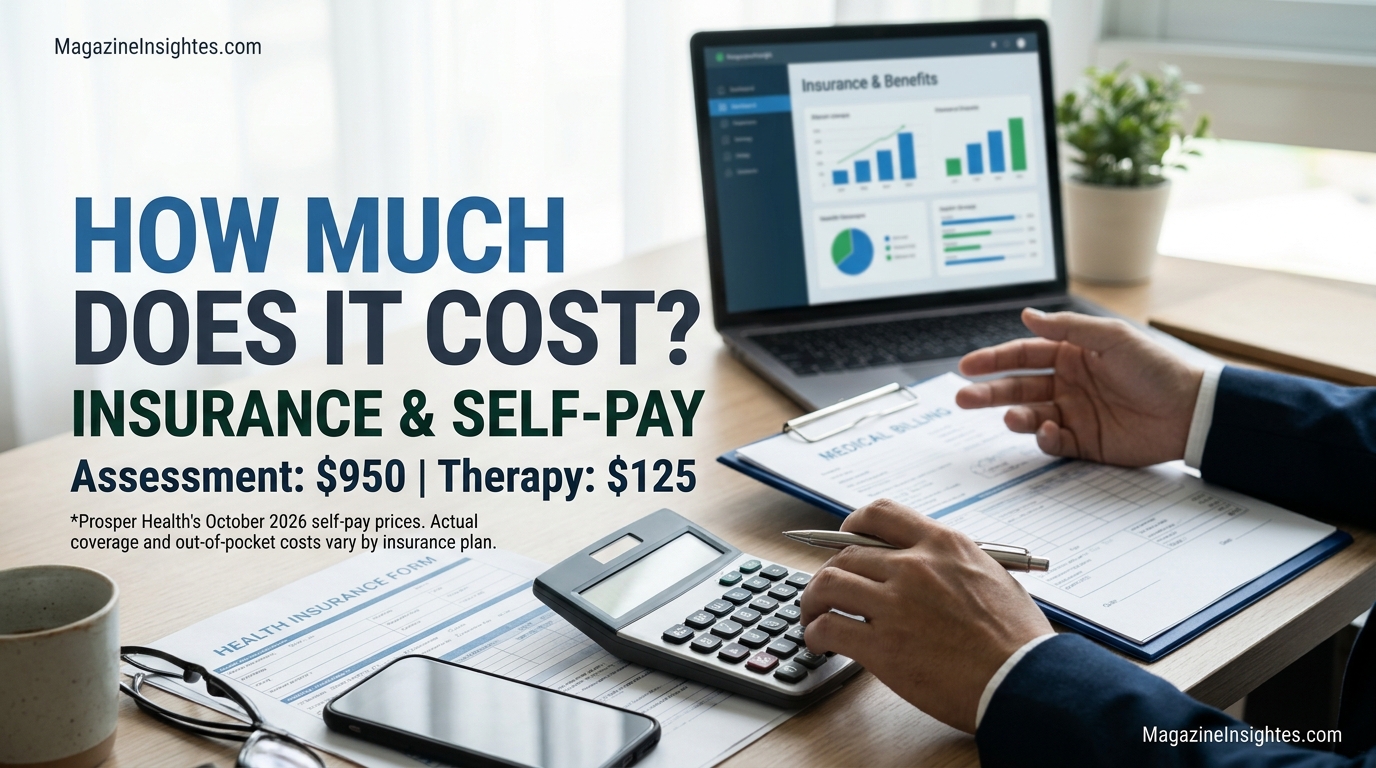
Therapy sessions cost $125 per session on a self pay basis, per Prosper Health, as of October 2026.
Assessments cost $950 for the complete autism assessment process, conveniently split into three separate payments of $316.67 each.
An Autism and ADHD assessment costs $1,250 for the complete process, split into four separate payments of $312.50 each.
That combined assessment is only offered in a small number of states, per Prosper Health, so check your state first.
A comprehensive private autism evaluation commonly costs $2,000 to $6,000, per competitor guides, so $950 is lower than the usual private price.
The Autism Society of America says a comprehensive adult evaluation runs $1,500 to $3,000 without insurance, per NeuroLaunch in April 2025.
Those general prices are competitor reported, so label them by source, and do not present them as Prosper Health prices.
A $49 structured self assessment is a different product, and it screens but does not diagnose, per NeuroLaunch.
Telehealth initial evaluations via platforms such as Klarity range roughly $100 to $150, with follow ups around $59, per NeuroLaunch in June 2026.
Those are platform prices, not Prosper Health prices, and they vary by provider and by insurance, so compare them with care.
Insurance and the 29-State List
Prosper Health accepts most major insurance plans, per its own site, and it verifies your insurance within 1 business day.
When you submit your information in the contact form, Prosper Health says it will send you an email and text with a cost estimate.
As of October 2026, it accepts Aetna, BCBS, Cigna, Oscar, Oxford, and United in 29 states, per its own FAQ page.
Those states are Alabama, Arizona, California, Colorado, Connecticut, Florida, Georgia, Idaho, Illinois, Kentucky, Maryland, Massachusetts, Michigan, Minnesota, and Mississippi.
The rest are Missouri, Nebraska, Nevada, New Hampshire, New Jersey, New York, North Carolina, Ohio, Oregon, Pennsylvania, South Carolina, Tennessee, Texas, Utah, Virginia, and Wisconsin.
That list changes, so re-check it on the day of publication, and date every insurance claim you make.
In Michigan and Pennsylvania, Prosper Health is unable to accept Cigna for therapy services, per its own FAQ page.
In Wisconsin, it does not accept Cigna for either therapy or assessments, per its own FAQ page.
Those exceptions matter, because a plan that is accepted in one state may not be accepted in another state.
One user screenshot from May 2026 shows insurance covering 94 percent of an assessment under UnitedHealthcare, with $60 for a full assessment.
The same screenshot shows $20 for individual therapy sessions, and two 90-minute appointments with a licensed psychologist.
That screenshot is a user post, not a verified price, so treat it as an example, not as a guarantee.
Another user says he paid $35 per session, in a Facebook video from October 2026, and that figure is also user reported.
Social media comments also mention a $950 cost, and ask about Tricare, Molina, and Ohio State University plans.
Tricare is not on the October 2026 accepted list, so check directly with Prosper Health before you book if you have Tricare.
| Service | Self-pay price | Payment split | With insurance |
|---|---|---|---|
| Therapy session | $125 per session | Per session | Most pay under $80, per Prosper Health |
| Autism assessment | $950 total | 3 payments of $316.67 | Most pay under $80, per Prosper Health |
| Autism + ADHD assessment | $1,250 total | 4 payments of $312.50 | Check your plan, limited states |
| Standalone ADHD assessment | Not offered | Not applicable | Not applicable |
This cost table comes from Prosper Health’s own FAQ page, as of October 2026, and it is the company’s own price list.
What Medicare and Medicaid Users Should Know
Prosper Health does not accept Medicare or Medicaid at this time, per its own FAQ page, as of October 2026.
That exclusion matters, because many adults who need an autism assessment rely on Medicare or Medicaid for care.
For children, Medicaid must cover medically necessary services to diagnose and treat autism for anyone under 21, under EPSDT.
For adults, there is no national EPSDT equivalent, so adult autism coverage under Medicaid is state dependent and consistently thinner.
State home and community based services waivers, under section 1915(c), are the other door for adults, per NeuroLaunch.
Pennsylvania’s Adult Autism Waiver is one concrete example of a state building a dedicated program for adults.
If you have Medicaid, ask your state Medicaid office what adult autism assessment coverage exists in your state.
Social media comments also ask about Medicaid acceptance, and some users say they cannot use Prosper Health because of it.
If Prosper Health does not take your plan, ask your primary care doctor for a referral to a local psychologist or a university clinic.
A GP or primary care referral remains a valid, often lower cost starting point, per NeuroLaunch.
Is a Telehealth Autism Diagnosis Valid?
Validity is the question behind the legitimacy question, because a real company can still give a diagnosis that other providers question.
An adult autism diagnosis is made clinically, through an evaluation that weighs developmental history, current presentation, and standardized screeners against DSM-5-TR criteria.
No blood test, brain scan, or lab panel confirms autism on its own, per the Integrative Psych clinical guide.
A late diagnosis is just as valid as one made in childhood, per the same guide, and for many adults it is the first time a lifelong pattern gets named.
Telehealth can suit most adult presentations, with the same clinical standards as in-person visits, per Integrative Psych, which offers telehealth in New York State.
That does not mean every telehealth assessment is equal, so check the clinician, the tools, and the report before you book.
How Adult Autism Is Diagnosed
A psychiatric evaluation includes a detailed developmental history, a structured clinical interview against DSM-5-TR criteria, and validated screeners.
It also includes a review of co-occurring conditions such as ADHD, anxiety, depression, and OCD, per Integrative Psych.
Prosper Health says its assessments employ trusted, clinically tested assessment tools adapted specifically for telehealth.
Its provider who evaluated one client shared that the majority of her therapy clients are autistic adults, per the blog post.
Ask the provider which tools it uses, how many sessions the assessment takes, and what the final report includes.
Ask whether the report is accepted by your employer, your school, or your insurer, because acceptance varies by setting.
A formal diagnosis requires a comprehensive evaluation, not just a quiz score, per every clinical guide in this research.
A study of 161 adults receiving their first autism diagnosis found that 66.5 percent had previously received at least one other psychiatric diagnosis.
That figure comes from a cited study in the MeetAugust guide, and it shows why misdiagnosis is common before a late diagnosis.
Screening vs Diagnosis: AQ-10 and RAADS-R
Screening and diagnosis are different jobs, and confusing them is the most common mistake in online autism content.
A screening suggests whether a full evaluation is worth pursuing, and that is the whole job, per NeuroLaunch.
It cannot diagnose you, and it never has been able to, per the same guide, so do not treat a score as a diagnosis.
The AQ-10 is a 10-item screening questionnaire from Cambridge’s Autism Research Centre, and it is free for non-profit use.
It takes about 5 to 10 minutes, and a score of 6 or above suggests a full assessment is worth considering.
That threshold comes from the 2012 validation work by Allison, Auyeung, and Baron-Cohen, per NeuroLaunch.
A high score suggests autistic traits are present, and a low score does not rule out autism if symptoms persist.
The RAADS-R is an 80-item validated research scale, built to capture the autism traits adults report about themselves.
Its original validation study landed on 65 as the screening threshold, above which a full evaluation makes sense, per NeuroLaunch.
The most reputable free version lives at Embrace Autism, an independent neurodiversity focused reference site, per NeuroLaunch.
NeuroLaunch’s own NeuroPassport is a 45 minute, evidence based questionnaire for a one-time $49, and it screens but does not diagnose.
That product is NeuroLaunch’s own, so label it as such, and do not present it as an independent recommendation.
| Tool | What it is | Threshold | Diagnoses |
|---|---|---|---|
| AQ-10 | 10-item screening questionnaire, Cambridge | 6 or above suggests a full assessment | No, screening only |
| RAADS-R | 80-item validated research scale | 65 or above suggests a full evaluation | No, screening only |
| Full evaluation | Developmental history, interview, screeners, DSM-5-TR | Clinician judgement | Yes, by a licensed clinician |
This screening table comes from NeuroLaunch and Integrative Psych, as seen on November 9, 2026, with each threshold labelled by source.
What If You Get No Diagnosis?
A full evaluation can end with no autism diagnosis, and that outcome is possible even when you have autistic traits.
Ask for the report and the reasoning, so you understand which criteria were met and which were not.
Consider a second opinion from another licensed clinician, especially if your developmental history was incomplete or your masking was strong.
Use the screening result to decide the next step, whether that is therapy, support, or a different kind of assessment.
Social media comments include people who received only symptom feedback without a formal diagnosis, and who called that a scam.
That reaction is understandable, but a no diagnosis result is not on its own proof of a scam, and it needs a second look.
Ask the provider before you book what happens if the result is no diagnosis, and whether you still get a report.
Ask whether the fee covers a second review, and whether therapy is still available without a diagnosis.
Prosper Health vs Alternatives
Prosper Health is not the only route to an adult autism diagnosis, and comparing it with alternatives helps you choose.
A local psychologist offers in-person care, but the waitlist can be months or years, and the cost can be $2,000 to $6,000.
A university clinic offers expert care, often at a lower cost, but the waitlist can also be long, and the location may be far.
Embrace Autism offers free screening tools, including the RAADS-R, but it does not diagnose, and it is a reference site, not a clinic.
Klarity is a telehealth marketplace that connects you with licensed clinicians nationwide, with same-day or next-day appointments commonly cited.
Klarity is a platform, not a single practice, and its own disclaimer says it does not guarantee prescriptions or medication fulfillment.
Diagnosing and prescribing are per-provider and per-state decisions on Klarity, per NeuroLaunch, so check the provider, not just the platform.
NeuroLaunch offers a $49 structured self assessment, and a free AQ-10, but neither diagnoses, and both are NeuroLaunch’s own products.
A primary care referral is a valid, often lower cost starting point, per NeuroLaunch, and it can lead to a local specialist.
Compare cost, wait time, insurance, and whether the provider specializes in adult autism before you choose, not just the price.
| Option | Cost | Wait time | Diagnoses | Best for |
|---|---|---|---|---|
| Prosper Health | $950 self-pay, most pay under $80 with insurance | Seen in about 1 week, per Prosper Health | Yes, licensed psychologist | Adults who want telehealth and insurance coverage |
| Local psychologist | Commonly $2,000 to $6,000 private | Months or years, often long | Yes, licensed clinician | People who want in-person care |
| University clinic | Often lower, varies by clinic | Often long | Yes, licensed clinician | People near a university clinic |
| Embrace Autism | Free screening tools | Immediate | No, screening only | People who want to screen first |
| Klarity | Roughly $100 to $150 initial, $59 follow-up | Same-day or next-day, commonly cited | Per provider, per state | People who want fast telehealth |
| Primary care referral | Often lower, varies by plan | Varies by referral | Via specialist referral | People with a trusted GP |
This comparison table uses Prosper Health’s own prices and competitor reported prices, with each figure labelled by source in the text.
Three Companies You Should Not Confuse With Prosper Health
Three different companies have similar names, and merging their reviews is the most common error in Prosper Health content.
Prospero Health and Social Care is a UK recruitment agency, at prosperohealthandsocial.com, with 20 years of experience recruiting health and social care staff.
Its Trustpilot score is 3.6 stars from 78 reviews, as seen on November 9, 2026, and its complaints are about recruitment, not autism care.
Its reviews include people who paid for their own DBS check, waited for compliance emails, and got no reply from the agency.
Those reviews have nothing to do with Prosper Health, and they must never be counted as Prosper Health reviews.
Prosper Medical is a separate virtual first healthcare platform, at prospermedical.com, with a Trustpilot score of 4.8 from 116 reviews.
Its patients praise the medical staff for being knowledgeable, compassionate, and attentive during telehealth and in-person appointments.
That is a different company from Prosper Health, and its 4.8 score must never be merged with Prosper Health’s 4.8 score.
Prosper Health Care Lending is a lending company that finances medical procedures and treatments, per an aggregator page from September 2024.
That aggregator says it has an A+ rating with the Better Business Bureau and a 4.9 star rating on Trustpilot.
Those ratings belong to the lending company, not to Prosper Health, and they must never be merged with Prosper Health’s ratings.
Check the web address before you trust a review, because prosperhealth.io is the autism provider, and the others are not.
| Company | What it does | Website | Trustpilot |
|---|---|---|---|
| Prosper Health | Adult autism assessment and therapy, telehealth | prosperhealth.io | 4.8 stars, about 1,065 reviews |
| Prospero Health and Social Care | UK health and social care recruitment | prosperohealthandsocial.com | 3.6 stars, 78 reviews |
| Prosper Medical | Virtual-first healthcare platform | prospermedical.com | 4.8 stars, 116 reviews |
| Prosper Health Care Lending | Medical procedure financing | Not stated here | 4.9 stars, per aggregator, not verified |
This confusion table is the page to check before you cite any review, because the names are close and the scores are not.
Red Flags and How to Check Any Telehealth Provider
Use this checklist for Prosper Health and for any telehealth provider, because the checks are the same for every company.
Step 1: check the clinician’s state license on your state licensing board site, using the full name and license number.
Step 2: check the Trustpilot profile, read the one-star reviews as well as the five-star reviews, and note the as-of date.
Step 3: check the Better Business Bureau profile, and note whether the company is accredited, rated, or neither.
Step 4: check the insurance list on the company’s own site, and confirm your plan and your state before you book.
Step 5: ask what happens if your clinician misses an appointment, and how fast support replies to a message.
Step 6: ask what the final report includes, and whether it is accepted by your employer, school, or insurer.
Step 7: ask what happens if the result is no diagnosis, and whether you still get a report and a next step.
Red flag 1: a provider that charges you to join, because a real provider charges for care, not for access.
Red flag 2: a provider that guarantees a diagnosis, because no provider should guarantee a diagnosis before an evaluation.
Red flag 3: a provider with no named clinicians, no license numbers, and no physical address or state list.
Red flag 4: a provider that only has reviews on its own site, with no independent reviews anywhere else.
Red flag 5: a provider that pressures you to pay in full before you have seen a cost estimate in writing.
Prosper Health does not show those red flags in the sources seen, but check them yourself before you book, because sources change.
No lawsuits or regulator action were found in the searches for this report, so say none found, not none exist.
Social Media Skepticism, Reported Fairly
Social media comments about Prosper Health are mixed, and this section reports them fairly instead of hiding them.
One Facebook video from October 2026 praises Prosper Health, with a man saying he paid $35 per session and was diagnosed at almost 30.
Comments on that video are largely critical and skeptical, with viewers asking about Tricare, Molina, and Ohio State University plans.
Some comments express frustration over cost, with $950 mentioned, and over lack of coverage for their plan.
A significant thread accuses the service of being a scam, and questions diagnostic validity without childhood history.
Others share painful experiences of medical abuse and PTSD from decades of misdiagnosis, and push back against the video’s optimistic framing.
One Instagram video from April 2026 recommends Prosper Health for diagnosis, and its comments are also divided.
Some comments share personal experiences with Prosper Health, including receiving only symptom feedback without a formal diagnosis.
Others raise political fears, warning that a formal diagnosis could lead to state registries being used against autistic people.
Those fears are real to the people who hold them, and this page reports them without endorsing or dismissing them.
Use social media as a tip to check, never as the sole source for a cost or legitimacy claim.
Related Health on MagazineInsightes
Readers who want to check their coverage can read do you need health insurance for the 2026 guide to mandates, costs, and open enrollment.
Readers who want to understand their plan can read what HMO means in health insurance for the plan types and the 2026 cost limits.
Readers who get calls from a health company can read why Signify Health is calling me for the verification steps and the phone numbers.
Readers who want a health career guide can read what a health science major is for the 2026 degree guide and salaries.
Is Prosper Health Legit FAQs
Answers below use the sources in this article, including Prosper Health, Prosper Health FAQ, Prosper Health reviews, Prosper Health diagnosis page, and NeuroLaunch.
Is Prosper Health legit?
Yes, it is a real telehealth provider for autistic adults, with licensed clinicians, insurance coverage, and a 4.8-star Trustpilot score.
Is Prosper Health a scam?
No evidence of a scam was found in the searches for this report, and the complaints are about appointments and communication, not fake services.
What is Prosper Health?
It is the first telehealth provider focused exclusively on autistic and neurodivergent adults, per its own site.
What does Prosper Health do?
It offers adult autism assessment and neurodivergent affirming therapy, all via telehealth, per its own site.
How much does Prosper Health cost?
Self-pay therapy is $125 per session, and a full autism assessment is $950, per Prosper Health, as of October 2026.
How much is a Prosper Health autism assessment?
It costs $950 in total, split into three payments of $316.67, per Prosper Health, as of October 2026.
Does Prosper Health accept insurance?
Yes, it accepts Aetna, BCBS, Cigna, Oscar, Oxford, and United in 29 states, per Prosper Health, as of October 2026.
Does Prosper Health accept Medicare?
No, it does not accept Medicare at this time, per Prosper Health, as of October 2026.
Does Prosper Health accept Medicaid?
No, it does not accept Medicaid at this time, per Prosper Health, as of October 2026.
Does Prosper Health accept Tricare?
Tricare is not on the October 2026 accepted list, so check directly with Prosper Health before you book.
How much do most people pay with insurance?
Prosper Health says most pay under $80 with insurance, and one user screenshot shows $60 for an assessment under UnitedHealthcare.
How long does a Prosper Health assessment take?
Prosper Health says you can be seen in about one week, and one user screenshot shows two 90-minute appointments.
What is Prosper Health’s Trustpilot score?
It is 4.8 stars from about 1,065 reviews, as seen on November 9, 2026, and the score changes over time.
What do Prosper Health clients praise?
Clients praise kind, supportive, knowledgeable staff, easy online scheduling, and affordable care with insurance, per the Trustpilot summary.
What do Prosper Health clients complain about?
Clients complain about missed appointments, communication problems, unreturned messages, and admin hurdles, per the Trustpilot summary.
Is Prosper Health BBB accredited?
No, it is not BBB accredited, and it is not rated, per the Better Business Bureau profile seen on November 9, 2026.
Why is Prosper Health not BBB rated?
The BBB says the business has been in business less than 6 months, and the BBB file itself opened on October 9, 2026.
Is a telehealth autism diagnosis valid?
Yes, an adult autism diagnosis is made clinically, via developmental history, a structured interview against DSM-5-TR, and validated screeners.
Can you be diagnosed with autism online?
Yes, if a licensed clinician does a full evaluation, while a quiz or a screening alone cannot diagnose autism.
What is the difference between screening and diagnosis?
A screening suggests whether a full evaluation is worth pursuing, while only a licensed clinician can diagnose.
What is AQ-10?
It is a 10-item screening questionnaire from Cambridge, and a score of 6 or above suggests a full assessment is worth considering.
What is RAADS-R?
It is an 80-item validated research scale, with a threshold of 65, and it screens but does not diagnose on its own.
Do I need a diagnosis to start therapy at Prosper Health?
No, a prior diagnosis is not needed to begin therapy, per Prosper Health.
Is Prosper Health the same as Prospero Health?
No, Prospero Health and Social Care is a separate UK recruitment agency, with a Trustpilot score of 3.6, and the two must not be merged.
How do I check if a telehealth provider is legit?
Check the clinician’s state license, the Trustpilot and BBB profiles, the insurance list, and whether it guarantees a diagnosis.
Conclusion
Is Prosper Health legit? Yes, it is a real telehealth provider for autistic adults, with licensed clinicians and real insurance coverage.
Its Trustpilot score is 4.8 stars from about 1,065 reviews, as seen on November 9, 2026, and most clients praise the staff and the scheduling.
Its Better Business Bureau profile is new and unrated, its satisfaction figures are self reported, and its main legitimacy page is its own blog.
Its self-pay prices are $125 per therapy session and $950 for a full autism assessment, as of October 2026.
It accepts six major insurance plans in 29 states, but it does not accept Medicare or Medicaid at this time.
Its complaints are about missed appointments, communication, and admin hurdles, not about fake services, and those are the risks to check.
Check the clinician’s license, confirm your insurance and your state, and ask what happens if an appointment is missed.
This page is general information only, not medical advice, and you should talk to a licensed clinician about your own care.
Sources used for this page include Prosper Health, NeuroLaunch, Integrative Psych, Trustpilot, and the Better Business Bureau, with the CDC named in plain text.
Trustpilot, the Better Business Bureau, and Integrative Psych are named in plain text only, because they returned a bot wall to the link checker on November 9, 2026.
Last verified on Monday, November 9, 2026, and this page will be updated when the Trustpilot score or the insurance list changes.