Why Is Signify Health Calling Me? The Honest 2026 Answer
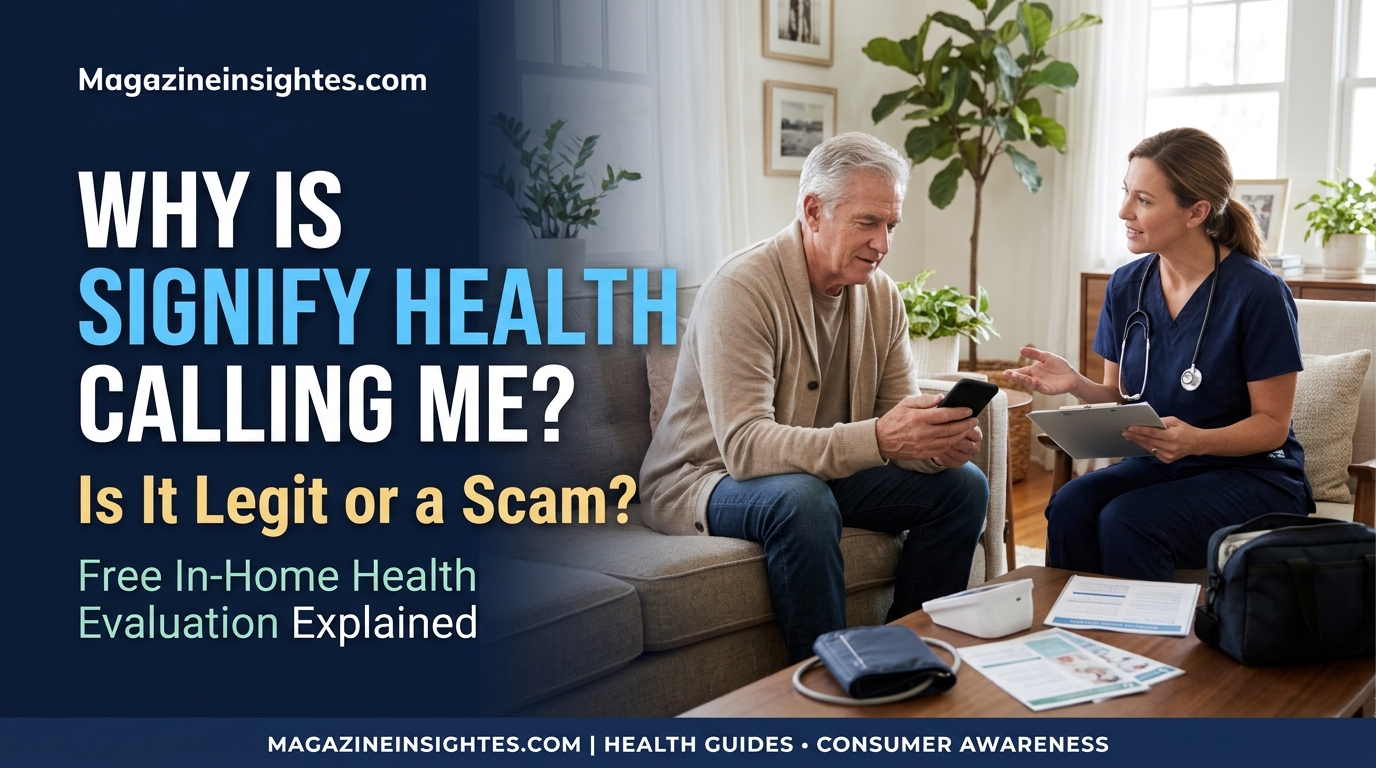
Why is Signify Health calling me is the first question most people ask after an unexpected call from a company they never heard of.
The short answer is that Signify Health is real, and it is calling to offer you a free health evaluation at home.
Signify Health works with your health plan. Your insurer asked the company to contact you about a service that is already included in your membership.
The call is usually about an In-Home Health Evaluation, a free visit from a licensed clinician.
That sounds simple. Yet many people hang up, because the call feels like a scam. A stranger asks about your health, offers a gift card, and wants to come to your home.
Caution is the right instinct.
This guide gives you the full picture.
You will learn why the calls happen, how to tell a real call from a fake one, and what happens during the visit.
You will also learn how to verify the number and how to stop the calls if you want them to stop.
The Short Answer: Why Is Signify Health Calling You
Signify Health is calling to schedule a free In-Home Health Evaluation. Your health plan asked the company to offer you this visit. It costs you nothing, and it is voluntary.
Your health plan wants to know more about your health. The visit helps the plan find gaps in your care, such as a screening you missed or a medicine that needs review.
It also helps the plan plan your care for the year.
The call is not a sales call. Signify Health does not sell you insurance, medicine, or equipment. The company is paid by your health plan to do the evaluation.
You do not have to accept. You can say no, and your coverage stays the same. You can also ask for a virtual visit instead of an in-home visit.
Is Signify Health Legit or a Scam?
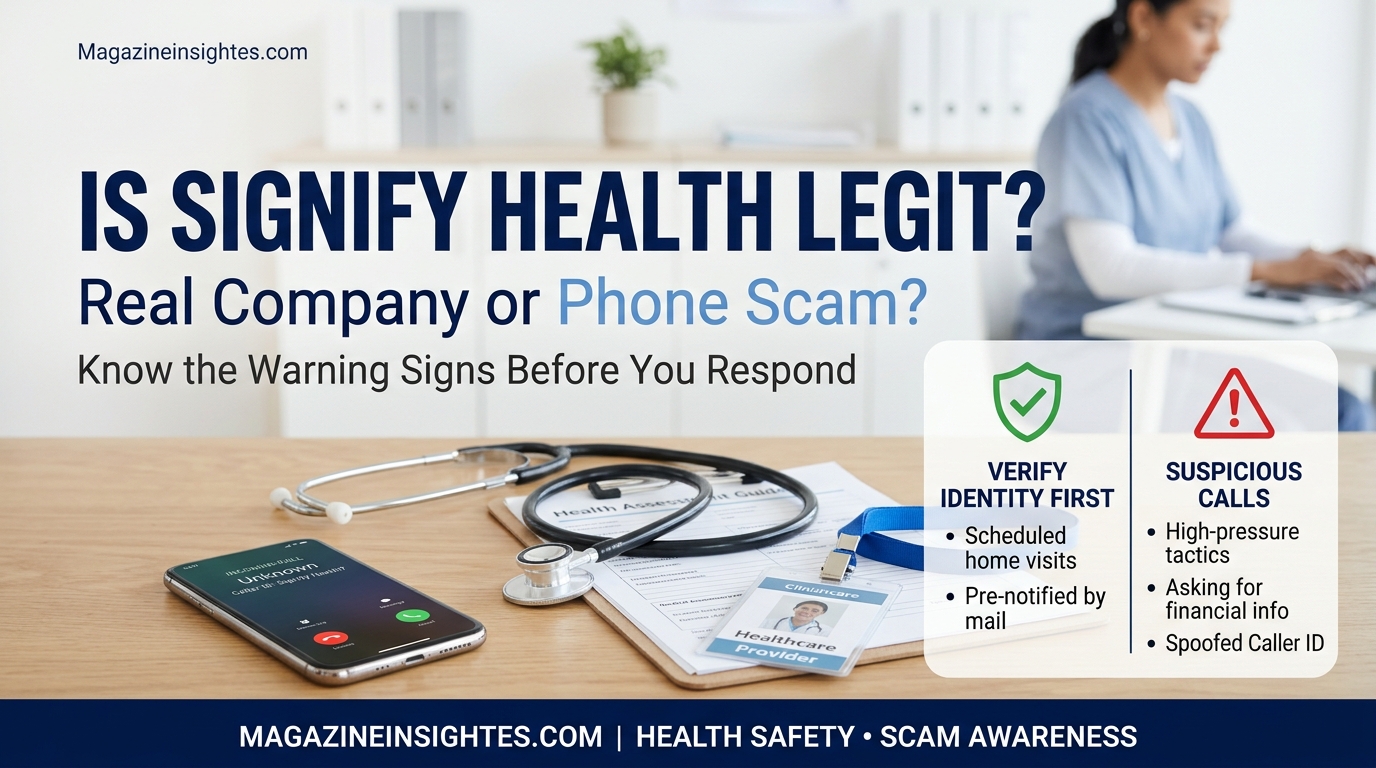
Signify Health is a legitimate company. It is part of CVS Health, one of the largest health companies in the United States.
It partners with Medicare Advantage plans, Medicaid plans, and commercial health plans across the country.
That does not mean every call that uses the name is real. Scammers spoof company names every day. A real Signify Health call follows strict rules, and a fake call breaks them.
The next two sections give you the test. One shows what makes a real call legitimate. The other shows why so many people think it is a scam.
What Makes Signify Health Legitimate
Signify Health was acquired by CVS Health in 2022. The company describes itself as a health care company that delivers personalized health evaluations in the home.
Its own website lists its services and its health plan partnerships.
The Better Business Bureau gives Signify Health an A+ rating, with over 4 out of 5 stars as of February 2026. That rating comes from Signify Health’s own blog, so treat it as self-reported.
The company also says it has a 4.7-star rating on Google Reviews from more than 10,000 reviews, also self-reported.
Trustpilot has 102 reviews of Signify Health. Reviewers say the clinicians are knowledgeable and polite, and they take time to answer questions. Many people found the home assessments helpful and thorough.
A federal court also ruled on the company’s calls. In Phelps v. Signify Health, decided in November 2025, the court found the calls were made with the member’s consent.
The case is explained in full later in this guide.
Why So Many People Think It Is a Scam
The call feels wrong to many people. A stranger calls about your health, offers a gift card, and wants to visit your home. That pattern matches the scams people hear about on the news.
Some callers use prerecorded messages. The Phelps case involved four prerecorded calls between August and December 2024. A robot voice asking you to call back does not build trust.
Gift cards add to the doubt. Some members were told they would receive a $100 gift card for completing a visit. Some say the card never arrived.
A broken promise about money turns a legitimate offer into a scam in the caller’s mind.
No-show visits make it worse. Several Trustpilot reviewers say the clinician never arrived, and no one called to explain.
Waiting all morning for a visit that never happens feels like fraud, even when the company is real.
Critics also raise a deeper concern. They say the visit documents diagnoses that let Medicare Advantage insurers collect more money. That criticism is covered in its own section below, with the source named.
Who Is Signify Health?
Signify Health is a health care company that brings health evaluations to people’s homes. It partners with health plans to offer In-Home Health Evaluations, virtual health assessments, focused visits, and care coordination.
The company says it works closely with many major health plans and supports millions of people across the country. Its focus is Medicare Advantage members, dual-eligible members, and people with chronic health issues.
Signify Health is not your doctor. It does not treat you, prescribe medicine, or replace your primary care provider.
It evaluates your health and shares the report with you, your primary care provider, and your health plan.
Signify Health and CVS Health
Signify Health is part of CVS Health. CVS Health acquired the company in 2022. The goal was to address health plan members’ needs in the home.
CVS Health also owns Aetna, CVS Caremark, CVS Specialty, and Oak Street Health. Oak Street Health is a primary care practice that serves Medicare patients.
That means one company can be your insurer, your pharmacy benefit manager, and the company that sends a clinician to your home.
Critics say that structure creates a conflict of interest. Supporters say it creates coordination. Both views are covered later in this guide.
The CVS Separation News
In November 2026, CVS Health announced it will separate into two publicly traded companies by mid-2028. Signify Health will stay in the healthcare solutions company, alongside Aetna, CVS Caremark, CVS Specialty, and Oak Street Health.
The separation does not change the calls. Signify Health will keep offering In-Home Health Evaluations for health plan members. The change matters only because it shows how large the company behind the calls has become.
The 5 Reasons Signify Health Calls You
Signify Health does not call at random. Your health plan identifies members who might benefit from an evaluation, and then Signify Health contacts them. These are the five reasons.
1. To Schedule an In-Home Health Evaluation
This is the most common reason. Your insurer partners with Signify Health to offer a free, in-home check-up. A licensed clinician visits your home and reviews your health.
The visit covers your medical history and your medications. It includes vital signs, blood pressure, heart rate, and reflexes. It can also include preventive screenings.
The visit lasts about 45 to 60 minutes. It costs you nothing. It does not affect your premium or your benefits. It is voluntary.
2. To Offer a Virtual Health Assessment
If you prefer not to have someone visit your home, Signify Health may offer a telehealth alternative. You complete the evaluation over a secure video call or a phone call.
The virtual visit covers the same topics as the in-home visit. A licensed clinician, such as a doctor, nurse practitioner, or physician assistant, conducts the call. The visit is still free and voluntary.
Some members prefer the virtual option because it feels safer. Others prefer the in-home visit because the clinician can check vital signs in person. Both options are real.
3. To Follow Up After a Hospital Stay
If you were recently discharged from a hospital, Signify Health might call as part of a care coordination program. The goal is to make sure you have the resources to recover safely at home.
The call may cover your discharge plan, your medicines, and your follow-up appointments. The clinician may ask whether you have food, transport, or help at home. The program connects you with services you might need.
This is not a bill collection call. It is a care coordination call, and it is part of your health plan’s benefits.
4. To Connect You With Social Health Support
Signify Health may offer help with areas like food, housing, or transport. These are called social health and support services. Many people qualify for programs they never use.
The caller may ask whether you have trouble getting to appointments or affording food. The answers help the company connect you with community programs.
You do not have to share anything you do not want to share.
5. To Remind You About an Annual Wellness Visit
Some calls are reminders for an annual wellness visit or updates about new benefits under your plan. Your health plan wants you to use the preventive services that are already included in your membership.
These calls are part of a broader effort to keep members engaged with their care. Active participation leads to better outcomes, for you and for your community.
| Reason | What happens | Cost |
|---|---|---|
| In-Home Health Evaluation | Licensed clinician visits your home for 45 to 60 minutes | Free |
| Virtual health assessment | Video or phone call with a licensed clinician | Free |
| Post-hospital follow-up | Care coordination after discharge | Free |
| Social health support | Connection to food, housing, or transport programs | Free |
| Annual wellness visit reminder | Reminder about preventive services in your plan | Free |
What Happens During a Signify Health Visit?

Knowing what happens during the visit removes most of the fear. The visit follows a clear pattern, and nothing in it should surprise you.
Before the Visit
You schedule a date and time that suits you. The company confirms the visit by phone. You should receive the clinician’s name and the visit window.
You do not need to prepare anything special. Have your medicine list ready if you can. Write down any questions you want to ask the clinician.
You do not need to clean your home or tidy up. The clinician only needs a quiet place to sit with you. You can ask a family member to be present.
During the 45 to 60 Minutes
A licensed clinician arrives at your home. The clinician may be a doctor, a nurse practitioner, or a physician assistant. They introduce themselves and explain the visit.
The clinician reviews your medical history and your medications. They check your vital signs, blood pressure, heart rate, and reflexes. They may ask about your daily life, your mobility, and your mood.
The clinician may do preventive screenings. They may ask about falls, memory, or depression. They may ask whether you have enough food or help at home.
The clinician will not offer treatment. They will not prescribe medication. They will not change your medicines. They will not replace your primary care provider.
After the Visit
Signify Health shares a comprehensive report with you, your primary care provider, and your health plan. The report describes what the clinician found and what care gaps exist.
Your primary care provider can use the report to plan your care. Your health plan can use it to connect you with services. You can ask for a copy of the report.
The visit does not change your coverage. It does not raise your premium. It does not reduce your benefits. It is an extra resource, not a requirement.
What They Will Ask vs What They Will Never Ask
This table is the fastest way to judge a call. A real caller asks for the items in the left column.
A caller who asks for anything in the right column is not legitimate, or is breaking the rules.
| A real caller may ask for | A real caller will never ask for |
|---|---|
| Your name | Your Social Security number |
| Your date of birth, to verify your identity | Your bank account number |
| Your address, to confirm the visit | Your credit card number |
| Your health plan name | Payment of any kind |
| A date and time for the visit | Your Medicare number over the phone |
| Your medicines and medical history, during the visit | Your passwords or PINs |
If a caller asks for your Social Security number or a credit card, hang up. Call Signify Health on the official number, or call your health plan directly.
Never give payment details to a caller you did not call yourself.
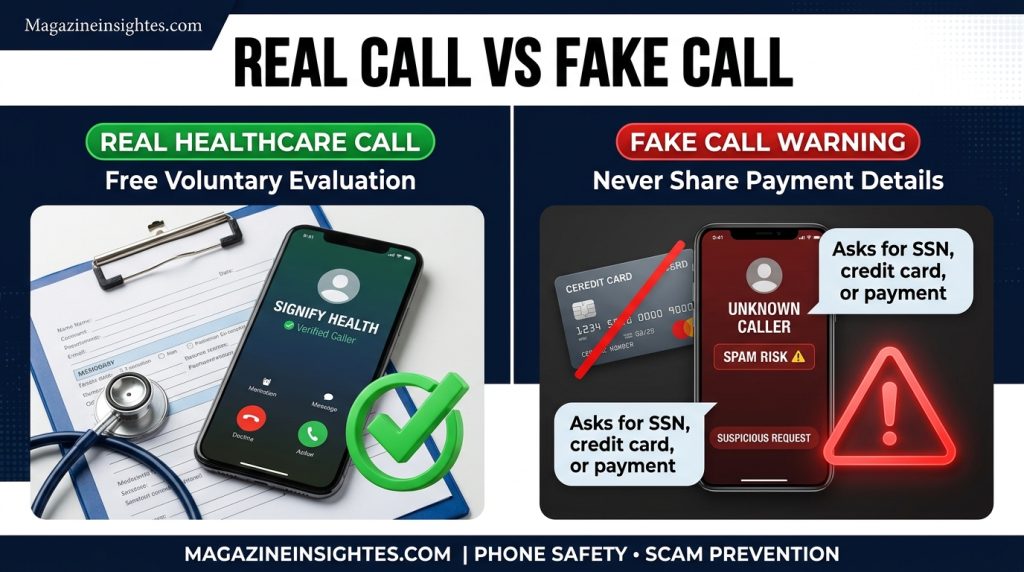
Real Call vs Fake Call: The Comparison
Scammers copy the name, but they cannot copy the behavior. Use this table to compare the call you received with a real one.
| Sign | Real Signify Health call | Fake call |
|---|---|---|
| Who they name | They name your insurance provider | They name no plan, or a plan you do not have |
| What they offer | A free evaluation, no cost, voluntary | A prize, a gift card, or a payment |
| What they ask for | Name and date of birth only | Social Security number, bank details, or payment |
| Pressure | No pressure, you can decline | High pressure, must decide now |
| Time of call | 7am to 7pm Central Time, Monday to Friday | Late at night, weekends, or holidays |
| Callback | They give you the official number to call back | They insist you stay on the line |
| Gift card | Offered by select plans only, not every visit | Promised to everyone, with a deadline |
Scam Red Flags: 10 Signs to Hang Up
These are the warning signs that the call is not from Signify Health. One red flag is enough to end the call. You can always call back on the official number.
- The caller asks for your Social Security number. A real caller never asks for it.
- The caller asks for payment, a bank account, or a credit card. The visit is free.
- The caller pressures you to decide now. A real caller lets you think and call back.
- The caller promises a gift card to everyone. Gift cards come from select plans only.
- The caller does not name your insurance provider. A real caller names your plan.
- The caller threatens to cancel your coverage. Declining the visit never affects your benefits.
- The caller asks for your Medicare number. Do not share it with an incoming caller.
- The caller calls late at night or on a holiday. Real calls come 7am to 7pm Central Time, Monday to Friday.
- The caller will not give you a number to call back. A real caller always offers the official number.
- The caller asks you to buy a gift card or wire money. That is always a scam.
How to Verify a Signify Health Call in 5 Steps
Verification takes five minutes. Do not trust the caller ID alone, because scammers can spoof numbers. Follow these steps in order.
- Ask for the caller’s name and the plan they represent. Write both down. A real caller will give them without hesitation.
- Ask for a callback number. Compare it with the official scheduling number, 1-855-319-2107. If it does not match, hang up.
- Hang up and call back yourself. Use the official number, or call your health plan on the number on your member card. Never call a number the caller gave you.
- Call your health plan. Ask whether Signify Health is offering you an In-Home Health Evaluation. Your plan can confirm it in seconds.
- Check the official website. Signify Health’s website explains the service and the scheduling number. The Centers for Medicare and Medicaid Services, known as CMS, also publishes Medicare guidance.
If any step fails, do not proceed. A real offer will still be there tomorrow. A scam will not survive a callback check.
Signify Health Phone Numbers and Contacts
Use only these numbers, taken from Signify Health’s own materials and from Trustpilot replies by the company. Re-check them on the official website before you call, because numbers can change.
| Purpose | Contact |
|---|---|
| Schedule a visit | 1-855-319-2107 |
| Member services | 855-984-5121 |
| Member services email | [email protected] |
| Your health plan | Number on the back of your member card |
| Report a scam | ReportFraud.ftc.gov |
| Medicare questions | Medicare.gov or 1-800-MEDICARE |
Real calls come between 7am and 7pm Central Time, Monday through Friday. A call outside those hours is a reason to be suspicious.
How to Stop Signify Health Calls
You can stop the calls. The visit is voluntary, and declining it has no effect on your coverage or your benefits. You have three options.
Option 1: Decline the Visit
Tell the caller you do not want the visit. The caller should note your decision. You do not need to give a reason.
Declining once may not stop future calls. Health plans offer the evaluation every year, so you may be contacted again next year. Ask the caller to note that you do not want to be contacted.
Option 2: Ask to Opt Out
Call member services on 855-984-5121 and ask to opt out of outreach calls. You can also contact your health plan and ask them to remove you from the Signify Health outreach list.
Keep a record of the call. Note the date, the time, and the name of the person you spoke with. If the calls continue after you opted out, that record helps you complain.
Option 3: Report the Calls
If the calls continue after you opted out, or if you believe the call was a scam, report it. You can report a scam to the Federal Trade Commission at ReportFraud.ftc.gov.
You can also complain to your health plan and to the Better Business Bureau.
If the caller used a prerecorded message and you never gave consent, the Telephone Consumer Protection Act may apply. A consumer protection lawyer can tell you whether you have a claim.
The Phelps case, covered below, shows how courts treat consent.
Should You Accept the Visit? Pros and Cons
There is no single right answer. Some people find the visit helpful. Others find it intrusive. This table weighs both sides so you can decide for yourself.
| Pros | Cons |
|---|---|
| Free, no cost to you | A stranger visits your home |
| Licensed clinician, 45 to 60 minutes of attention | Visit may feel intrusive or unnecessary |
| Finds care gaps, such as a missed screening | Clinician may be a no-show, with no warning |
| Report shared with your primary care provider | Gift card promises are sometimes broken |
| Connects you with support services | Findings may be used by your insurer for risk adjustment |
| Virtual option available if you prefer it | Does not replace your own doctor |
Accept the visit if you want an extra check on your health, if you have not seen a doctor recently, or if you want help finding support services.
Decline it if you already see your doctor regularly, if you do not want a stranger in your home, or if you are uncomfortable with the way the company works.
Either choice is fine. Your coverage does not change. Your benefits do not change. Your premium does not change.
The Other Side: What Critics Say
Not everyone trusts the program. The criticism deserves a fair hearing, because it explains why some people decline the visit even though it is free.
Critics say Signify Health documents diagnoses during the visit. Medicare Advantage insurers can use those diagnoses to collect more money through a system called risk adjustment.
The insurer benefits financially, even if the member gets no extra care.
Critics also say the findings can be used against the member. A diagnosis in the report could support a denial of prior authorization, or the end of coverage for a treatment.
The visit, they argue, serves the insurer more than the patient.
These claims come from opinionated sources, including a November 2026 blog post on shouldntneedtobealawyer.com about the CVS breakup.
That post calls Signify Health a company that sends a clinician to your home to report back to your insurer. It is criticism, not verified fact.
No court or regulator has found that Signify Health harms members in this way.
The other side of the argument is that risk adjustment is a normal part of Medicare Advantage. Plans are paid more for sicker members, because sicker members cost more to care for.
Documenting a real diagnosis is not fraud. It is how the system is designed.
You should know both sides before you decide. If the criticism worries you, ask your health plan how the visit report is used. Ask whether the findings can affect your prior authorization requests.
Get the answer in writing if it matters to you.
The TCPA Case: Phelps v. Signify Health
The most important legal case about these calls is Phelps v. Signify Health. It was decided in the U.S. District Court for the District of Arizona in November 2025.
The court granted summary judgment for Signify Health and Aetna.
The plaintiff, Jon Phelps, said Signify Health violated the Telephone Consumer Protection Act, known as the TCPA. The law limits calls made with a prerecorded voice without the recipient’s prior express consent.
Phelps enrolled in a Banner-Aetna plan effective January 1, 2023. During registration, he gave his phone number to Aetna. Between August and December 2024, he received four prerecorded calls from Signify Health.
The calls asked him to call back to discuss a service included in his membership. The message said the company was available 7am to 7pm Central Time, Monday through Friday.
It did not try to sell him anything.
The court found that Phelps had consented when he gave his number to Aetna. The calls were about a service included in his membership, so they were within the scope of that consent.
The court also found that Signify Health acted as Aetna’s agent, so the calls were treated as if Aetna itself had made them.
The lesson is practical. When you give your phone number to your health plan during enrollment, you may be consenting to calls about services in your plan.
That consent can cover calls from companies like Signify Health. If you want to stop the calls, you need to opt out, not just ignore them.
Signify Health Reviews: What People Say
Reviews of Signify Health are mixed. The pattern is consistent across Trustpilot and the company’s own blog. People praise the clinicians and complain about the logistics.
Trustpilot has 102 reviews. The summary says most reviewers were somewhat happy overall. Patients say the clinicians are knowledgeable, polite, and take time to answer questions.
Many people enjoyed their home appointments and found the assessments helpful and comprehensive.
The complaints are also consistent. Some reviewers say clinicians missed scheduled visits without warning and left them waiting for hours. Several complain about persistent phone calls and broken promises about gift cards.
A few say the visit felt intrusive or unnecessary.
One reviewer said the company scheduled a virtual wellness check, promised a $100 gift card, and then cancelled the virtual appointment and pressured the member to reschedule an in-home visit.
Another reviewer said the company wanted them to change their primary care doctor to a CVS-owned practice. These are user opinions, not verified facts.
Signify Health replies to many reviews. The company asks unhappy members to contact member services on 855-984-5121 or by email at [email protected].
The company says the visit is included in the member’s health plan at no extra cost.
The company’s own blog says it holds an A+ rating with the Better Business Bureau and over 4 out of 5 stars as of February 2026.
It also says it has a 4.7-star rating on Google Reviews from more than 10,000 reviews. Both figures are self-reported, so treat them as the company’s own claims.
The Gift Card Truth
Gift cards are the most confusing part of the offer. Some members are told they will get one. Some never receive it. This table sets out the truth as the company states it.
| Question | Answer |
|---|---|
| Does every visit come with a gift card? | No. Gift cards are offered by select health plan partners only. |
| How much is the gift card? | It varies by plan. One reviewer was promised $100. Others report no gift card at all. |
| When do you get it? | After the visit, by mail. Some reviewers say it never arrived. |
| Should you accept a visit for the gift card? | No. Accept the visit only if you want the evaluation. |
| What if the gift card never arrives? | Contact member services on 855-984-5121 and ask for help. |
A gift card promise is a red flag when it comes from a caller who also asks for payment details. A real offer never asks you to pay anything to receive a gift card.
Keep Reading the Health Cluster
Signify Health calls are part of a bigger question: how your health coverage works, and what it costs. The health cluster on this site covers the basics.
Do you need health insurance? explains the law, the six states that still fine you, and what coverage costs in 2026. It is the best place to start if you are unsure about your coverage.
Healthy meal plan for beginners gives you a 7-day guide to eating well at home. Healthy morning habits covers 10 habits that improve your daily routine.
Benefits of walking 30 minutes a day lists 10 benefits of a daily walk. Home workout for beginners gives you a 15-minute workout with no equipment.
For official information, Medicare.gov is the official Medicare site. CMS, the Centers for Medicare and Medicaid Services, runs Medicare and Medicaid.
Signify Health’s What We Do page explains the company’s services in its own words, and Signify Health’s reviews page gives the company’s view of its own reviews.
To report a scam, use ReportFraud.ftc.gov, the Federal Trade Commission’s reporting site.
Signify Health and Your Health Plan: How the Partnership Works
Most people never hear about the partnership behind the call. Your health plan hires Signify Health to do the evaluations. You never pay Signify Health directly.
Your plan starts by finding members who might benefit. It looks at claims data, such as a recent hospital stay, a missed screening, or a chronic condition. It then sends those names to Signify Health.
Signify Health contacts you on the plan’s behalf. The caller says they are calling for your plan, and they name the plan. That is how you know the call is connected to your coverage.
The plan pays Signify Health for each completed evaluation. The amount is not public. The plan pays because the evaluation helps it manage your care and meet its quality goals.
After the visit, Signify Health sends the report to three parties. You get a copy. Your primary care provider gets a copy. Your health plan gets a copy.
Your plan uses the report to find care gaps. A care gap is a service you need but have not received, such as a flu shot or a diabetes eye exam.
The plan may then remind you, or connect you with a service.
The plan also uses the report for risk adjustment. Medicare Advantage plans receive more money for members with more documented conditions.
That is the part critics focus on, and it is covered in the criticism section above.
You can ask your plan how it uses the report. Call the number on your member card and ask three questions. First, what does Signify Health share with you?
Second, can the report affect my prior authorization requests? Third, how do I opt out of the program?
Your plan must answer those questions. If the answer worries you, you can decline the visit. Your coverage stays the same either way.
One more fact matters. Signify Health is not the only company that does this work. Other companies offer similar home evaluations for other health plans. The same verification rules apply to all of them.
FAQs About Signify Health
Why is Signify Health calling me?
Signify Health is calling to schedule a free In-Home Health Evaluation. Your health plan asked the company to offer you this visit. It costs you nothing, and it is voluntary.
Is Signify Health legit?
Yes. Signify Health is a real company, part of CVS Health. It partners with Medicare Advantage, Medicaid, and commercial health plans. Verify the call on the official number before you share information.
Is Signify Health a scam?
No, the company itself is not a scam. But scammers copy its name. A real caller never asks for your Social Security number, bank details, or payment. If a caller asks for those, hang up.
What is Signify Health?
Signify Health is a health care company that brings health evaluations to people’s homes. It offers In-Home Health Evaluations, virtual health assessments, focused visits, and care coordination.
Who is Signify Health?
Signify Health is part of CVS Health, acquired in 2022. It works with health plans across the United States to offer evaluations to plan members, especially Medicare Advantage members.
Is Signify Health safe?
A real Signify Health call is generally safe. The clinician is licensed, the visit is free, and the company shares the report with your primary care provider.
Verify the call first, and never share payment details.
Should I answer Signify Health?
You can answer, but you do not have to. If you answer, ask for the caller’s name and your plan’s name. Then hang up and call back on the official number to verify.
Should I let Signify Health come to my home?
That is your choice. The clinician is licensed, and the visit is free. You can ask a family member to be present. You can also ask for a virtual visit instead.
Do I have to do the Signify Health visit?
No. The visit is voluntary. Declining it does not affect your coverage, your benefits, or your premium. You can say no at any time.
Can I decline Signify Health?
Yes. Tell the caller you do not want the visit. You can also call member services on 855-984-5121 and ask to opt out of future outreach calls.
Does Signify Health cost money?
No. The visit is free for you. Your health plan pays Signify Health. The visit does not affect your premium or your benefits.
Will Signify Health affect my benefits?
No. Accepting or declining the visit does not change your coverage or your benefits. The visit is an extra resource, not a requirement.
Will Signify Health affect my Medicare?
No. The visit does not change your Medicare coverage. It is a service included in many Medicare Advantage plans. It does not replace your Medicare benefits.
What is an In-Home Health Evaluation?
An In-Home Health Evaluation, or IHE, is a free visit from a licensed clinician at your home. It lasts 45 to 60 minutes. The clinician reviews your history, your medicines, and your vital signs.
How long does a Signify Health visit last?
About 45 to 60 minutes. The clinician may spend up to 45 minutes with you, with time for questions. You can ask the clinician to slow down or repeat anything.
Who comes to my home for a Signify Health visit?
A licensed clinician, such as a doctor, a nurse practitioner, or a physician assistant. The company confirms the clinician’s name when you schedule the visit.
What happens during a Signify Health visit?
The clinician reviews your medical history and medicines. They check your vital signs, blood pressure, heart rate, and reflexes. They may do preventive screenings and ask about your daily life.
Will Signify Health prescribe medication?
No. The clinician will not prescribe medication, offer treatment, or change your medicines. The visit is an evaluation only. Your own doctor makes treatment decisions.
Will Signify Health replace my doctor?
No. The visit does not replace your primary care provider. Signify Health shares the report with your doctor so your doctor can use it in your care.
What is the Signify Health phone number?
The scheduling number is 1-855-319-2107. Member services is 855-984-5121. Re-check both numbers on the official website before you call, because numbers can change.
How do I verify a Signify Health call?
Ask for the caller’s name and your plan’s name. Hang up and call back on the official number, 1-855-319-2107.
Or call your health plan on the number on your member card and ask whether the offer is real.
How do I know if a Signify Health call is real?
A real caller names your insurance provider, offers a free voluntary visit, and never asks for your Social Security number or payment. A real caller gives you the official number to call back.
Will Signify Health ask for my Social Security number?
No. A real caller never asks for your Social Security number. If a caller asks for it, hang up and report the call to the Federal Trade Commission.
How do I stop Signify Health calls?
Call member services on 855-984-5121 and ask to opt out. You can also contact your health plan and ask them to remove you from the outreach list. Keep a record of the call.
How do I report a Signify Health scam?
Report it to the Federal Trade Commission at ReportFraud.ftc.gov. You can also complain to your health plan and to the Better Business Bureau. Keep the caller’s number and the time of the call.
Conclusion
Why is Signify Health calling me has a simple answer: your health plan asked the company to offer you a free evaluation at home.
The company is real, part of CVS Health, and the visit costs you nothing.
That does not mean you should trust every call. Verify the caller on the official number, 1-855-319-2107, or call your health plan. Never share your Social Security number or payment details with an incoming caller.
Decide for yourself whether the visit is worth it. If you want an extra check on your health, accept it. If you do not want a stranger in your home, decline it.
Either way, your coverage stays the same.
If the calls continue after you opted out, report them. Your health plan, the Federal Trade Commission, and the Better Business Bureau all take complaints. You have the right to be left alone.