What Does HMO Mean in Health Insurance? The Complete 2026 Guide

What does HMO mean in health insurance is the first question most people ask when they see the letters on a plan. HMO stands for Health Maintenance Organization.
It is a type of health plan that gives you care through a network of doctors and hospitals, at the lowest premium of any plan type.
An HMO trades freedom for price. You must use doctors in the plan’s network. You must pick a primary care physician, called a PCP, who coordinates your care.
You must get a referral before you see a specialist.
In exchange, you pay less each month and less when you get care. That trade-off is the whole story of the HMO.
This guide explains it in full, with 2026 costs, a four-plan comparison, and a decision guide.
You will learn what an HMO is, how it works, and what it costs.
You will see how it compares with PPO, EPO, and POS plans, who should choose one, and how to change your PCP or appeal a denial.
Every figure is labelled by source and year.
The Short Answer
An HMO is a health insurance plan that covers care only from doctors and hospitals in its network, except for emergencies.
You pick a primary care physician who coordinates your care and writes referrals to specialists.
HMOs have the lowest premiums of the four main plan types. They also have the tightest rules. If you go outside the network for non-emergency care, the plan pays nothing.
An HMO suits people who want low, predictable costs and are happy with one group of doctors.
It does not suit people who travel often, see specialists in several states, or want to choose any doctor without a referral.
What Does HMO Stand For?
HMO stands for Health Maintenance Organization. The name comes from the plan’s focus on maintaining your health, not just treating illness. HMOs emphasize preventive care, wellness, and coordinated treatment.
An HMO is a type of managed care organization. It makes agreements with doctors, hospitals, labs, and other providers.
Those providers agree to treat HMO members at pre-negotiated rates, in exchange for a steady stream of patients.
The HMO chooses how much it is willing to pay for different services. Because it controls costs through a limited network and fixed rates, it can charge lower premiums than other plan types.
HMOs are not third-party payer systems, and they do not work on a fee-for-service basis. Instead, they work as capitated systems.
The organization receives a fixed amount per enrollee through monthly premiums and small copayments, regardless of how much care is provided.
The HMO Act of 1973
The HMO as it exists today was established under the Health Maintenance Organization Act of 1973.
The law defined HMOs as a public or private entity organized to provide basic and supplemental health services to its members.
The Act required employers with 25 or more employees to offer federally certified HMO options, if the employer offered traditional health care options.
That rule helped HMOs spread across the country in the 1970s and 1980s.
The law has changed since then, but the core idea remains. An HMO provides or arranges managed care for health insurance, acting as a liaison between members and health care providers on a prepaid basis.
How an HMO Works
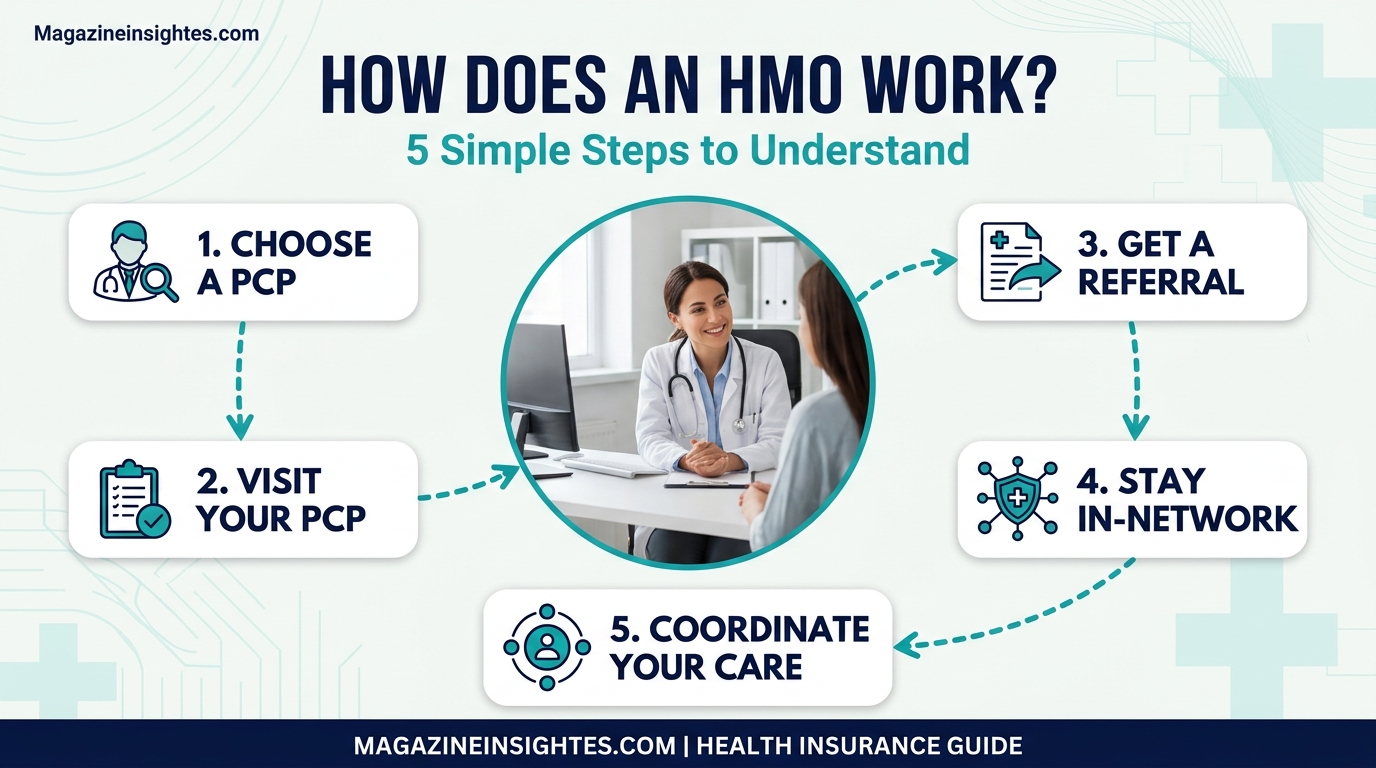
An HMO works in five steps. Each step is simple on its own. Together, they form a system that keeps costs low and care coordinated.
1. You Pick a Primary Care Physician
When you enroll in an HMO, you select a primary care physician from the plan’s network. Your PCP is your first point of contact for most health needs. Your PCP coordinates all your medical care.
Under the Affordable Care Act, you have the right to pick any available primary care provider in your plan’s network. You can choose a family doctor, an internist, or a pediatrician for your child.
Your PCP keeps your records, tracks your preventive care, and knows your history. That coordination is one of the main benefits of an HMO. You have one doctor who sees the whole picture.
2. Your PCP Acts as Gatekeeper
Your PCP acts as a gatekeeper. You must see your PCP first, before you see a specialist. Your PCP decides whether you need specialist care, and writes a referral if you do.
The gatekeeper role has two purposes. It prevents unnecessary procedures, and it keeps your care coordinated. Your PCP knows what tests you have already had, so you do not repeat them.
Some people dislike the gatekeeper. They want to book a specialist directly. In an HMO, you cannot do that without a referral, except in an emergency.
3. You Get a Referral to See a Specialist
To see a specialist, you need a referral from your PCP. Your PCP writes the referral, and the plan approves it. The referral names the specialist and the reason for the visit.
Referrals take time. You may wait days for the referral, then wait weeks for the specialist appointment. If you need urgent specialist care, tell your PCP, and ask for an expedited referral.
Some HMOs allow direct access to certain specialists, such as an OB-GYN or a dermatologist. Check your plan’s rules before you assume you need a referral for every specialist.
4. You Stay Inside the Network
An HMO only pays for care delivered by providers and facilities inside its contracted network. The network includes doctors, hospitals, labs, and pharmacies that have agreed to the plan’s rates.
If you go outside the network for non-emergency care, the plan pays nothing. You pay the full bill. That is the strictest rule in the HMO, and the one that surprises people most.
Emergency care is the exception. HMOs cover emergency care regardless of the provider’s contracted status. If you have a heart attack while traveling, go to the nearest emergency room. The plan must cover it.
5. You Must Live or Work in the Service Area
HMOs contract with providers within specific geographic service areas. To be a member of an HMO, you must live or work in its service area.
The Texas Department of Insurance explains this rule in its HMO guide.
The service area rule matters if you move. If you move out of the area, you may need to switch plans.
If you travel often, an HMO may not suit you, because care outside the area is not covered except in an emergency.
| Step | What happens | What you must do |
|---|---|---|
| Pick a PCP | You choose a primary care physician from the network | Pick any available PCP in the network |
| PCP as gatekeeper | Your PCP coordinates all your care | See your PCP first for most needs |
| Get a referral | Your PCP refers you to a specialist | Wait for the referral before booking |
| Stay in-network | The plan pays only for in-network care | Check the provider directory first |
| Live in the service area | The plan covers a specific geographic area | Live or work inside the area |
What Does an HMO Cover?
An HMO covers the same essential health benefits as any ACA plan. The difference is not what it covers, but where you get the care and who approves it.
Under ACA Section 2713, all non-grandfathered health plans, including HMOs, must cover certain preventive services with zero cost-sharing. That means free vaccines, free screenings, and free annual check-ups, when you use an in-network provider.
HMOs cover doctor visits, hospital stays, emergency care, prescription drugs, lab tests, imaging, mental health care, and maternity care.
The plan’s summary of benefits lists exactly what is covered and what your copay is for each service.
Some HMOs charge no deductible for certain services. You may pay a flat copay for a doctor visit, such as $25 or $35, without meeting a deductible first.
Check your plan, because every HMO is different.
HMO vs PPO vs EPO vs POS: The Complete Comparison
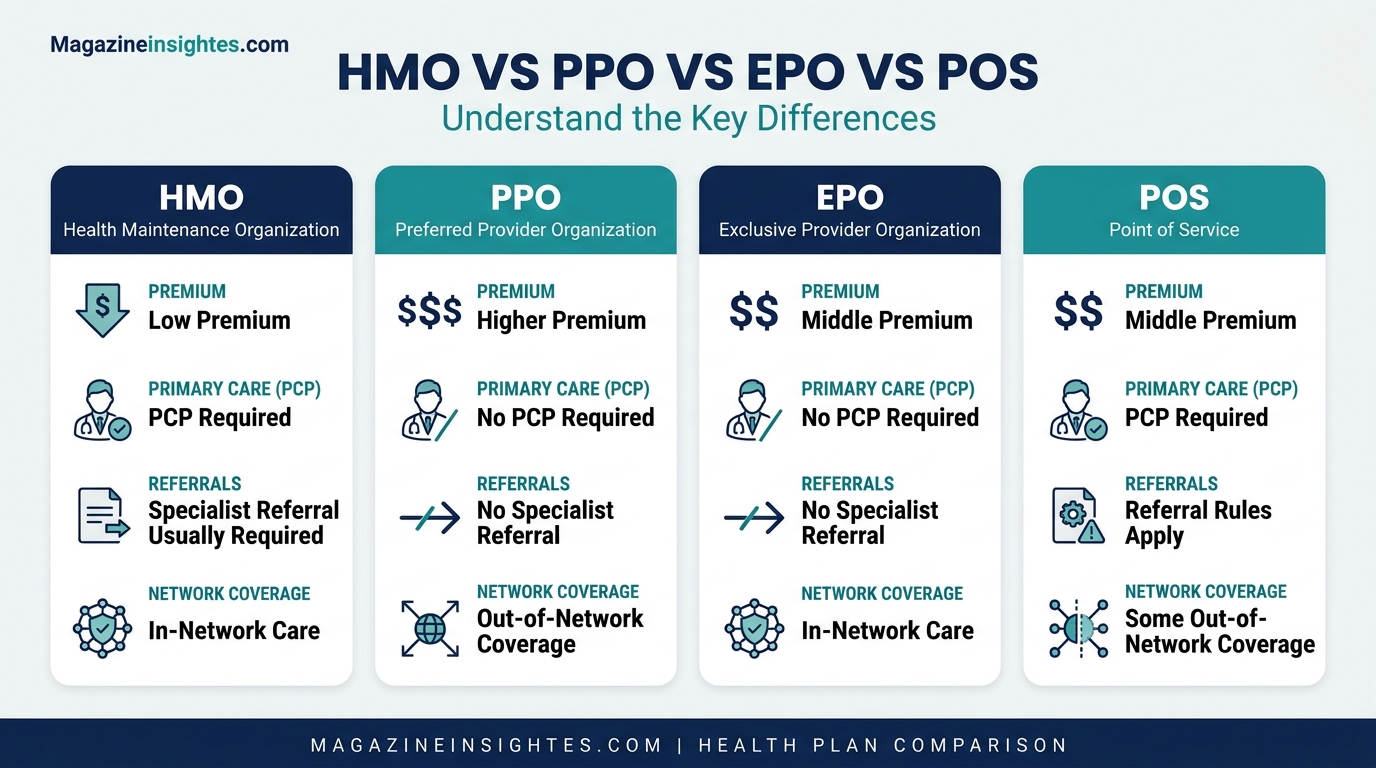
Four plan types dominate American health insurance.
They differ on three questions: do you need a referral to see a specialist, does the plan pay for care outside its network, and how much is the premium. This table answers all three.
| Feature | HMO | PPO | EPO | POS |
|---|---|---|---|---|
| Primary care physician required | Yes | No | No | Yes |
| Referral to see a specialist | Yes | No | No | Yes, for out-of-network |
| Out-of-network care | Emergencies only | Covered, at a higher cost | Emergencies only | Partly covered, at a higher cost |
| Typical premium | Lowest | Highest | Middle | Middle |
| Network size | Smallest | Largest | Small to medium | Medium |
| Best for | Low cost, in-network OK | Flexibility, travelers | Low cost, no referrals | HMO savings plus some flexibility |
HMO vs PPO
HMO vs PPO comes down to freedom versus cost. A PPO lets you see any specialist without a referral and pays part of out-of-network care.
An HMO routes care through a primary care doctor, needs referrals, and covers only emergencies outside its network. That is why the HMO has the lowest premium.
A PPO has a larger network and no gatekeeper. You pay more each month for that freedom.
A PPO also has higher out-of-pocket costs when you go out of network, including a separate deductible that may not count toward your out-of-pocket maximum.
HMO vs EPO
An EPO, or Exclusive Provider Organization, is like an HMO without the referral rule. You must use in-network providers, and out-of-network care is covered only in emergencies.
But you can see a specialist without a referral.
An EPO costs more than an HMO, because it drops the gatekeeper. It suits people who want direct specialist access but can stay in network.
Kaiser Permanente sells only HMO and EPO plans in the states where it offers ACA coverage.
HMO vs POS
A POS, or Point of Service, plan is a hybrid. It works like an HMO inside the network, with a PCP and referrals. It also covers some out-of-network care, at a higher cost.
The premium sits in the middle.
A POS suits people who want HMO prices but occasionally need an out-of-network doctor. You pay more for the visit, and you may need a referral first. The out-of-network deductible is usually separate.
HMO vs HDHP
An HDHP, or High Deductible Health Plan, is not a network type. It is a cost-sharing structure.
An HDHP has a high deductible in exchange for a low premium, and it can pair with a Health Savings Account, called an HSA.
For 2026, an HSA-eligible HDHP must have a deductible of at least $1,700 for one person or $3,400 for a family, according to the IRS.
You can put up to $4,400 into an HSA for yourself or $8,750 for a family, tax-free. The HDHP out-of-pocket maximum for 2026 is capped at $8,500 for one person.
An HMO and an HDHP can overlap. Some HMOs are also high-deductible plans. The network rules and the cost-sharing rules are separate questions, and you should check both.
What Does an HMO Cost?
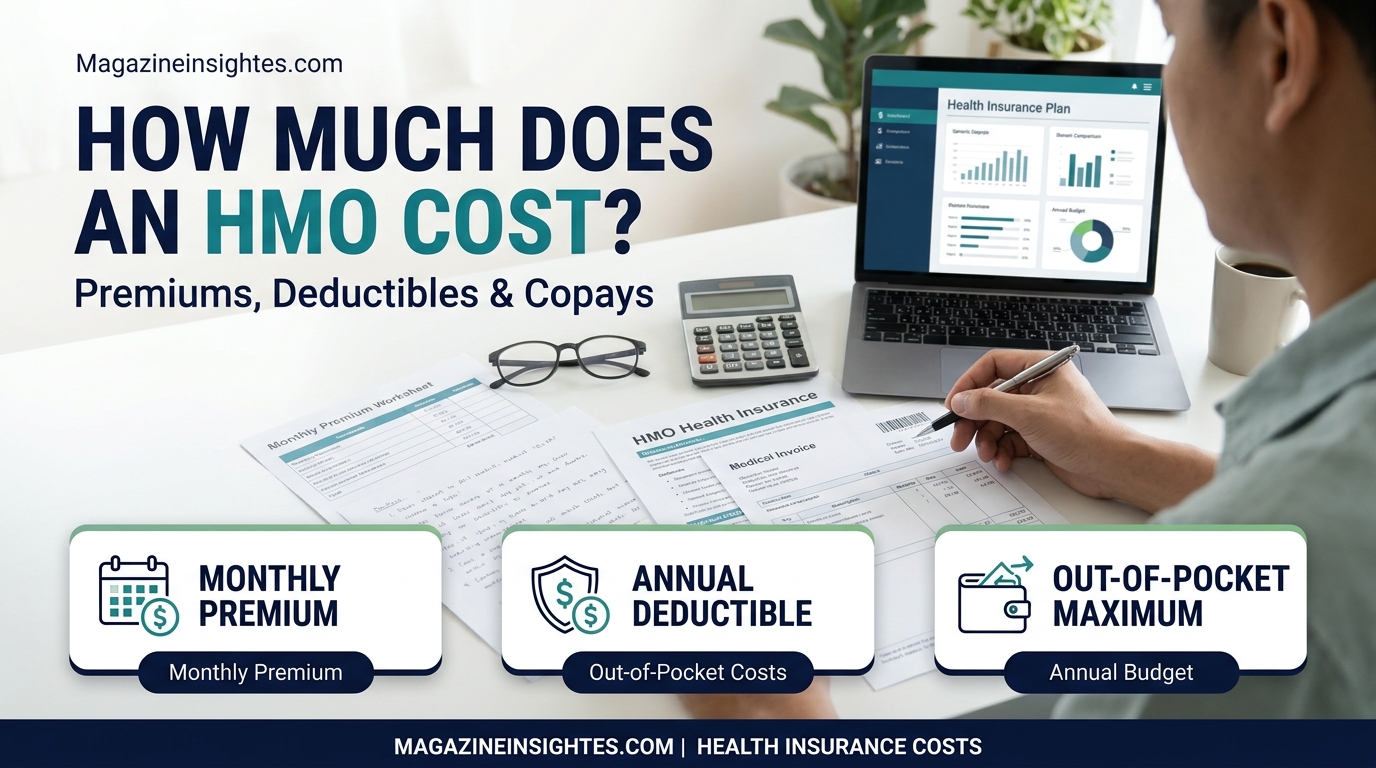
HMOs have the lowest premiums and the lowest out-of-pocket costs of the four plan types.
The reason is simple: the insurer negotiates fixed reimbursement rates with a limited set of providers, and the gatekeeper prevents unnecessary care.
Premiums vary by state, age, and plan. The figures below are labelled by source, so you can judge them for yourself. Never treat a premium from one source as a quote for your situation.
Employer Plan Costs (KFF 2026)
The KFF 2026 Employer Health Benefits Survey gives the most reliable national figures. The average employer premium for single coverage is $9,804 a year, of which workers pay $1,672.
The average employer premium for family coverage is $28,303 a year, of which workers pay $7,471, up 9% in a year.
The average deductible for single coverage is $1,955. About 38% of workers have a deductible of $2,000 or more. These figures cover all plan types, not HMOs alone.
Enrollment by plan type in 2025 was PPO 50%, HSA-qualified plans 29%, HMO 12%, and POS 8%. HMOs cover a small share of workers, because many employers offer PPOs as the default.
Marketplace Premiums
On the marketplace, HMO premiums are the lowest. MoneyGeek compared Kaiser Permanente and Anthem in 2026. The national HMO average was $678 a month.
Kaiser Permanente charged $598 a month for its HMO, and Anthem charged $683 a month.
Kaiser undercuts the national average by $80 a month, saving buyers $960 a year. Anthem’s HMO costs $85 a month more than Kaiser’s, or $1,020 a year.
These are averages for a 40-year-old, and they vary by state and county.
A hypothetical 35-year-old single person, in a mid-tier plan, would pay about $350 a month for an HMO, with a $2,500 deductible and a $7,000 out-of-pocket maximum.
The same person would pay about $480 a month for a PPO, with a $3,500 deductible and an $8,500 out-of-pocket maximum. These figures come from Finance24Me, and they are hypothetical, not quotes.
PPOs cost roughly 35% more in premium than HMOs.
Out-of-Pocket Maximums
Every ACA plan caps in-network costs. For 2026, the cap is $10,600 for one person and $21,200 for a family.
For 2027, the cap rises to $12,000 for one person and $24,000 for a family, according to CMS.
The cap is the most you can pay in a year for covered in-network care. After you hit it, the plan pays 100%.
Out-of-network costs on a PPO usually have their own deductible and may not count toward the cap.
The cheapest premium is not always the cheapest year. A low premium with a high deductible can cost more in a bad year than a higher premium with a low deductible.
Run the math before you choose.
| Figure | 2026 | Source |
|---|---|---|
| Average employer premium, single | $9,804 a year, worker pays $1,672 | KFF Employer Health Benefits Survey 2026 |
| Average employer premium, family | $28,303 a year, worker pays $7,471, up 9% | KFF Employer Health Benefits Survey 2026 |
| Average deductible, single coverage | $1,955 | KFF 2026 |
| Workers enrolled by plan type | PPO 50%, HSA-qualified 29%, HMO 12%, POS 8% | KFF 2026 |
| Out-of-pocket maximum cap | $10,600 single, $21,200 family | CMS, 2026 |
| Out-of-pocket maximum cap, next year | $12,000 single, $24,000 family | CMS, 2027 |
| HSA-eligible HDHP minimum deductible | $1,700 single, $3,400 family | IRS, 2026 |
| HSA contribution limit | $4,400 single, $8,750 family | IRS, 2026 |
| HDHP out-of-pocket maximum | $8,500 single | IRS, 2026 |
The Total Yearly Cost: Premium Plus Care
Never choose a health plan by premium alone. Your real yearly cost is premiums plus what you pay for care, minus any employer HSA money and tax savings.
This section shows you how to run the math.
The Bad Year Test
Add a year of premiums to the out-of-pocket maximum. That is the most the plan can cost you in a terrible year. Compare that number across plans, not just the monthly premium.
For example, an HMO at $350 a month costs $4,200 a year in premiums. Add a $7,000 out-of-pocket maximum, and the worst year costs $11,200.
A PPO at $480 a month costs $5,760 a year in premiums. Add an $8,500 out-of-pocket maximum, and the worst year costs $14,260.
The HMO saves $3,060 in a bad year, in this hypothetical example. The figures are hypothetical, from Finance24Me, and they are labelled as such. Your real numbers will differ by state, age, and plan.
The Normal Year Test
For a healthy person, an HDHP with an HSA usually wins, especially when the employer adds money to the HSA.
In one example from Lifoholic, an HDHP cost $1,506 in a normal year, against $2,900 for a PPO.
For a person who uses a lot of care, a PPO or HMO with low copays wins when the premium gap is small.
In a chronic-condition example, the PPO saved $394 in a normal year and $2,141 in a bad one, compared with the HDHP.
Run both tests before you enroll. The plan that wins in a normal year may lose in a bad year, and the reverse is also true.
Who Should Choose an HMO?
An HMO is not right for everyone. This table matches life situations with the best plan type. Find your situation and see what the table says.
| Your situation | Best plan | Why |
|---|---|---|
| Healthy, low care use, tight budget | HMO | Lowest premium, low copays, preventive care free |
| Family with young children | HMO | Predictable costs, one PCP coordinates the family |
| Chronic condition, frequent specialist visits | PPO | No referrals, direct specialist access, larger network |
| Traveler, snowbird, multi-state | PPO | Out-of-network coverage, no service area limit |
| Want direct specialist access, stay in network | EPO | No referrals, middle premium, in-network only |
| Want HMO prices plus some flexibility | POS | HMO inside the network, some out-of-network cover |
| Healthy, want tax savings | HDHP with HSA | Lowest premium, tax-free HSA, employer may contribute |
HMO Pros and Cons
Every plan type has trade-offs. Here are the HMO’s pros and cons, side by side.
| Pros | Cons |
|---|---|
| Lowest premiums | Must stay in-network, except emergencies |
| Low out-of-pocket costs | Must get a referral to see a specialist |
| Predictable copays | Must live or work in the service area |
| Coordinated care through one PCP | Cannot keep a doctor outside the network |
| Free preventive services | Referrals take time, appointments may be slow |
| Focus on wellness and prevention | Out-of-state care not covered, except emergencies |
How to Choose Between HMO and PPO: A Decision Guide
Ask yourself five questions. Your answers will point to the right plan. This guide works for open enrollment, a new job, or a life change.
- Do you travel often or live in two states? If yes, choose a PPO. An HMO will not cover non-emergency care outside its service area.
- Do you see specialists regularly? If yes, choose a PPO or EPO. An HMO requires a referral for every specialist visit, which adds time and friction.
- Do you have a doctor you want to keep? If yes, check whether that doctor is in the HMO’s network. If not, choose a PPO, or switch doctors.
- Is your budget tight? If yes, choose an HMO. It has the lowest premium and the lowest out-of-pocket costs, as long as you stay in network.
- Do you want one doctor to coordinate everything? If yes, choose an HMO. The PCP model gives you a single point of contact for all your care.
If you answered yes to the first three questions, a PPO is probably better. If you answered yes to the last two, an HMO is probably better.
If you are split, an EPO or POS may be the middle ground.
How to Change Your PCP
Changing your PCP is easy in most HMOs. You can usually do it online, through the plan’s member portal, or by calling member services.
The change often takes effect on the first day of the next month.
Pick a new PCP from the plan’s provider directory. Check that the doctor is accepting new patients. Check the office location, the hours, and the reviews.
You can change your PCP as often as you need to, but most plans limit changes to once a month.
Tell your old PCP that you are switching, and ask for your records to be sent to the new doctor. Your new PCP will need your history, your medicines, and your test results.
The transfer is free.
How to Appeal an HMO Denial
An HMO can deny a referral, a test, or a treatment. You have the right to appeal. The process has two levels, and you should use both if you need to.
Step 1: Internal Appeal
Call the plan’s member services number and ask for an internal appeal. You usually have 180 days from the denial to file.
The plan must decide within 30 days for a standard appeal, or 72 hours for an urgent appeal.
Ask your doctor to write a letter explaining why the care is medically necessary. Include your records, your test results, and any guidelines that support the treatment.
The more evidence you provide, the stronger your appeal.
Step 2: External Review
If the internal appeal fails, you can ask for an external review. An independent reviewer, not employed by the plan, will decide. The reviewer must be a medical professional in the relevant field.
External review is free. The plan must follow the reviewer’s decision. If the reviewer rules in your favor, the plan must cover the care.
You can ask your state’s department of insurance for help with the process.
Open Enrollment Checklist
Open enrollment for 2027 coverage runs November 1, 2026 to January 15, 2027 on HealthCare.gov. Enroll by December 15 for coverage starting January 1. Use this checklist to prepare.
- List your doctors and check whether each one is in the HMO’s network.
- List your medicines and check whether each one is on the plan’s formulary.
- Check the plan’s service area and make sure you live or work inside it.
- Compare the premium, deductible, copays, and out-of-pocket maximum across plans.
- Run the bad year test: premiums plus out-of-pocket maximum.
- Check whether the plan covers your preferred hospital.
- Check whether the plan requires referrals for the specialists you see.
- Check your subsidy eligibility on HealthCare.gov before you enroll.
Marketplace premiums jumped an average of 21% in 2026, according to KFF. Insurers asked for a median increase of about 15% for 2027.
The enhanced premium tax credits expired December 31, 2025, so the subsidy cliff at 400% of the federal poverty level is back. Check your subsidy before you assume you cannot afford coverage.
Keep Reading the Health Insurance Cluster
An HMO is one piece of the health insurance puzzle. The health insurance cluster on this site covers the rest.
Do you need health insurance? explains the law, the six states that still fine you, and what coverage costs in 2026.
Why is Signify Health calling me? explains the free in-home health evaluations that Medicare Advantage plans offer.
What is health science major? explains the degree that leads to careers in health care. How does social media affect teens mental health? explains the research, the risks, and what parents can do.
Healthy morning habits covers 10 habits that improve your daily routine. Benefits of walking 30 minutes a day lists 10 benefits of a daily walk.
Home workout for beginners gives you a 15-minute workout with no equipment. Healthy meal plan for beginners gives you a 7-day guide to eating well at home.
For official information, HealthCare.gov is the official marketplace, where you can compare plans and check your subsidy. KFF publishes the Employer Health Benefits Survey and the marketplace premium data quoted in this guide.
CMS, the Centers for Medicare and Medicaid Services, sets the out-of-pocket maximum caps. Investopedia’s HMO guide explains the history and the costs in plain language.
WebMD’s HMO guide explains the PCP and referral rules from a medical point of view.
The Texas Department of Insurance publishes an HMO guide that explains the service area rule.
It is named in plain text here, because the state guides vary and you should check your own state’s department of insurance for local rules.
7 HMO Mistakes to Avoid
Most HMO complaints come from avoidable mistakes. People enroll without checking the network, assume a doctor is covered, or skip the referral. These seven mistakes cover almost every bad experience.
Mistake 1: Not Checking Your Doctor
The most common mistake is enrolling without checking whether your doctor is in the network. You assume your doctor is covered, then you learn the plan pays nothing for the visit.
Check the provider directory before you enroll, not after. Call the doctor’s office and ask whether they accept the plan. Directories can be out of date, and the office is the most reliable source.
Mistake 2: Not Checking Your Hospital
Your doctor may be in network, but your preferred hospital may not be. A surgery at an out-of-network hospital can cost thousands of dollars, even if your surgeon is in network.
Check the hospital before you enroll. Ask whether the hospital, the anesthesiologist, and the lab are all in network. A single out-of-network provider in an in-network hospital can still bill you.
Mistake 3: Skipping the Referral
Some people book a specialist directly, without a referral. The plan denies the claim, and the patient pays the full bill. The referral is not optional in an HMO.
Always get the referral first. Ask your PCP to write it, wait for the plan to approve it, and then book the appointment. Keep a copy of the referral number.
Mistake 4: Choosing by Premium Alone
The cheapest premium is not always the cheapest year. A low premium with a high deductible can cost more in a bad year than a higher premium with a low deductible.
Run the bad year test before you enroll. Add a year of premiums to the out-of-pocket maximum. Compare that number across plans, not just the monthly premium.
Mistake 5: Ignoring the Service Area
An HMO covers a specific geographic area. If you move out of the area, you may lose coverage. If you travel often, non-emergency care outside the area is not covered.
Check the service area before you enroll. If you split your time between two states, a PPO is a better choice. An HMO suits people who stay in one place.
Mistake 6: Not Checking Your Medicines
Every plan has a formulary, a list of covered drugs. Your medicine may not be on the list, or it may require prior authorization.
A drug that is not covered can cost hundreds of dollars a month.
Check the formulary before you enroll. Look up each medicine you take. Ask your doctor whether a covered alternative exists if your drug is not on the list.
Mistake 7: Not Appealing a Denial
Many people accept a denial without appealing. The plan counts on that. An appeal is free, and it often works, especially when your doctor writes a letter.
File the internal appeal within 180 days. If it fails, ask for an external review. An independent reviewer will decide, and the plan must follow the decision.
HMO and Medicare: A Special Case
HMOs also exist in Medicare. A Medicare Advantage HMO works much like a regular HMO, with a network, a PCP, and referrals. About half of Medicare Advantage members are in HMO plans.
Medicare Advantage HMOs often include extra benefits, such as dental, vision, and hearing coverage. They may also include prescription drug coverage. The trade-off is the same: lower costs, tighter network.
Medicaid also uses HMOs in many states. Medicaid HMOs, called managed care organizations, coordinate care for low-income members. The rules vary by state, so check your state’s Medicaid agency for local details.
Signify Health, a company owned by CVS Health, offers free in-home health evaluations to Medicare Advantage members. The visits are voluntary and cost nothing.
If you receive a call about one, verify it on the official number before you share information.
The HMO model works the same way in every program. The network, the PCP, and the referral rules do not change. What changes is who pays the premium and what extra benefits the plan includes.
What to Check Before You Enroll: A Final List
Use this list as a final check before you enroll in any HMO. If you can answer yes to every item, the plan is a good fit.
- Your PCP is in the network, and the office is accepting new patients.
- Your specialists are in the network, or you are willing to change specialists.
- Your preferred hospital is in the network.
- Your medicines are on the plan’s formulary.
- You live or work inside the plan’s service area.
- You understand the referral rule, and you are willing to follow it.
- You ran the bad year test, and the total cost fits your budget.
- You checked your subsidy on HealthCare.gov, if you buy on the marketplace.
If any item is a no, pause. Call the plan, call your doctor, or compare a different plan type. A few minutes of checking now can save thousands of dollars later.
FAQs About HMO Health Insurance
What does HMO mean in health insurance?
HMO stands for Health Maintenance Organization. It is a health plan that covers care only from doctors and hospitals in its network, except for emergencies. You pick a primary care physician who coordinates your care.
What is an HMO?
An HMO is a type of health insurance plan that provides care through a network of contracted providers, for a fixed monthly fee.
It has the lowest premiums of the four main plan types, but the tightest rules.
What does HMO stand for?
HMO stands for Health Maintenance Organization. The name comes from the plan’s focus on maintaining your health through preventive care, wellness, and coordinated treatment.
How does an HMO work?
You pick a primary care physician from the network. Your PCP coordinates your care and writes referrals to specialists. You stay inside the network, and the plan pays only for in-network care, except in emergencies.
Is HMO better than PPO?
It depends on what you value. An HMO is cheaper, with the lowest premium and the lowest out-of-pocket costs. A PPO is more flexible, with no referrals and out-of-network coverage.
Choose an HMO for price, a PPO for freedom.
What is the difference between HMO and PPO?
An HMO requires a PCP and referrals, and covers only emergencies outside its network. A PPO needs no PCP or referrals, and covers out-of-network care at a higher cost. The PPO premium is higher.
What is the difference between HMO and EPO?
An EPO is like an HMO without the referral rule. You must use in-network providers, and out-of-network care is covered only in emergencies. But you can see a specialist without a referral.
An EPO costs more than an HMO.
What is the difference between HMO and POS?
A POS plan works like an HMO inside the network, with a PCP and referrals. It also covers some out-of-network care, at a higher cost.
The premium sits in the middle, between an HMO and a PPO.
What is the difference between HMO and HDHP?
An HDHP is a cost-sharing structure, not a network type. It has a high deductible in exchange for a low premium, and it can pair with an HSA. An HMO is a network type.
Some HMOs are also high-deductible plans.
Does HMO require a referral?
Yes, in most cases. You need a referral from your PCP to see a specialist. Some HMOs allow direct access to certain specialists, such as an OB-GYN. Check your plan’s rules.
Does HMO cover out of network?
No, except for emergencies and out-of-area urgent care. If you go outside the network for non-emergency care, the plan pays nothing, and you pay the full bill.
Does HMO cover emergency care?
Yes. HMOs cover emergency care regardless of the provider’s contracted status. If you have an emergency while traveling, go to the nearest emergency room. The plan must cover it.
Does HMO cover preventive care?
Yes. Under ACA Section 2713, all non-grandfathered plans, including HMOs, must cover certain preventive services with zero cost-sharing. That includes vaccines, screenings, and annual check-ups, when you use an in-network provider.
How much does an HMO cost per month?
It varies by state, age, and plan. The national HMO average was $678 a month in 2026, according to MoneyGeek. Kaiser Permanente charged $598 a month, and Anthem charged $683 a month.
Check HealthCare.gov for your county.
What is the HMO premium?
The premium is the monthly fee you pay for the plan, whether or not you use care.
HMOs have the lowest premiums of the four plan types, because they limit you to a network and require referrals.
What is the HMO deductible?
The deductible is the amount you pay for covered care before the plan starts paying. The average deductible for single coverage is $1,955, according to KFF 2026. Some HMOs charge no deductible for certain services.
What is the HMO copay?
A copay is a flat fee you pay for a service, such as $25 for a doctor visit. HMOs often use copays instead of coinsurance, which makes costs predictable.
The copay varies by service and by plan.
What is the HMO out-of-pocket maximum?
The out-of-pocket maximum is the most you can pay in a year for covered in-network care. For 2026, the cap is $10,600 for one person and $21,200 for a family.
For 2027, it rises to $12,000 and $24,000.
Can I see a specialist with an HMO?
Yes, with a referral from your PCP. Your PCP writes the referral, and the plan approves it. The referral names the specialist and the reason for the visit.
Can I see a specialist without a referral?
Usually no, in an HMO. Some HMOs allow direct access to certain specialists, such as an OB-GYN or a dermatologist. Check your plan’s rules before you book.
Can I change my PCP?
Yes. You can usually change your PCP online, through the member portal, or by calling member services. The change often takes effect on the first day of the next month.
How do I change my PCP?
Pick a new PCP from the plan’s provider directory. Check that the doctor is accepting new patients.
Tell your old PCP you are switching, and ask for your records to be sent to the new doctor.
Can I keep my doctor with an HMO?
Only if your doctor is in the plan’s network. Check the provider directory before you enroll. If your doctor is not in network, you will need to switch doctors or choose a different plan type.
What happens if I go out of network with an HMO?
The plan pays nothing, except for emergencies. You pay the full bill. That is the strictest rule in the HMO, and the one that surprises people most.
Does HMO cover out-of-state care?
Only in an emergency. Non-emergency care outside the plan’s service area is not covered. If you travel often or live in two states, a PPO is a better choice.
Conclusion
What does HMO mean in health insurance has a simple answer: a Health Maintenance Organization is a network-only plan with a primary care physician, referrals, and the lowest premiums.
It trades freedom for price, and for many people, that trade is worth it.
An HMO suits you if you want low, predictable costs and are happy with one group of doctors.
It does not suit you if you travel often, see specialists in several states, or want to choose any doctor without a referral.
Before you enroll, check three things: your doctors are in the network, your medicines are on the formulary, and you live inside the service area.
Run the bad year test, and compare the total yearly cost, not just the monthly premium.
Open enrollment for 2027 coverage runs November 1, 2026 to January 15, 2027. Enroll by December 15 for coverage starting January 1. Compare plans on HealthCare.gov, and check your subsidy before you decide.