How Does Social Media Affect Teens Mental Health? The Honest 2026 Answer
How does social media affect teens mental health is one of the most urgent questions parents ask today. The honest answer is that it affects teens through specific habits, not through the phone itself.
Up to 95% of American teens ages 13 to 17 use a social media platform. The average teen spends 3.5 hours a day on these apps. More than a third use them almost constantly.
The research points to real risk, especially at high use and for certain young people. It does not prove that social media causes teen depression. That distinction matters, and this guide keeps it clear throughout.
You will learn the five ways social media affects teens, what the strongest studies actually found, what the skeptics say, how girls and boys differ, what helps, and what to do tonight.
Every figure is labelled by source and year.
If you are worried about a young person right now, call or text 988 in the United States. The 988 Suicide and Crisis Lifeline is free, confidential, and open 24 hours a day.
You can also text HOME to 741741 to reach the Crisis Text Line.
The Short Answer
Social media affects teens mental health mostly through five habits: constant comparison, lost sleep, conflict in group chats, addictive design, and lost time. The phone itself is rarely the main problem.
Teens who use social media more than three hours a day face about double the risk of poor mental health outcomes, including symptoms of depression and anxiety.
That finding comes from a 2019 study in JAMA Psychiatry of 6,595 American adolescents, and it was cited in the U.S. Surgeon General’s 2023 advisory.
At the same time, most teens say social media helps them. In a 2025 Pew Research Center survey, 74% of teens said they feel more connected to friends through these apps.
Only 14% said social media hurts them personally.
Both facts are true. Social media can connect and harm at the same time. The effect depends on how much a teen uses it, what they do on it, and who they are.
The 5 Ways Social Media Affects Teens
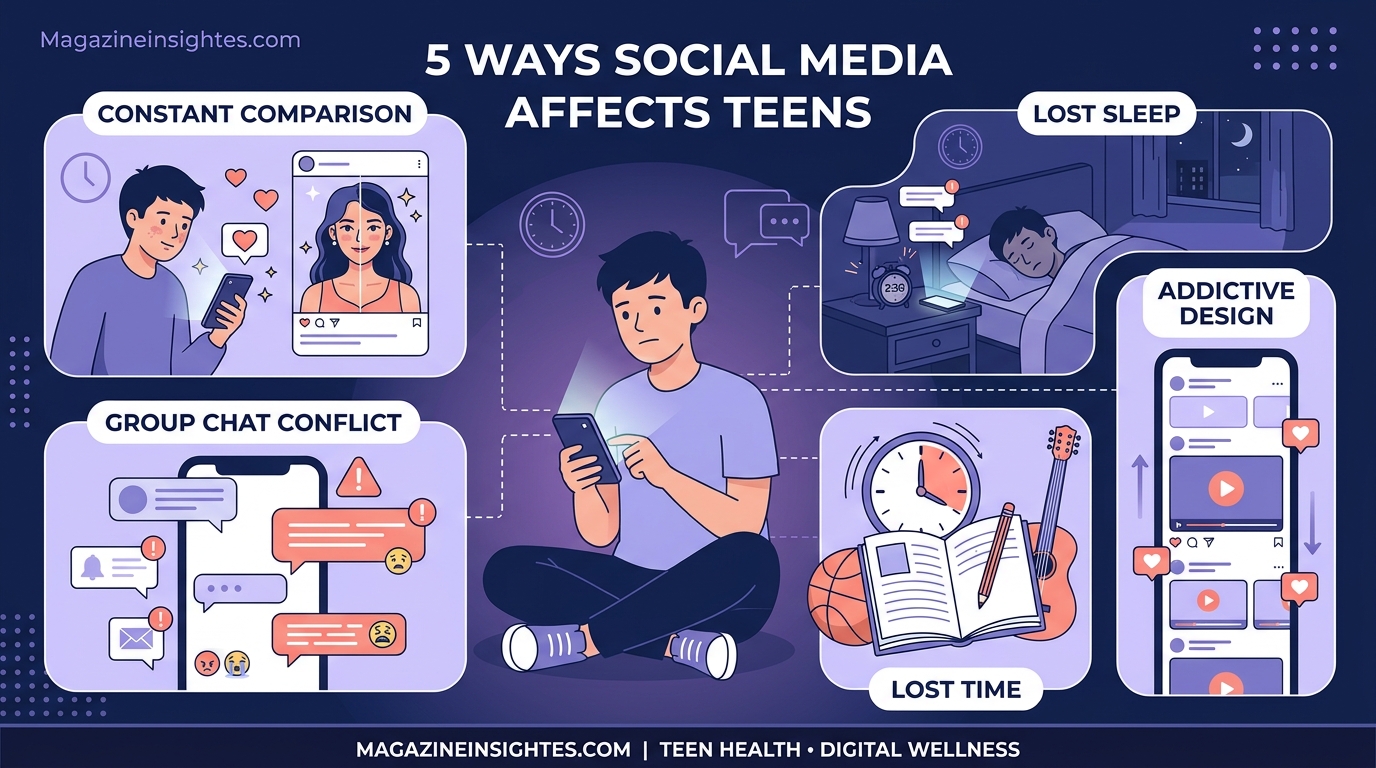
Researchers describe five mechanisms. Each one works differently, and each one has its own fix. Understanding them is more useful than arguing about screen time alone.
1. Constant Comparison
Teens compare their own looks, life, and skills against curated posts. The posts show highlight reels, not real life. Over time, the comparison wears down self-esteem.
A comparison spiral starts when a teen measures their life against other people’s best moments. Each round makes them feel worse. The loop feeds anxiety and low mood.
In a 2022 Pew Research Center survey, 46% of adolescents ages 13 to 17 said social media makes them feel worse about their bodies. Only 14% said it makes them feel better.
Filters make the problem worse. Beauty filters change faces in real time. A teen can compare their real face with a filtered face every day, and the real face always loses.
2. Lost Sleep
Late-night scrolling cuts into the 8 to 10 hours of sleep that teens need, according to the CDC. Short sleep makes anxiety, irritability, and low mood harder to manage the next day.
In the 2025 Pew survey, 45% of teens said social media hurts the amount of sleep they get. The same survey found 45% said they spend too much time on social media.
Researchers at the University of Iowa reviewed more than 80 studies. They found that 93% of teens report losing sleep by staying up past their bedtime to use social media.
Nighttime use is a major concern.
Teens often feel less accountable late at night. They may make riskier online decisions after midnight. Sleep loss and poor decisions feed each other.
3. Conflict in Group Chats
Group chats never close. A fight that starts at school continues at home, all evening, on a screen. There is no break, no cooling off, and no adult in the room.
Cyberbullying is the sharpest form of this harm. A cruel message can reach a teen at midnight, in their bedroom, with no escape. The audience is invisible and unlimited.
Online harassment is one of the pathways researchers found in the UK Millennium Cohort Study. Heavier social media use was linked to poor sleep, online harassment, low self-esteem, and poor body image.
Those in turn were linked to more depressive symptoms.
4. Addictive Design
Platforms are designed to maximize engagement, because more time online means more profit. Algorithms prioritize emotionally charged content, such as anger, fear, sadness, or excitement.
Design features like infinite scrolling, autoplay, and short-form video deliver a constant stream of content. A developing brain may struggle to tell what is authentic from what is manipulated.
Meta’s own research has shown that only about 7% of the content users see comes from people they actually know. The rest comes from the algorithm, chosen to keep them scrolling.
The algorithm rewards users with likes, comments, and shares. Each reward gives a small rush of motivation. Over time, the loop becomes hard to control, and use disrupts daily life.
5. Lost Time
Every hour on social media is an hour not spent elsewhere. Teens lose time for sleep, exercise, homework, hobbies, and face-to-face friendship. Researchers call this time displacement.
Offline experiences are essential for building self-esteem, self-efficacy, and long-term mental health. A teen who spends four hours a day scrolling has four fewer hours for those experiences.
A 2023 Gallup survey found that 51% of American teens spend a minimum of four hours daily on social media. That is a large share of a teen’s waking life.
| Mechanism | What happens | Who is most at risk |
|---|---|---|
| Constant comparison | Teen compares real life with curated posts, self-esteem falls | Teenage girls, teens with low self-esteem |
| Lost sleep | Late-night use cuts sleep, mood worsens next day | Teens who use phones in bed, night owls |
| Group chat conflict | Fights and bullying continue all evening, no break | Teens in large group chats, cyberbullying targets |
| Addictive design | Infinite scroll and algorithms keep teens online for hours | Younger teens, teens with poor impulse control |
| Lost time | Hours online replace sleep, exercise, hobbies, and friends | Heavy users, 4 or more hours a day |
The Risk Evidence: What the Strongest Studies Found
The evidence is real, and it is specific. The risk rises with hours of use, and it is larger for teenage girls.
The strongest studies are described here with their numbers, their years, and their limits.
The Three-Hour Line
The most cited study followed 6,595 American teens for three years. Kira Riehm and colleagues at Johns Hopkins published it in JAMA Psychiatry in 2019.
It found that teens using social media more than three hours a day were more likely to develop anxiety and depression symptoms later, even after accounting for their earlier mental health.
Compared with no use, 3 to 6 hours a day meant a 60% higher risk of internalizing problems. More than 6 hours meant a 78% higher risk. Internalizing problems include anxiety and low mood.
That three-hour line shows up again in the U.S. Surgeon General’s 2023 advisory on social media and youth mental health.
The advisory said teens using social media for more than three hours a day face double the risk of depression and anxiety symptoms.
The Surgeon General’s Advisory
In May 2023, U.S. Surgeon General Dr. Vivek Murthy issued a formal advisory called Social Media and Youth Mental Health. Advisories are reserved for urgent public health issues.
The advisory concluded that we cannot yet say social media is sufficiently safe for children and adolescents.
The advisory said social media presents a profound risk of harm to children and adolescents. It called for action from technology companies and policymakers. It did not declare social media uniformly harmful.
The advisory described a mixed evidence base. Some young people, including LGBTQ+ youth and those with marginalized identities, report genuine community and support online.
Heavy use and exposure to harmful content are associated with worse outcomes.
The Pew 2025 Survey
In a 2025 Pew Research Center survey of teens and parents, 48% of teens said social media has a mostly negative effect on people their age. That is up sharply from 32% in 2022.
Only 14% said it hurts them personally.
Girls were more likely than boys to say it had hurt their mental health, 25% versus 14%.
The share of teens who say social media makes them feel supported through tough times fell to 52% in 2024, down from 67% in 2022.
The same survey found 74% of teens feel more connected to friends through these apps.
The gap between what teens say about peers and what they say about themselves is one of the most striking findings in the research.
The UK Millennium Cohort Study
The UK Millennium Cohort Study followed 10,904 fourteen-year-olds. Heavier social media use was linked to poor sleep, online harassment, low self-esteem, and poor body image. Those factors were in turn linked to more depressive symptoms.
Girls took the bigger hit across the board.
Compared with 1 to 3 hours a day, using social media 5 or more hours went with a 50% jump in depressive symptom scores for girls and 35% for boys.
Sleep was one of the pathways to the mood effects. Poor sleep, online harassment, low self-esteem, and poor body image together explained much of the link between heavy use and depression.
The Long-Term Trend
Researcher Jean Twenge found that the rate of major depressive episodes among teens increased by 52% between 2005 and 2017. The data came from the National Survey on Drug Use and Health.
The rise coincided with the mass adoption of smartphones and social media.
Twenge also found that teens who use social media for more than 5 hours daily are twice as likely to report symptoms of depression, compared with those who use it for less than 1 hour.
The finding was published in the Journal of Abnormal Psychology.
Experts disagree about how much of the rise social media caused. The youth mental health crisis started in 2009, during the early days of smartphones.
Social media has certainly made it worse, but how much remains debated.
| Study or source | Year | Key finding |
|---|---|---|
| Riehm et al., JAMA Psychiatry, 6,595 US teens | 2019 | 3 to 6 hours a day, 60% higher risk of internalizing problems; 6+ hours, 78% higher |
| Surgeon General advisory | 2023 | Over 3 hours a day, about double the risk of depression and anxiety symptoms |
| Pew Research Center | 2025 | 48% of teens say mostly negative effect on peers, up from 32% in 2022 |
| UK Millennium Cohort, 10,904 fourteen-year-olds | 2019 | Girls 5+ hours, 50% jump in depressive scores; boys, 35% |
| Gallup | 2023 | 51% of US teens spend at least 4 hours a day on social media |
| Twenge, NSDUH data | 2005-2017 | Major depressive episodes among teens up 52% |
The Skeptic Counterpoint: What the Doubters Say
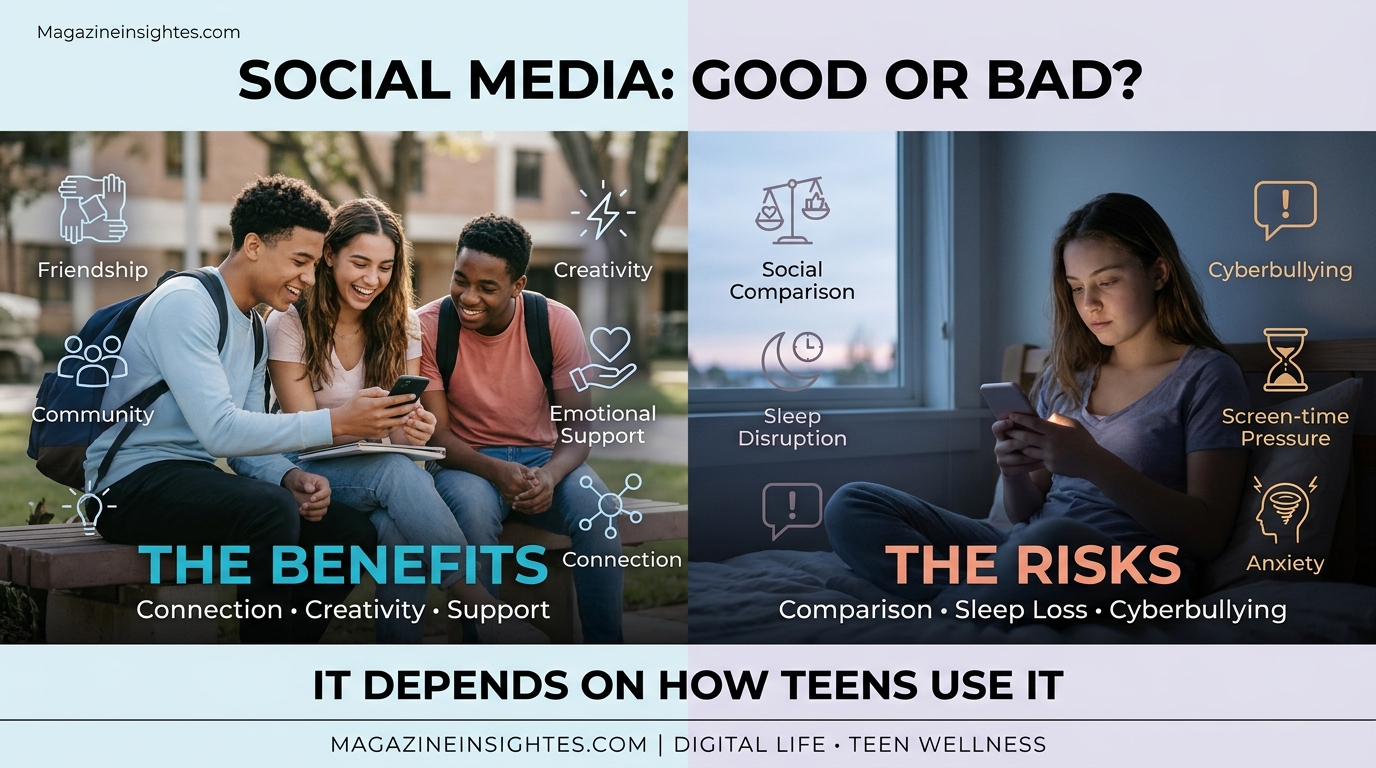
Not every researcher agrees that social media is the main cause of the teen mental health crisis. The counterpoint is strong, and an honest guide must present it.
The 0.4% Finding
Amy Orben and Andrew Przybylski analyzed data from 355,358 adolescents in 2019. They found that digital technology use explained at most 0.4% of the variation in well-being. The association was negative, but very small.
Their point is that average effects hide the real story. A small average effect can hide larger effects for some groups.
The Surgeon General’s advisory flagged exactly this gap: the evidence is observational, and averages can hide who is most at risk.
Candice Odgers made a similar argument in Nature in 2024. She asked whether social media is really behind an epidemic of teenage mental illness.
Her answer was that the evidence does not support a simple cause-and-effect story.
Correlation Is Not Causation
Most studies on this topic are observational. They show a link, not a cause. A teen who is already depressed may spend more time scrolling, because scrolling is a way to cope.
The scrolling may not have caused the depression.
A 2024 meta-analysis of reduction experiments found that the pooled effect of cutting back was not distinguishable from zero. A 2025 reanalysis split the studies by length.
Breaks shorter than a week made things slightly worse. Breaks of a week or more led to small but real improvements.
A 2024 meta-analysis of 53 studies with nearly 60,000 people found that social anxiety and problematic social media use are strongly linked. The study cannot say which causes which.
The honest summary is the one the Surgeon General reached. The evidence points to real risk, especially at high use and for certain young people.
It is not yet strong enough to prove that social media is the direct cause of the broader rise in youth distress.
What the Experiments Show
A randomized controlled trial at the University of Pennsylvania found that limiting social media use to 30 minutes per day led to significant reductions in loneliness and depression over three weeks.
The study was published in the Journal of Social and Clinical Psychology in 2018.
A 2023 study of 619 people found that using the phone one hour less a day improved anxiety and depression symptoms.
The gains were stronger and lasted longer over four months than a week of total abstinence.
These experiments suggest that cutting back helps, but the effects are modest. A detox is not a cure. It is one tool among many.
| Evidence for risk | Evidence for caution |
|---|---|
| Riehm 2019: 3+ hours a day, double the risk | Orben 2019: digital tech explains at most 0.4% of well-being |
| UK Millennium Cohort: heavy use linked to depression | Odgers 2024: no simple cause-and-effect story |
| Pew 2025: 48% say mostly negative effect on peers | 2024 meta-analysis: cutting back, pooled effect near zero |
| Twenge: depressive episodes up 52% from 2005 to 2017 | Most studies are observational, not experiments |
| UPenn RCT: 30 minutes a day reduced loneliness | 2025 reanalysis: short breaks made things slightly worse |
How Social Media Affects Teen Girls vs Boys
Girls and boys use social media differently, and the effects differ too. The research is clearest on this point: girls carry the larger risk.
Girls are more likely to compare their appearance with others. They are more likely to seek feedback on their looks. They are more likely to be targeted by appearance-based bullying.
In the 2025 Pew survey, 25% of girls said social media had hurt their mental health, compared with 14% of boys.
In the UK Millennium Cohort, girls using social media 5 or more hours a day had a 50% jump in depressive symptom scores, compared with 35% for boys.
Boys face different risks. Boys are more likely to be drawn into gaming, gambling-like features, and conflict in group chats.
Boys are also less likely to talk about how social media makes them feel, which makes the harm harder to see.
A review of 50 studies across 17 countries between 2016 and 2021 was published in PLOS Global Public Health.
It suggested that relentless online exposure to largely unattainable physical ideals may trigger a distorted sense of self and eating disorders.
The risk is highest for girls.
The Royal Society for Public Health ranked Instagram as the most harmful platform for young people’s mental health, particularly around body image, sleep, FOMO, and bullying.
Instagram is also the platform girls use most for appearance comparison.
Platform by Platform: Which Apps Carry the Most Risk
Not all platforms work the same way. The design of each app shapes the risk. This table compares the major platforms teens use.
| Platform | Main risk | Why |
|---|---|---|
| Body image, comparison | Photo-based, beauty filters, appearance feedback | |
| TikTok | Addictive design, time loss | Short-form video, autoplay, For You Page algorithm |
| Snapchat | Conflict, pressure, streaks | Disappearing messages, streaks, constant contact |
| YouTube | Time loss, rabbit holes | Autoplay, recommendations, long sessions |
| Lower use among teens | Teens use it less, but family conflict can spill over | |
| Discord and Reddit | Harassment, extreme content | Anonymous communities, weak moderation in some groups |
In 2023, Pew found that 9 out of 10 teens ages 13 to 17 use YouTube, followed by TikTok, Snapchat, and Instagram.
YouTube is the most used platform, but Instagram carries the highest body image risk.
The platform matters less than the habit. A teen who uses Instagram actively to message friends faces less risk than a teen who scrolls passively for hours. Active use and passive use are very different.
Active Use vs Passive Use
Active use means messaging friends, posting your own content, and joining conversations. Passive use means scrolling, watching, and comparing without interacting. The research links passive use with worse outcomes.
A teen who messages a friend about homework is using social media actively. A teen who scrolls through strangers’ photos for two hours is using it passively.
The same app can help or harm, depending on how it is used.
Parents should ask what their teen does on the app, not just how long they use it. The answer tells you more than the screen time number.
The Benefits: What Social Media Gives Teens
Social media is not all harm. Most teens say it helps them, and the research backs them up on several points. A fair guide must name the benefits.
In a 2022 Pew survey, a majority of teens said social media helps them feel more accepted (58%).
They also said it gives them people who can support them through tough times (67%).
It gives them a place to show their creative side (71%) and a stronger connection to what is going on in their friends’ lives (80%).
LGBTQ+ youth and young people with marginalized identities often find community online that they cannot find at school. For some, the internet is the only place where they feel accepted.
That benefit is real and should not be dismissed.
Social media also helps teens learn, create, and organize. Teens use it to study, to share art and music, to follow news, and to join causes.
A teen who makes videos or writes posts is building skills, not just scrolling.
The benefits do not cancel the risks. They explain why a ban is not the answer for most families. The goal is to keep the benefits and reduce the harms.
| Benefit | Evidence |
|---|---|
| Feeling connected to friends | 74% of teens, Pew 2025 |
| Feeling accepted | 58% of teens, Pew 2022 |
| Support through tough times | 67% of teens, Pew 2022 |
| A place to show creativity | 71% of teens, Pew 2022 |
| Community for LGBTQ+ youth | Surgeon General advisory, 2023 |
What Parents Can Do: A 7-Step Action Plan
Parents ask for practical steps, not lectures. This plan works tonight, this week, and this month. It is based on the American Psychological Association’s 2023 health advisory, which gave ten recommendations for parents.
- Talk before you ban. Ask your teen what they enjoy online and what bothers them. Listen first. A teen who feels heard is more likely to accept limits.
- Set a phone-free bedroom. Charge phones outside the bedroom at night. This one change protects sleep, which protects mood. The CDC says teens need 8 to 10 hours of sleep.
- Agree on a daily limit together. The three-hour line from the research is a useful guide. A teen who uses social media more than three hours a day faces about double the risk. Set the limit with your teen, not for them.
- Watch for the warning signs. Look for falling grades, lost sleep, withdrawal from friends, irritability, and talk about body image. These are signs to take seriously, not to punish.
- Model the behavior you want. Put your own phone away at dinner. Do not scroll in bed. Teens copy what they see, not what they are told.
- Use parental controls in early adolescence. The APA recommends parental monitoring in early adolescence. Use the controls built into the phone, not a spy app. Tell your teen what you are doing and why.
- Know when to get help. If your teen talks about self-harm, shows sudden changes in mood, or stops eating, call your pediatrician or a mental health professional. If there is immediate danger, call or text 988.
What Teens Can Do: A Self-Check
Teens can protect their own mental health. This self-check takes two minutes. If you answer yes to three or more, it is time to change something.
- Do you check social media first thing in the morning and last thing at night?
- Do you feel worse about yourself after scrolling?
- Do you lose sleep because you stayed up on your phone?
- Do you feel anxious when you cannot check your phone?
- Do you compare your body or your life with people you see online?
- Do you feel left out when you see friends posting without you?
- Do you spend more than three hours a day on social media?
- Do you find it hard to stop scrolling, even when you want to?
If you answered yes to several, try one change this week. Charge your phone outside your bedroom. Unfollow accounts that make you feel bad. Set a timer for one hour.
Tell a friend how you feel. Small changes work better than a total ban.
The Family Media Plan
A family media plan is a written agreement about screens. It works better than rules imposed without discussion. Write it together, and review it every month.
| Rule | Detail |
|---|---|
| Phone-free bedroom | Phones charge outside the bedroom, every night |
| No phones at meals | Meals are screen-free for everyone, including parents |
| Daily limit | Agree on a limit together, such as 2 hours on weekdays |
| Active use first | Messaging friends counts more than passive scrolling |
| Unfollow freely | Anyone can unfollow an account that makes them feel bad |
| Talk about it | Weekly check-in: what was good online, what was hard |
| Breaks are allowed | A week off is fine, and it works better than a day off |
The American Psychological Association recommends protecting sleep and physical activity. A family media plan that protects both will do more than any app.
The Policy Picture: Warning Labels, Bans, and Lawsuits
Governments and courts are now involved. The policy picture changed fast in 2024, 2025, and 2026. These are the developments that matter most.
The Warning Label Call
In June 2024, Surgeon General Vivek Murthy called for a warning label on social media platforms. He compared the platforms to tobacco and alcohol. A warning label would require an act of Congress to implement.
No federal warning label exists yet. The call matters because it shows how seriously public health leaders take the risk. It also shows that the debate has moved from research to policy.
The Australia Ban
Australia banned social media for children under 16 in late 2024. It was the first national ban of its kind. Other countries are watching the results closely.
The ban raises hard questions. Age verification is difficult to enforce. Teens can lie about their age. A ban may push teens to less regulated platforms. The results will take years to measure.
The Meta Settlement
In August 2026, Meta agreed to pay up to $17 billion over the next decade to settle a lawsuit. Attorneys general in 47 states, the District of Columbia, and U.S. territories brought the case.
They alleged that Facebook and Instagram were designed to be addictive to children, and that Meta knew about and concealed the risks to teens’ mental health.
This figure is reported by Yale Medicine. A settlement is not a finding of wrongdoing. Re-verify the settlement details before republishing, because the terms may change.
Age Guidance
The American Psychological Association recommends against social media use for children under 13. It recommends supervised use for 13 to 15 year olds.
The Surgeon General has called for a minimum age of 16 with strict enforcement.
Most platforms set their minimum age at 13. Enforcement is weak. Parents, not platforms, are the real gatekeepers for now.
| Event | Date | What happened |
|---|---|---|
| Surgeon General advisory | May 2023 | Social media presents a profound risk of harm to youth |
| APA health advisory | May 2023 | Ten recommendations, including parental monitoring |
| Warning label call | June 2024 | Murthy asked Congress to require a warning label |
| Australia ban under 16 | Late 2024 | First national social media ban for under-16s |
| Meta settlement | August 2026 | Up to $17 billion over a decade, per Yale Medicine |
Where to Get Help
If you are worried about a young person, do not wait. Help is free, confidential, and available now.
| Resource | How to reach it |
|---|---|
| 988 Suicide and Crisis Lifeline | Call or text 988, 24 hours a day, free, confidential |
| Crisis Text Line | Text HOME to 741741, free, 24 hours a day |
| Your pediatrician | Call your child’s doctor and describe the change |
| School counselor | Ask the school for a meeting with the counselor |
| National Alliance on Mental Illness | Call the NAMI HelpLine, 1-800-950-6264 |
If a teen talks about self-harm, take it seriously. Stay with them. Call 988 or go to the nearest emergency department. Do not leave them alone.
Keep Reading the Health Cluster
Teen mental health connects with the rest of your family’s health. The health cluster on this site covers the basics.
Do you need health insurance? explains the law, the six states that still fine you, and what coverage costs in 2026.
What is health science major? explains the degree that leads to careers in health care, including mental health.
Why is Signify Health calling me? explains the free in-home health evaluations that Medicare Advantage plans offer. Healthy morning habits covers 10 habits that improve your daily routine, including sleep and phone-free mornings.
Benefits of walking 30 minutes a day lists 10 benefits of a daily walk, including better mood and better sleep. Home workout for beginners gives you a 15-minute workout with no equipment.
Healthy meal plan for beginners gives you a 7-day guide to eating well at home.
For official information, Yale Medicine’s parent’s guide explains the Surgeon General’s advisory and the Meta settlement. The University of Iowa’s Q and A with Jonathan Platt summarizes more than 80 studies.
Pew Research Center publishes the teen surveys quoted in this guide. The 988 Suicide and Crisis Lifeline is free, confidential, and open 24 hours a day.
Crisis Text Line lets you text HOME to 741741 for free, 24-hour support.
The Surgeon General’s advisory, the American Psychological Association’s health advisory, and the CDC’s sleep guidance are named in plain text in this guide.
Dartmouth Health’s guide to social media and teen mental health is also a strong source. Re-check all of them at publication, because guidance changes.
FAQs About Social Media and Teen Mental Health
How does social media affect teens mental health?
Social media affects teens through five habits: constant comparison, lost sleep, conflict in group chats, addictive design, and lost time.
The effect depends on how much a teen uses it, what they do on it, and who they are.
Is social media bad for teens?
It is not all bad. Social media helps teens feel connected, accepted, and creative. It also carries real risks, especially at high use. The answer depends on the habit, not the app.
Does social media cause depression in teens?
The research shows a link, not a proven cause. Teens using social media more than three hours a day face about double the risk of depression and anxiety symptoms.
Most studies are observational, so they cannot prove causation.
Does social media cause anxiety in teens?
Heavy use is linked with higher anxiety, especially through comparison, conflict, and lost sleep. A teen who is already anxious may also spend more time scrolling. The direction of the link is not settled.
How much social media is too much for teens?
The three-hour line from the research is a useful guide. Teens using social media more than three hours a day face about double the risk of poor mental health outcomes.
The average teen spends 3.5 hours a day.
What age should teens use social media?
The American Psychological Association recommends against use under 13, and supervised use for 13 to 15 year olds. The Surgeon General has called for a minimum age of 16.
Most platforms set their minimum at 13.
How does social media affect teen girls?
Girls carry the larger risk. They compare their appearance more, seek more feedback on looks, and face more appearance-based bullying.
In Pew 2025, 25% of girls said social media hurt their mental health, versus 14% of boys.
How does social media affect teen boys?
Boys face different risks, including gaming, conflict in group chats, and gambling-like features. Boys are also less likely to talk about how social media makes them feel, which makes the harm harder to see.
How does social media affect teen sleep?
Late-night scrolling cuts into the 8 to 10 hours teens need. In Pew 2025, 45% of teens said social media hurts their sleep.
Researchers found 93% of teens lose sleep by staying up past bedtime to use it.
How does social media affect teen body image?
In a 2022 Pew survey, 46% of teens ages 13 to 17 said social media makes them feel worse about their bodies. Beauty filters, curated photos, and appearance feedback all contribute.
Girls face the highest risk.
How does social media affect teen self-esteem?
Constant comparison wears down self-esteem over time. A teen who measures their real life against curated posts will feel worse each round. Active use, such as messaging friends, is less harmful than passive scrolling.
How does social media affect teen loneliness?
It cuts both ways. Social media can connect a teen with friends and community, and 74% of teens say it makes them feel more connected.
Heavy passive use can also increase loneliness, by replacing face-to-face time.
How does social media affect teen attention?
Short-form video, autoplay, and infinite scroll train the brain to expect constant novelty. Teens may find it harder to focus on homework, reading, or long conversations. The effect is larger for heavy users.
How does social media affect teen grades?
Heavy use is linked with lower grades, mostly through lost sleep and lost study time. A teen who spends four hours a day scrolling has less time for homework.
The link is through time displacement, not the app itself.
What is social media addiction in teens?
Social media addiction means use that is hard to control and disrupts daily life. Signs include anxiety when the phone is away, lost sleep, falling grades, and withdrawal from friends.
It is a pattern of use, not a formal diagnosis.
What are the signs of social media addiction in teens?
Look for checking first thing in the morning, feeling worse after scrolling, losing sleep, anxiety without the phone, comparing body or life with online posts, and finding it hard to stop.
Three or more signs mean it is time to change something.
How can parents protect teens on social media?
Talk first, then set limits together. Use a phone-free bedroom, agree on a daily limit, model the behavior you want, and use parental controls in early adolescence.
Know the warning signs and when to get help.
How can parents limit teen screen time?
Agree on a limit together, such as 2 hours on weekdays. Use the screen time controls built into the phone. Charge phones outside the bedroom. Set phone-free meals. Review the plan every month.
How can teens use social media safely?
Use it actively, not passively. Message friends instead of scrolling strangers’ photos. Unfollow accounts that make you feel bad. Keep your phone out of your bedroom. Tell a trusted adult if someone harasses you.
What is a digital detox for teens?
A digital detox is a break from social media. Research suggests breaks of a week or more help, while breaks shorter than a week can make things slightly worse.
A detox works best as part of a longer change, not a one-day stunt.
Should I ban social media for my teen?
A ban is rarely the best answer. Teens need connection, and a ban can push them to secret accounts. Set limits, protect sleep, and talk about what they see online.
A ban makes sense only when the harm is severe and other steps have failed.
Should I take my teen’s phone away?
Taking the phone away can help in a crisis, but it is not a long-term plan. It can damage trust and cut off support.
Use it as a short-term step, and work with your teen on a plan to earn it back.
How do I talk to my teen about social media?
Ask what they enjoy online and what bothers them. Listen first, without judging. Share what you have learned, not what you fear. Ask them to show you their favorite accounts.
A teen who feels heard will talk again.
What is cyberbullying?
Cyberbullying is repeated harassment online, through messages, posts, or images. It can happen at any hour, in any place, with an invisible audience.
Tell a trusted adult, save the evidence, block the bully, and report it to the platform and the school.
Where can a teen get help for mental health?
Call or text 988 for the Suicide and Crisis Lifeline, free and confidential, 24 hours a day. Text HOME to 741741 for the Crisis Text Line.
Talk to a school counselor, a pediatrician, or a mental health professional. You are not alone.
Conclusion
How does social media affect teens mental health has no simple answer, and that is the honest truth. Social media affects teens through specific habits, not through the phone itself.
Comparison, lost sleep, conflict, addictive design, and lost time are the five mechanisms that matter most.
The research points to real risk, especially above three hours a day and for teenage girls. It also points to real benefits, especially connection and community.
The skeptics are right that the average effect is small and that causation is not proven. Both sides deserve a hearing.
What you do tonight matters more than what you believe about the debate. Charge phones outside the bedroom. Agree on a daily limit with your teen. Talk about what they see online.
Watch for the warning signs.
If you are worried about a young person, do not wait. Call or text 988, or text HOME to 741741. Help is free, confidential, and available now.