What Is Health Science Major? The Complete 2026 Guide
Last updated: November 7, 2026, 18:00 PKT. Facts checked November 7, 2026. Salary figures are labelled by source and date. This article is general information only.
Verify degree requirements on the university catalog before you apply. Salaries change every year, and requirements vary by school.
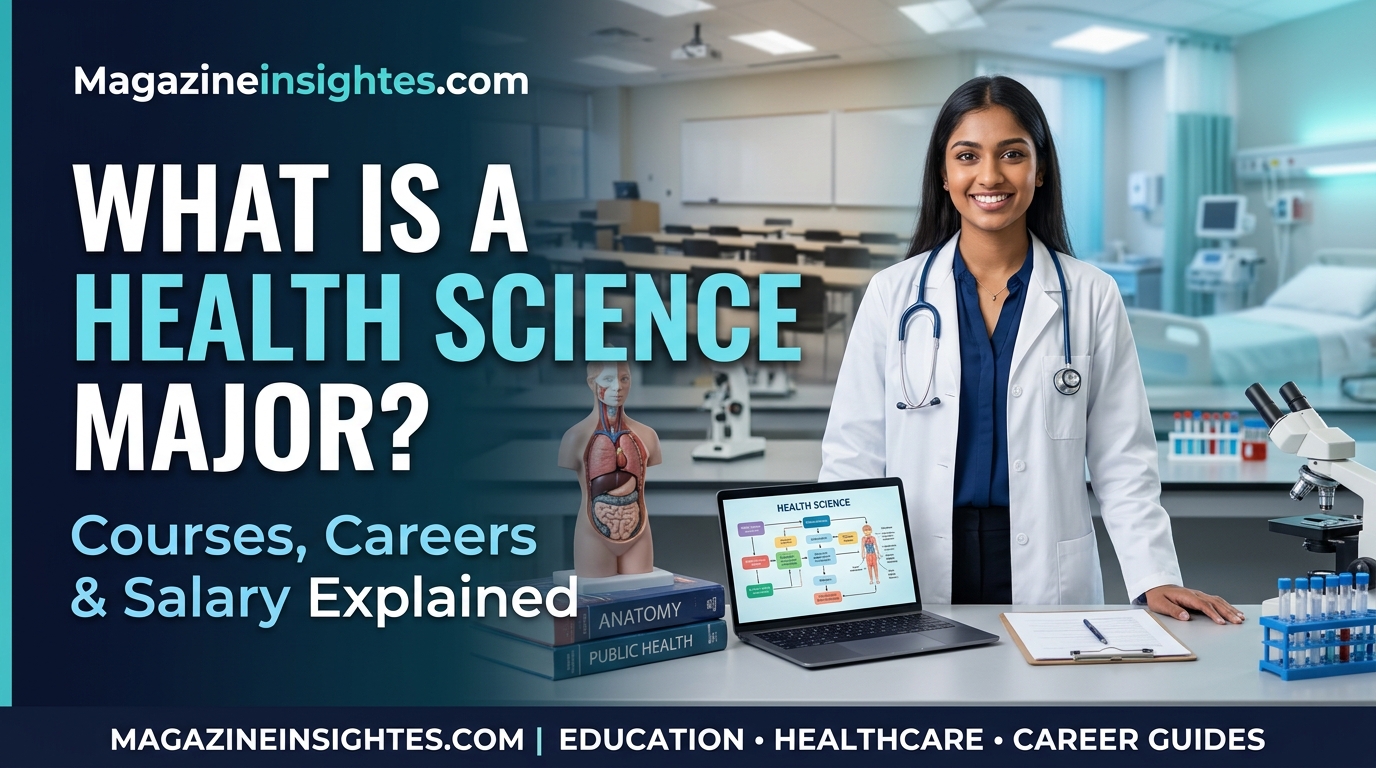
A health science major is an interdisciplinary bachelor’s degree that studies human health from every angle. Biology, chemistry, anatomy, and physiology meet public health, healthcare systems, epidemiology, psychology, nutrition, and health policy in one program.
The degree prepares you for clinical work, for public health, for administration, for research, and for graduate school.
The degree is broad on purpose. Health science is not biology, not public health, and not nursing. Biology goes deeper into lab science. Public health works at the population level.
Nursing trains you for one clinical role. Health science gives you the science and the systems, so you can choose your path after graduation.
This guide explains the major in full.
It defines health science and shows the curriculum year by year.
It compares the major with biology, public health, and nursing, explains the pre-med path, lists the jobs and salaries, and shows how to choose a program.
It ends with 25 FAQs.
What Is Health Science Major? The Short Answer
Health science is an interdisciplinary degree program that introduces the student to the broad health care field. Kristin Ann Paloncy-Patel, assistant professor of health science at North Central College, defined it that way.
The program is intended for students wishing to pursue careers in healthcare, including those that want to be clinical and those that want to be involved in healthcare but not necessarily treat patients.
The study of health science covers a broad spectrum of ideas and subdivisions both within medicine and adjacent to medical care.
A degree in health science could include studying how hospitals, clinics, laboratories, and health insurance companies operate as businesses.
Health science students can also get into very specific areas.
These include communicable diseases, different kinds of disorders, and ongoing care in speech pathology, occupational therapy, prosthetics and orthotics, or nutrition.
The major is tremendously versatile.
A health science major is broad enough and does not require specializations.
That lets a student enjoy the subjects they are learning and still earn a degree that can lead to many options for jobs within health care.
The versatility is the point. The breadth is the feature, not the flaw.
What Do Health Science Majors Study?
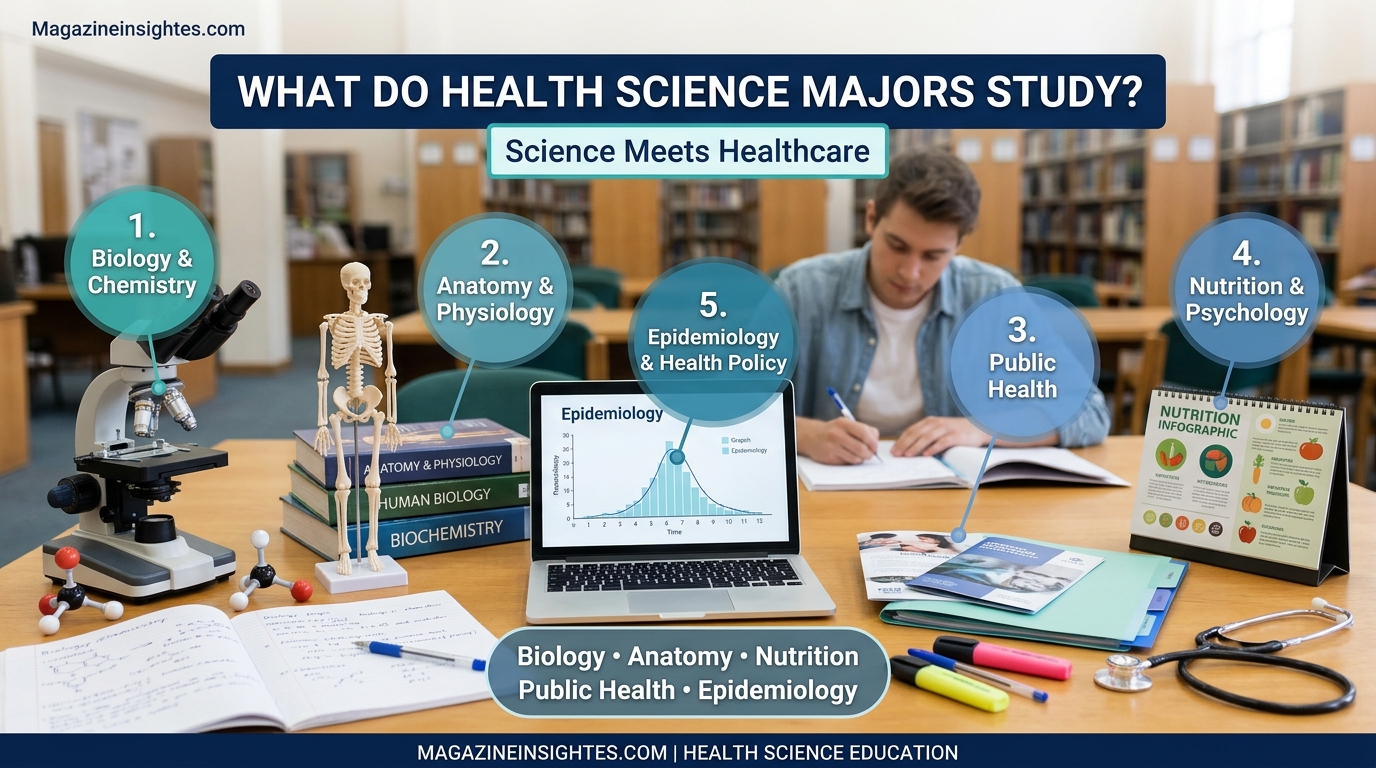
The curriculum has two halves. The first half is science: general biology, general chemistry, anatomy and physiology, microbiology, biochemistry, and organic chemistry.
The second half is health: public health, epidemiology, biostatistics, health policy, healthcare systems, health behavior, nutrition, kinesiology, pharmacology, and healthcare ethics.
Programs usually require coursework in health-related social science fields such as epidemiology, sociology, and psychology.
Health science degrees also typically include coursework in nutrition and exercise science, and they frequently call for many public health classes.
The social sciences are not electives. They are core, because health is social, not just biological.
Students also learn how care is delivered. Courses cover the United States healthcare system and beyond, expanding knowledge of evidence-based healthcare, health policy and administration, and quality-of-care improvement. The system is the subject.
The science is the foundation. The two together are the major.
Health Science Major Curriculum
The curriculum is structured in four years, with a clear progression. The first two years build the science foundation. The second two years apply it to health.
The table below shows the shape, based on Boston University, the University of New Hampshire, and Northeastern University. Exact courses vary by school, so check the catalog.
| Year | What you study | Example courses |
|---|---|---|
| Year 1 | Core sciences and general education | General biology, general chemistry, mathematics, English, humanities |
| Year 2 | Human body and health foundations | Anatomy and physiology, microbiology, nutrition, medical terminology, psychology |
| Year 3 | Public health and healthcare systems | Epidemiology, biostatistics, public health, healthcare systems, health policy, research methods |
| Year 4 | Specialization, practicum, and capstone | Concentration courses, practicum or internship, senior seminar, senior thesis, exit exam |
Boston University runs the pattern clearly. The Health Science major is a Bachelor of Science program.
During the first two years, the curriculum integrates core courses in the biological sciences, humanities, and social sciences, included in the BU Hub requirements, with a strong foundation in global health and the health sciences.
The second two years feature specialized coursework applying health sciences to the challenges of global public health.
Students get training in both qualitative and quantitative methods, plus focused study of a chosen area in global health through the senior seminar.
The program culminates in a practicum wherein students gain hands-on experience in public health or clinical healthcare at an affiliated site, either in the Boston area or while studying abroad.
A minimum of 128 credits is required for graduation.
Northeastern adds co-ops. The Bouvé College of Health Sciences runs a 4-year program with 1 or 2 co-ops.
A co-op is a paid, full-time work placement in a hospital, a clinic, a research lab, or a public health agency. The co-op is the experience. The classroom is the theory.
The two together are the degree.
Truman State adds accountability. The Health Science program focuses on accountability.
The health science graduate demonstrates a high level of health knowledge.
Their skills follow the seven Areas of Responsibility of a Certified Health Education Specialist (CHES), as assessed by a senior exit examination.
The program is approved by the Society for Public Health Education and the American Association of Health Education Baccalaureate Program Approval Committee.
The major requires a Public Health Practicum or internship in which students gain important practical experience directly related to their career interests.
Health Science Major Concentrations
Most programs let you specialize in year three or four. Indiana University Kokomo offers a Bachelor of Science in Health Sciences with three concentrations: Health Promotion, Exercise and Sport Science, and Nutritional Science.
Truman State requires one career concentration ranging from 22 to 26 credits. The concentration is the focus. The major is the foundation.
| Concentration | What it covers | Leads to |
|---|---|---|
| Health Promotion | Helping people, organizations, and communities change lifestyle behaviors toward improved health | Health educator, community health worker, wellness coordinator |
| Exercise and Sport Science | Movement, fitness, injury prevention, athletic performance | Athletic trainer, exercise physiologist, fitness director |
| Nutritional Science | Food, diet, metabolism, community nutrition | Dietitian (with graduate work), nutrition educator, wellness coach |
| Community Health Education | Protecting and promoting the health of the public | CHES certification, public health educator |
| Pre-Medicine | Organic chemistry, biochemistry, and MCAT preparation | Medical school, PA school, pharmacy school |
| Health Administration | Managing hospitals, clinics, and health systems | Healthcare administrator, health services manager |
Health Education and Promotion is the science of helping people, organizations, and communities change lifestyle behaviors to move toward a state of improved health, resulting in decreases in chronic disease and health care costs.
Nutritional Science is an important component of a well-rounded Health Sciences undergraduate degree.
The two sentences are the concentration in one line each.
Health Science vs Biology vs Public Health vs Nursing
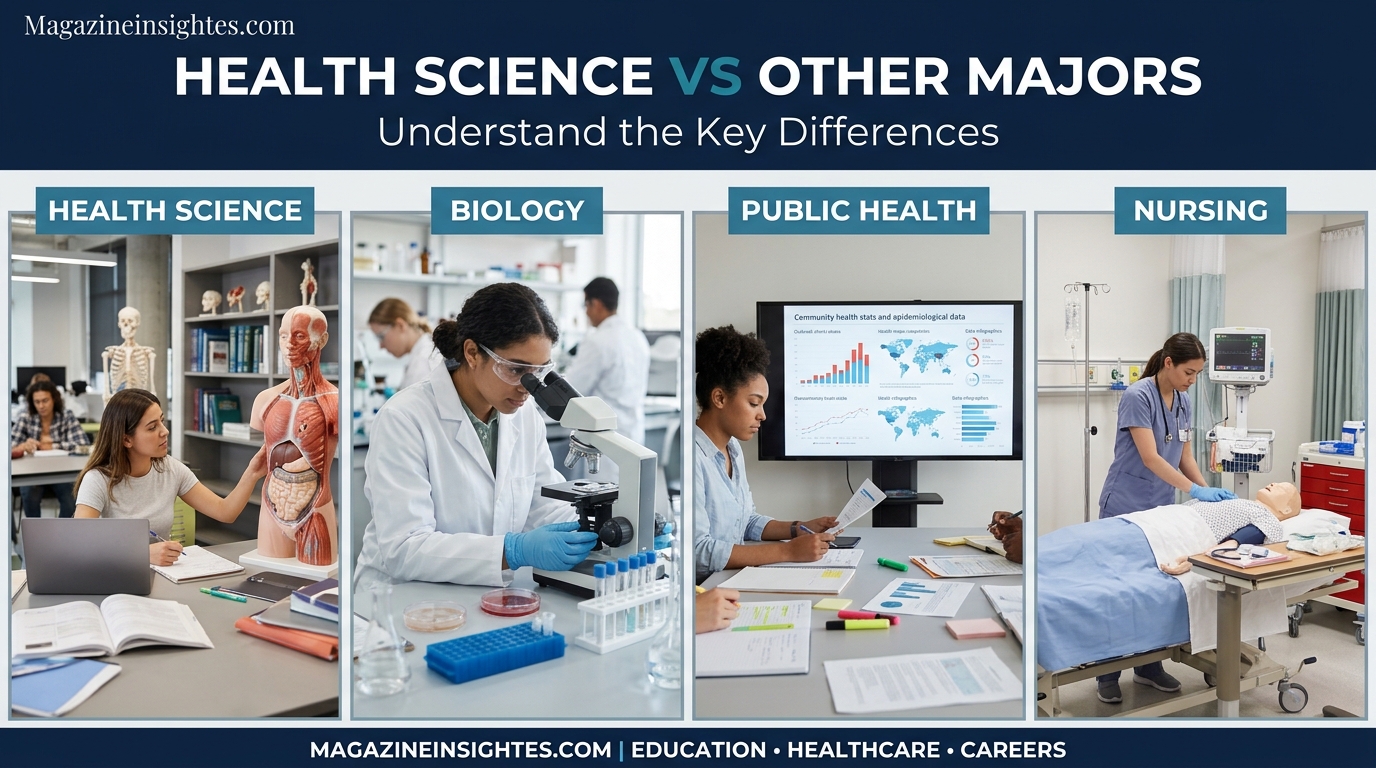
The four majors look alike from the outside, and they are different on the inside. The table below is the comparison no competitor page has in one place.
| Health Science | Biology | Public Health | Nursing | |
|---|---|---|---|---|
| Focus | Human health, applied | Living organisms, lab science | Population health, prevention | Patient care, clinical |
| Core courses | Biology, chemistry, anatomy, public health, health policy, epidemiology | Molecular biology, genetics, advanced chemistry, microbiology | Epidemiology, biostatistics, health policy, environmental health | Nursing fundamentals, pharmacology, clinical rotations |
| Clinical experience | Practicum, internship, co-op | Lab work, research | Fieldwork, community projects | Clinical rotations, required |
| Career range | Widest: clinical, non-clinical, admin, research, public health | Research, medicine, lab science | Population health, policy, epidemiology | One role: registered nurse, then specialties |
| Best for | Undecided, wants options | Loves lab science | Wants population impact | Wants to treat patients now |
Both health science and biology build a strong scientific foundation. Gordon College wrote that sentence. The difference is scope.
A biology degree focuses primarily on lab sciences, while health science layers in coursework around healthcare delivery, patient care, and how medicine operates in real-world settings.
Biology goes deeper into lab-based sciences like molecular biology, genetics, and advanced chemistry. Health science balances those foundations with coursework in public health, healthcare systems, and clinical practice.
Public health is population-level prevention. The goal of allied health professionals is to collaborate with physicians and other members of the health care team to deliver high-quality patient care services.
The focus of public health intervention is to prevent rather than treat a disease through surveillance of cases and the promotion of healthy behaviors. Health science includes public health, but it is wider.
Public health is the population half. Health science is the whole.
Nursing is narrower and tougher.
The health sciences give students a more general overview of the health profession.
Nursing is more focused on the nursing occupation.
Some say nursing courses are tougher because they are more specialized and delve more deeply into specific issues.
Nursing trains you for one role. Health science trains you for many.
Is Health Science Good for Pre-Med?
Yes, with the right concentration. A health science degree can cover pre-med prerequisites, prepare students for the Medical College Admission Test (MCAT), and open doors to careers across healthcare.
The degree shares a strong science foundation with biology but adds coursework in public health, clinical practice, and healthcare systems.
In the United States, most universities do not offer a specific pre-med major.
Instead, many students major in a related field, such as health science, biology, or chemistry, and take a pre-med track that prepares them for medical school with relevant courses.
A health science major often strongly overlaps with approved pre-med track courses, making it a potentially helpful major for those hoping to enter medical school.
Health science programs typically require general biology, general chemistry, and anatomy and physiology. These courses overlap directly with medical school prerequisites.
Health science programs that offer a pre-med concentration often build organic chemistry and biochemistry into the required coursework, keeping students on track for the exam alongside their core health science classes.
Neither major is inherently better for getting into medical school.
Medical schools accept students from many different academic backgrounds and weigh admissions factors like GPA, MCAT performance, clinical experience, and personal statement more heavily than the degree on the diploma.
Biology is the most commonly chosen pre-med major because its coursework overlaps heavily with medical school prerequisites and MCAT content.
Health science covers much of the same foundational science but approaches the field from a wider angle.
The wider angle is the insurance policy. A biology degree is closely tied to research and medical pathways.
A health science degree connects to a broader set of healthcare careers, which can matter if plans shift after graduation.
If you do not get into medical school, a health science degree still leads to jobs. A biology degree, without graduate school, leads to fewer.
Boston University makes the pre-med path explicit. The Health Science major is an excellent option for students who wish to pursue the accelerated BS/MPH (4+1) program.
It also covers prerequisite course requirements for graduate programs in medicine, nursing, physician assistant training, or physical therapy.
The BS/MPH is a five-year Bachelor of Science and Master of Public Health, offered with the Boston University School of Public Health.
Health Science Major Skills: What You Actually Learn

The degree teaches skills, not just facts. Employers and graduate schools care about what you can do.
Health science graduates leave with five skill groups that show up in every job posting and every graduate application.
Skill 1: Scientific literacy. You learn to read a study, to spot a weak method, and to explain a finding in plain language. Biology, chemistry, and biostatistics build the literacy. Research methods build the judgment.
The literacy is the foundation.
Skill 2: Data and research methods. You learn qualitative and quantitative methods, the two ways researchers study health. Quantitative methods count things. Qualitative methods explain why people do things. Boston University trains students in both.
The two together are the research toolkit.
Skill 3: Communication. You learn to explain health to patients, to communities, and to policymakers. Health education is communication. Health promotion is communication. A health science graduate who cannot explain a finding cannot use it.
Skill 4: Systems thinking. You learn how hospitals, clinics, laboratories, and health insurance companies operate as businesses. You learn how policy shapes care.
You learn how a change in one part of the system changes the rest. The system is the subject.
Skill 5: Cultural competence. The University of New Hampshire teaches culturally responsive healthcare. The skill is practical. Patients come from different cultures, speak different languages, and hold different beliefs about health.
A health professional who cannot cross that gap cannot do the job.
Health Science Major: What to Expect in Your First Year
Your first year is science and general education. General biology and general chemistry take most of your time. Mathematics and English fill the rest. The year is the foundation. The foundation is the gate.
Expect labs. Biology and chemistry both have labs, and labs take time. A three-credit lecture can mean three hours of lab a week. Plan your schedule around the labs, not the lectures.
Expect writing. Health science is not only science. Humanities and social sciences are part of the first two years at Boston University. You will write essays, read case studies, and discuss ethics.
The writing is the communication skill.
Expect to choose early. If you want pre-med, choose the pre-medicine concentration in year one, not year three. Organic chemistry and biochemistry take time, and the MCAT takes preparation. The plan is the path.
Start the path early.
Real Graduate Paths: Four Stories
Path 1: The BS/MPH graduate. A Boston University student finishes the BS in Health Science, then the Master of Public Health in one extra year through the 4+1 program.
She works for a state health department, tracking disease outbreaks and running vaccination campaigns. The 4+1 saved her a year and a tuition bill.
Path 2: The co-op graduate. A Northeastern student completes two co-ops, one in a hospital and one in a research lab. The hospital hires her after graduation as a clinical research coordinator.
The co-op was the interview. The interview was the job.
Path 3: The CHES graduate. A Truman State student passes the senior exit exam and earns the Certified Health Education Specialist credential.
He works as a health educator for a county health department, running community programs on nutrition and chronic disease prevention. The credential was the differentiator.
Path 4: The pre-med graduate. A Gordon College student completes the Pre-Medicine concentration, takes the MCAT, and enters medical school.
If medical school had not worked out, the degree still led to jobs in public health and administration. The breadth was the insurance policy.
Health Science Major Jobs and Careers
Health science careers span five major pathways. CareerOneStop, a U.S. Department of Labor-sponsored resource, identifies five major career clusters within health science: diagnostic services, therapeutic services, health informatics, support services, and biotechnology research and development.
The five clusters are the map. Every job fits in one.
| Cluster | What it is | Example jobs |
|---|---|---|
| Diagnostic services | Finding out what is wrong | Radiologic technologist, clinical laboratory technologist, diagnostic medical sonographer |
| Therapeutic services | Treating patients directly | Physical therapist, occupational therapist, speech-language pathologist, respiratory therapist |
| Health informatics | Managing health data and systems | Health information technician, medical records technician, health data analyst |
| Support services | Keeping care running | Health educator, community health worker, healthcare administrator |
| Biotech research and development | Discovering new treatments | Clinical research coordinator, laboratory scientist, research assistant |
Graduates work in hospitals, government health departments, NGOs, research institutions, and corporate wellness programs.
Students in this major are eligible for employment in the field of health and human services, including public health, governmental and community agencies, the insurance industry, hospitals, or the pharmaceutical industry.
The field is the single largest industry in the country, accounting for more than 14 million jobs, according to Indiana University Kokomo.
The degree level decides the job. An associate’s degree opens the door to entry-level roles in clinical support and diagnostic services.
A bachelor’s degree gives you access to clinical coordination, public health, health administration, and research assistant roles. The most specialized clinical and research roles require a master’s degree, doctoral degree, or professional degree.
This includes physician assistants, nurse practitioners, audiologists, speech-language pathologists, physical therapists, and occupational therapists.
Health Science Major Salary
Salaries vary considerably by role, setting, experience, and geographic location. The table below reflects May 2024 median annual wages from the Bureau of Labor Statistics Occupational Outlook Handbook, as reported by PublicHealthOnline.
Every figure is labelled by source and date. Re-verify on BLS at publication.
| Career | Median annual wage (BLS, May 2024) | Projected growth 2024-2034 | Degree needed |
|---|---|---|---|
| Physician Assistant | $133,260 | 20% | Master’s |
| Nurse Practitioner | $132,050 | 35% | Master’s |
| Health Care Administrator | $117,960 | High | Bachelor’s, master’s preferred |
| Occupational Therapist | $98,340 | 14% | Master’s or doctorate |
| Speech-Language Pathologist | $95,410 | 15% | Master’s |
| Audiologist | $92,120 | 9% | Doctor of Audiology (Au.D.) |
| Clinical Laboratory Technologist | $58,780 | Moderate | Bachelor’s |
Entry-level positions for those with a bachelor’s degree typically offer median salaries ranging from $58,780 for a clinical laboratory technologist to over $110,680 for a medical and health services manager, according to Research.com.
With a master’s degree, salaries increase significantly.
A physician’s median salary is over $239,200, and a pharmacist earns a median of $136,030 as of 2025, according to the same source.
Those Research.com figures are older and conflict with the BLS May 2024 figures above. Present them by source and date, never merged.
Healthcare and social assistance are projected to be the fastest-growing industry sectors in the United States economy through 2034, according to the Bureau of Labor Statistics.
The sector outpaces overall job growth by more than 2.5 times.
Many roles project job growth two to four times the national average. The growth is the opportunity. The degree is the entry.
One salary figure is stale and should not be reused.
The University of Bridgeport reported a median annual wage of $42,000 for community health workers and educators in 2020, and $59,070 for government health educators in 2020.
Those figures are six years old. Do not quote them as current.
Is a Health Science Major Worth It?
For many undergraduate students, a degree in science has appeal, as it can be a great jumping-off point for students interested in pursuing any number of careers.
For those contemplating a career in health and wellness, the best choice is undoubtedly a Health Science degree.
The degree has four advantages, according to the University of Bridgeport.
Advantage 1: A focus on health outcomes. A Health Science degree is uniquely different from other science degrees such as biology, physics, or chemistry. Those degrees are highly specific in their scope.
By contrast, a degree in Health Science focuses on all topics related to health. This type of science degree concentrates on health problems and outcomes. It encompasses both natural and behavioral sciences.
Advantage 2: A strong foundation in science. By earning a degree in Health Science, you will gain a strong understanding of all the scientific disciplines, as well as research skills.
Regardless of their area of concentration, all Health Science students must take classes in biostatistics, anatomy and physiology, chemistry, biochemistry, research methods, and math.
Advantage 3: Versatility. As the Health Science degree provides, at the minimum, a broad understanding of science and research, graduates are highly versatile and well-prepared for a number of exciting careers.
The versatility is the value. The breadth is the safety net.
Advantage 4: Preparation for graduate school.
Whether you are interested in becoming a health educator or a healthcare administrator, public health officer or even a nurse, a Health Science degree is wonderful preparation for advanced studies.
With a strong basis in human biology, nutrition, and anatomy, a Health Science degree prepares students for graduate research, graduate assistantships, and graduate-level coursework.
The honest counterpoint is the starting salary. A bachelor’s degree alone, without graduate school, leads to entry-level roles. A clinical laboratory technologist earns a median of $58,780 a year.
A health care administrator earns a median of $117,960, but employers prefer a master’s degree. The degree is a stepping stone, not a destination. The stepping stone is worth it if you plan to climb.
How to Choose a Health Science Program
Five programs dominate the search results, and they are different in useful ways. The table below compares them on the facts that matter: degree type, credits, GPA rule, hands-on experience, and accreditation.
| Program | Degree | Credits / GPA | Hands-on | Accreditation |
|---|---|---|---|---|
| Boston University | BS in Health Science | 128 credits | Practicum, Boston or abroad | BU School of Public Health, BS/MPH 4+1 |
| University of New Hampshire | BS in Health Sciences | GPA 2.85 by end of sophomore year | Clinical and community placements | CHHS |
| Northeastern University | BS in Health Science | 4 years | 1 or 2 co-ops | CEPH accredited |
| Indiana University Kokomo | BS in Health Sciences | 3 concentrations | Entry and mid-level placements | IU bulletin |
| Truman State University | BS in Health Science | Concentration 22 to 26 credits | Public Health Practicum | SOPHE-AAHE approved, CHES exit exam |
| Gordon College | BS in Health Science, Pre-Medicine concentration | Pre-med track | Clinical practice | Gordon catalog |
Check five things before you apply. First, is the program accredited, and by whom. CEPH accreditation matters for public health. Second, what is the GPA rule.
UNH requires a minimum cumulative GPA of 2.85 by the end of the sophomore year. Third, what hands-on experience is required. A practicum, an internship, or a co-op is not optional.
It is the experience that gets you hired. Fourth, what concentrations exist. A pre-medicine concentration matters if you want medical school. Fifth, what graduate pathways exist.
A BS/MPH 4+1 saves a year and a tuition bill.
How to Get Into a Health Science Program
Step 1: Take the right high school courses. Biology, chemistry, and mathematics are the foundation. A health science program expects them. Take them, and take them seriously.
Step 2: Build your GPA early. Some programs set a GPA floor after admission. UNH requires a minimum cumulative GPA of 2.85 by the end of the sophomore year. The floor is the rule.
The GPA is the gate.
Step 3: Get health experience before college. Volunteer at a hospital, a clinic, or a community health center. Shadow a health professional. The experience is the story in your application.
The story is what admissions remembers.
Step 4: Apply, and check the catalog. Requirements vary by school. Some programs require department chair approval for transfer students. Some require a practicum. Some require an exit exam. Check the catalog, not a blog.
The catalog is the authority.
Step 5: Plan your concentration early. If you want pre-med, choose the pre-medicine concentration in year one, not year three. Organic chemistry and biochemistry take time. The plan is the path.
The path is the degree.
Health and Wellness: The Habits That Support the Degree
Health science students study health, and they should practice it. Healthy morning habits are the daily routine that keeps a student focused. A healthy meal plan for beginners is the nutrition foundation the degree teaches.
Walking 30 minutes a day is the simplest preventive habit, and it costs nothing. A 15-minute home workout for beginners needs no equipment and no gym. The habits are the practice.
The degree is the theory.
Health insurance matters for future health workers too. Do you need health insurance explains the 2026 rules, the six states that fine you, and the cost of going without.
Health science graduates work in the system. They should understand it before they enter it.
FAQs About Health Science Major
What is a health science major?
A health science major is an interdisciplinary bachelor’s degree that studies human health from every angle. Biology, chemistry, anatomy, and physiology meet public health, healthcare systems, epidemiology, psychology, nutrition, and health policy in one program.
The degree prepares you for clinical work, public health, administration, research, and graduate school.
What does a health science major study?
A health science major studies biology, chemistry, anatomy and physiology, microbiology, biochemistry, and organic chemistry, plus public health, epidemiology, biostatistics, health policy, healthcare systems, health behavior, nutrition, kinesiology, pharmacology, and healthcare ethics.
The curriculum has two halves: science and health.
The two together are the major.
What classes do you take as a health science major?
Year one covers general biology, general chemistry, mathematics, and general education. Year two covers anatomy and physiology, microbiology, nutrition, medical terminology, and psychology.
Year three covers epidemiology, biostatistics, public health, healthcare systems, health policy, and research methods. Year four covers concentration courses, a practicum or internship, a senior seminar, and a capstone or thesis.
Is health science a good major?
Yes, if you want options. Health science is the broadest health degree. It leads to clinical work, public health, administration, research, and graduate school.
Healthcare and social assistance are the fastest-growing sectors in the United States economy through 2034, outpacing overall job growth by more than 2.5 times, according to the Bureau of Labor Statistics.
Is health science major worth it?
Yes, if you plan to climb. The degree is a stepping stone, not a destination. A bachelor’s degree alone leads to entry-level roles. With a master’s degree or a professional degree, salaries rise significantly.
A physician assistant earns a median of $133,260 a year, and a nurse practitioner earns a median of $132,050, according to BLS May 2024 figures.
Is health science major hard?
It is rigorous, but less specialized than nursing or biology. The degree requires biology, chemistry, anatomy, biostatistics, and research methods. Biology is generally seen as more challenging, because it goes deeper into lab sciences.
Nursing is generally seen as tougher, because it is more specialized and delves more deeply into specific issues. Health science balances the two.
What can you do with a health science major?
You can work in hospitals, government health departments, NGOs, research institutions, corporate wellness programs, clinics, laboratories, health insurance companies, and the pharmaceutical industry.
You can also go to graduate school in medicine, nursing, physician assistant studies, physical therapy, pharmacy, public health, health administration, business, or law.
What jobs can you get with a health science major?
With a bachelor’s degree, you can become a clinical laboratory technologist, a health educator, a community health worker, a research assistant, or a healthcare administrator.
With a master’s degree or a professional degree, you can become a physician assistant, a nurse practitioner, an occupational therapist, a speech-language pathologist, an audiologist, or a physical therapist.
What is the salary of a health science major?
It depends on the job and the degree level. A clinical laboratory technologist earns a median of $58,780 a year. A health care administrator earns a median of $117,960.
A physician assistant earns a median of $133,260. A nurse practitioner earns a median of $132,050. All figures are BLS May 2024 medians, except the administrator figure, which is BLS December 2025.
How much does a health science major make?
Entry-level positions for bachelor’s degree holders typically offer median salaries ranging from $58,780 for a clinical laboratory technologist to over $110,680 for a medical and health services manager, according to Research.com.
With a master’s degree, salaries increase significantly.
With a doctoral or professional degree, salaries rise further. A physician’s median salary is over $239,200, according to the same source.
Is health science good for pre-med?
Yes, with the right concentration. A health science degree can cover pre-med prerequisites, prepare you for the MCAT, and open doors to careers across healthcare.
Programs that offer a pre-med concentration build organic chemistry and biochemistry into the required coursework. Neither health science nor biology is inherently better for medical school admission.
Is health science the same as public health?
No. Public health works at the population level, preventing disease through surveillance and healthy behaviors. Health science includes public health, but it is wider. It adds biology, chemistry, anatomy, clinical practice, and healthcare systems.
Public health is the population half. Health science is the whole.
Is health science the same as biology?
No. Biology focuses primarily on lab sciences like molecular biology, genetics, and advanced chemistry. Health science layers in coursework around healthcare delivery, patient care, and how medicine operates in real-world settings.
Biology goes deeper into lab science. Health science goes wider into health systems.
Is health science the same as nursing?
No. Nursing trains you for one clinical role: registered nurse, then specialties. Health science trains you for many roles, clinical and non-clinical. Nursing courses are more specialized and delve more deeply into specific issues.
Health science gives you a more general overview of the health profession.
What is the difference between health science and public health?
Health science is broader. It includes public health, plus biology, chemistry, anatomy, clinical practice, and healthcare systems. Public health is population-level prevention.
Health science is human health from every angle, individual and population, clinical and non-clinical.
What is the difference between health science and biology?
Scope. Biology focuses on lab sciences. Health science balances lab foundations with public health, healthcare systems, and clinical practice. Biology is deeper. Health science is wider. Both cover MCAT content. Both lead to medical school.
What is the difference between health science and nursing?
Focus. Nursing trains you to treat patients in one role. Health science trains you for many roles, including ones that never treat patients. Nursing is clinical and specialized. Health science is interdisciplinary and versatile.
What is the difference between BS and BA in health science?
A BS is a Bachelor of Science, with more science and math coursework. A BA is a Bachelor of Arts, with more humanities and social science coursework. Most health science programs award a BS.
The BS is the standard for pre-med and clinical graduate programs.
How long does it take to get a health science degree?
Four years for a bachelor’s degree, full-time. Northeastern runs 4 years with 1 or 2 co-ops. Boston University offers an accelerated BS/MPH in five years. A master’s degree adds one to two years.
A professional degree adds two to four years.
How many credits is a health science degree?
Boston University requires a minimum of 128 credits for graduation. Other programs vary, but most bachelor’s degrees require 120 to 128 credits.
Truman State requires one career concentration of 22 to 26 credits on top of the core.
What GPA do you need for a health science major?
It varies by school. The University of New Hampshire requires a minimum cumulative GPA of 2.85 by the end of the sophomore year. Other programs set their own floors. Check the catalog.
The GPA is the gate, and the gate varies.
What are the requirements for a health science major?
High school biology, chemistry, and mathematics are the foundation. Most programs require general biology, general chemistry, anatomy and physiology, and a GPA floor. Some require department chair approval for transfer students.
Check the catalog for the exact list.
What are the concentrations in health science?
The most common concentrations are Health Promotion, Exercise and Sport Science, Nutritional Science, Community Health Education, Pre-Medicine, and Health Administration. Indiana University Kokomo offers the first three.
Truman State offers a career concentration of 22 to 26 credits. Gordon College offers a Pre-Medicine concentration.
What is a CHES certification?
CHES stands for Certified Health Education Specialist. The certification is awarded by the National Commission for Health Education Credentialing. It is based on seven Areas of Responsibility.
Truman State assesses CHES competency with a senior exit examination. The CHES is the credential for health educators.
What is CEPH accreditation?
CEPH stands for the Council on Education for Public Health. CEPH accredits public health programs and schools. Northeastern’s Bouvé College of Health Sciences is CEPH accredited.
Accreditation matters for public health careers and for graduate school.
Conclusion
A health science major is an interdisciplinary bachelor’s degree that studies human health from every angle. Biology, chemistry, anatomy, and physiology meet public health, healthcare systems, epidemiology, psychology, nutrition, and health policy in one program.
The degree prepares you for clinical work, for public health, for administration, for research, and for graduate school.
The degree is broad on purpose. Health science is not biology, not public health, and not nursing. Biology goes deeper into lab science. Public health works at the population level.
Nursing trains you for one clinical role. Health science gives you the science and the systems, so you can choose your path after graduation.
The jobs are real, and the growth is real.
Healthcare and social assistance are the fastest-growing sectors in the United States economy through 2034, outpacing overall job growth by more than 2.5 times, according to the Bureau of Labor Statistics.
A physician assistant earns a median of $133,260 a year. A nurse practitioner earns a median of $132,050. A health care administrator earns a median of $117,960.
The figures are BLS medians, labelled by source and date.
The pre-med path is real too. A health science degree can cover pre-med prerequisites, prepare you for the MCAT, and open doors to medical school. Neither health science nor biology is inherently better for admission.
GPA, MCAT performance, clinical experience, and personal statement weigh more than the degree on the diploma.
Check the catalog before you apply. University of New Hampshire Health Sciences shows the GPA rule and the coursework. Northeastern Bouvé Health Science shows the co-op model and the CEPH accreditation.
PublicHealthOnline shows the career clusters and the BLS salary table. Gordon College shows the pre-med comparison with biology. Indiana University Kokomo shows the three concentrations and the 14 million jobs figure.
The catalog is the authority. The blog is the guide.