Another Word for Mental Health: 40 Synonyms Explained
Last checked: November 17, 2026, against the World Health Organization, Cambridge Dictionary, Oxford Dictionary, the National Institute of Mental Health, SAMHSA, and TASO.
Crisis resources: Call or text 988 to reach the 988 Suicide and Crisis Lifeline, free and confidential, 24 hours a day, 7 days a week.
Text HOME to 741741 to reach the Crisis Text Line, and call 911 for an emergency.
General information only: This page is about word choice, not medical advice, and it does not diagnose or treat any condition.
Another word for mental health is psychological well-being in formal writing, mental wellness in everyday writing, and emotional wellness for a positive tone.
No single word fully replaces “mental health,” because the phrase covers emotional, psychological, and social well-being on a continuum.
That continuum framing comes from the World Health Organization, in its 2022 definition, quoted verbatim below.
Readers will learn the 40 best synonyms, with meanings, example sentences, and the context each one fits.
Readers will also learn the words that are not synonyms at all, the words that stigmatize, and the words to use instead.
Every definition carries its source, every low-authority claim is labelled, and every UK source is flagged by country.
The Short Answer: The 10 Best Synonyms
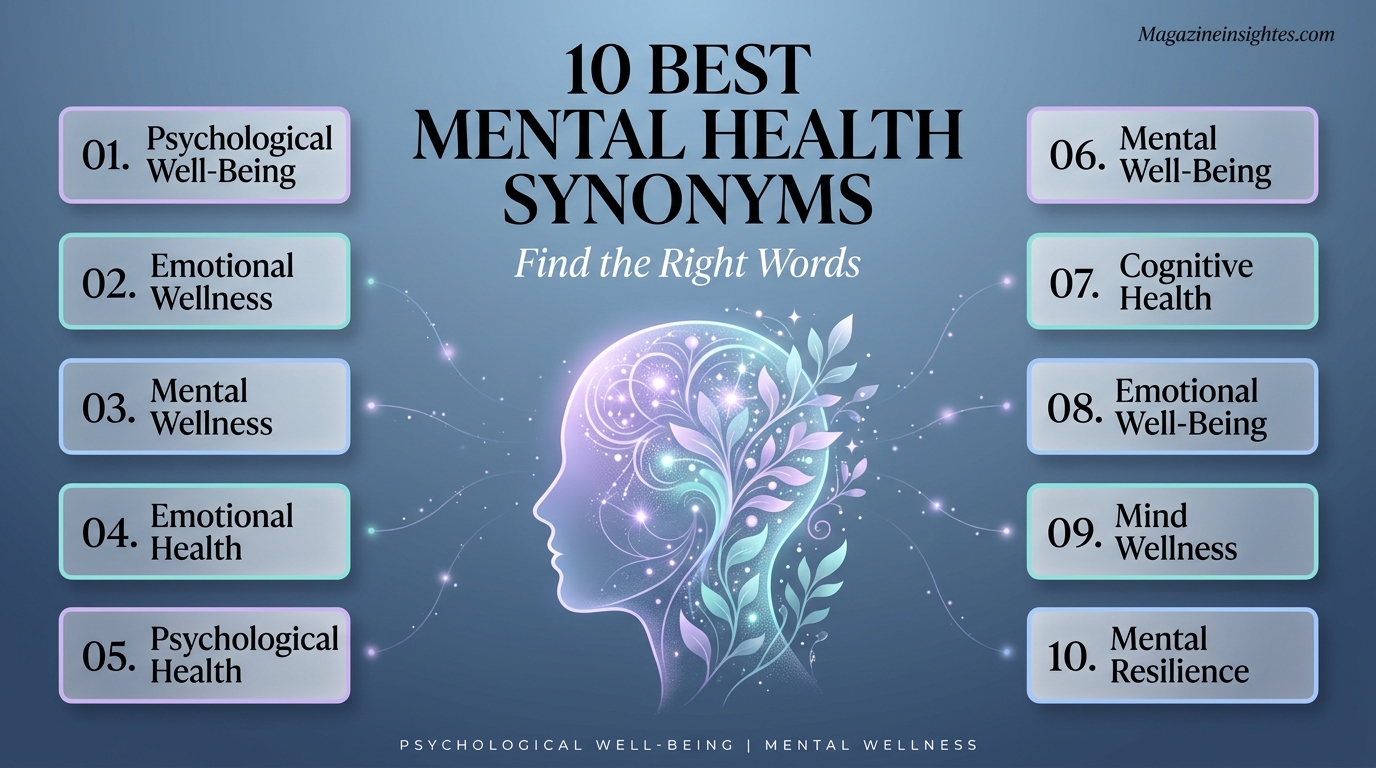
The table below gives the 10 best synonyms in one place, with a one-line meaning and the context each one fits.
Every synonym below is used by a dictionary, a thesaurus, or a health authority, and every one is explained in full later.
Top 10 Synonyms Table
| Synonym | One-line meaning | Best context |
|---|---|---|
| Psychological well-being | Inner stability, self-awareness, and emotional harmony | Formal, academic, clinical |
| Emotional wellness | Managing emotions healthily, navigating stress, keeping positive relationships | Workplace, self-care, positive |
| Mental wellness | Accessible, positive, no medical jargon | Everyday, general, positive |
| Emotional health | The feeling side: emotions and emotional regulation | Everyday, personal, health |
| Psychological health | Cognitive and emotional functioning together | Formal, health, professional |
| Mental well-being | Holistic psychological state, emotional, psychological, social | General, public health, therapy |
| Cognitive health | Thinking, memory, and reasoning | Formal, narrow, cognition only |
| Emotional well-being | Positive emotions and moods, the positive side of emotional health | Positive, personal, wellness |
| Mind wellness | Holistic health of the mind: thoughts, emotions, stress | Workplace, wellness programs |
| Mental resilience | Recovering quickly from difficulties, toughness of mind | Strength, coping, growth |
The One-Sentence Answer
If one synonym must be chosen, choose psychological well-being, because it is the most precise, the most formal, and the closest in scope.
If the writing is everyday and positive, choose mental wellness, because it is accessible, warm, and free of medical jargon.
If the writing is about feelings specifically, choose emotional wellness, because it names the feeling side directly.
When in doubt, use “mental health” itself, because it is correct and inoffensive, per WordSelector, named in plain text here.
What Does Mental Health Mean? The WHO Definition
Word choice starts with meaning, and the most authoritative meaning comes from the World Health Organization.
This section quotes the WHO definition verbatim, explains the continuum, and gives the Cambridge and Oxford definitions.
The WHO 2022 Definition, Verbatim
“Mental health is a state of mental well-being that enables people to cope with the stresses of life, realise their abilities, learn well and work well, and contribute to their community.”
“Mental health is more than the absence of mental disorders. It exists on a complex continuum, which is experienced differently from one person to the next.”
“With varying degrees of difficulty and distress and potentially very different social and clinical outcomes,” the WHO definition continues.
The definition is quoted from the World Health Organization, 2022, as reproduced in the TASO glossary of terms, October 15, 2024.
The spelling “realise” is the WHO original, with UK spelling, and it is kept verbatim here, per the TASO quote.
The TASO mental health glossary carries the full WHO 2022 definition and the preferred-language guidance, and it was verified live on November 17, 2026.
TASO is a UK source, and its guidance is labelled UK throughout this page, because US and UK usage differ.
The Continuum: More Than the Absence of Illness
The most important sentence in the WHO definition is the second one: mental health is more than the absence of mental disorders.
Mental health exists on a complex continuum, experienced differently from one person to the next, per WHO (2022).
A person can have a mental disorder and still have good mental health in other areas, and vice versa, per the continuum framing.
The continuum framing matters for word choice, because it rules out any synonym that treats mental health as a binary.
Words like “sanity” and “insanity” imply a binary: sane or insane, with nothing between, and that binary contradicts the WHO continuum.
Words like “well-being” and “wellness” fit the continuum, because they describe a spectrum, from flourishing to struggling.
The Cambridge and Oxford Definitions
Cambridge defines mental health as “the condition of someone’s mind and whether or not they are suffering from any mental illness.”
Cambridge also defines it as “the condition of the mind that shows whether someone is feeling happy, able to work, etc.”
Both definitions come from the Cambridge Advanced Learner’s Dictionary, per the Cambridge Dictionary page, checked November 17, 2026.
The Cambridge Dictionary mental health definition carries both definitions and related words, and it was verified live on November 17, 2026.
Oxford defines mental health as “the state of health of somebody’s mind,” per the Oxford Dictionary, quoted by Impactful Ninja.
Impactful Ninja is a synonym blog, not a dictionary, and the Oxford quote is labelled by source here, not verified on the Oxford site.
The Cambridge definitions tie mental health to illness and happiness, while the WHO definition ties it to well-being and functioning.
For health writing, the WHO definition is the authority; for dictionary writing, the Cambridge definitions are the authority.
The Best Synonyms, With Meanings and Examples

Each synonym below carries a meaning, a shade of meaning, an example sentence, and the context it fits.
The meanings come from the competitor consensus, with the strongest source named for each, and low-authority sources labelled.
Psychological Well-Being
Psychological well-being emphasizes inner emotional processes, including self-awareness, dignity, and purpose, per coursereps.upsu.net.
Coursereps.upsu.net is a student union blog, labelled low authority here, and its claim is competitor-reported, not verified research.
The term is favored in clinical psychology and research for its precision in describing non-pathological states of mind, per the same source.
Psychological well-being leans toward inner stability, self-awareness, and emotional harmony, per the competitor consensus.
Example: “Regular reflection and supportive relationships protect her psychological well-being during a stressful year.”
Use it in formal, academic, and clinical writing, where precision matters more than warmth.
Pros: precise, formal, broad scope. Cons: long, formal, unfamiliar to some readers.
Emotional Wellness
Emotional wellness focuses on the ability to manage emotions healthily, navigate stress, and maintain positive relationships, per the competitor consensus.
It emphasizes balance, resilience, and day-to-day emotional regulation, per coursereps.upsu.net, labelled low authority here.
It is widely used in workplace wellness programs and self-care resources, per the competitor consensus.
WordSelector calls emotional wellness an excellent informal and positive synonym, named in plain text here.
Example: “The workplace wellness program offers workshops on emotional wellness and stress management.”
Use it in workplace, self-care, and positive writing, where warmth matters more than clinical precision.
Pros: positive, accessible, workplace-friendly. Cons: narrower than mental health, covers feelings only.
Mental Wellness
Mental wellness is a direct, accessible synonym that avoids medical jargon, per WordSelector, named in plain text here.
It is a positive, inclusive synonym focusing on well-being rather than illness, per cdn.dji.nl, labelled low authority here.
It shifts the narrative from deficit to growth and balance, per the same low-authority source, labelled here.
Mental wellness is the best everyday synonym, because it is short, warm, and understood by every reader.
Example: “Daily walks, good sleep, and honest conversations support his mental wellness.”
Use it in everyday, general, and positive writing, where accessibility matters most.
Pros: short, warm, accessible. Cons: positive framing can miss the difficulty side of the continuum.
Emotional Health
Emotional health focuses on affective states and coping strategies, per cdn.dji.nl, labelled low authority here.
It covers the feeling side of mental health: how a person feels, manages feelings, and responds to stress.
Emotional health is one part of mental health, not a full synonym, because mental health also covers thinking and social well-being.
Example: “Journaling helps her track patterns in her emotional health across the week.”
Use it when the writing is about feelings specifically, not about the full scope of mental health.
Pros: clear, specific, familiar. Cons: narrower than mental health, misses cognition and social well-being.
Psychological Health
Psychological health is a state of psychological well-being and functioning, emphasizing cognitive and emotional processes, per Impactful Ninja.
Impactful Ninja is a synonym blog, and its definition is labelled by source here, not verified on a health authority site.
It is a formal synonym emphasizing cognitive and emotional functioning, per cdn.dji.nl, labelled low authority here.
Example: “Regular exercise has been beneficial for his psychological health,” per Impactful Ninja’s example sentence.
Use it in formal, health, and professional writing, where “psychological” fits the tone better than “mental.”
Pros: formal, precise, health-framed. Cons: long, formal, can sound clinical.
Mental Well-Being
Mental well-being is a widely used, accessible term that combines emotional, psychological, and social health aspects, per cdn.dji.nl, labelled low authority here.
It is a widely accepted term emphasizing holistic psychological state, frequently cited in public health campaigns and therapy settings, per the same source.
The WHO definition itself uses “mental well-being” as its opening phrase, giving the term the strongest possible authority.
Example: “The school’s programs support students’ mental well-being alongside their academic learning.”
Use it in general, public health, and therapy writing, where the WHO framing fits.
Pros: WHO-backed, holistic, accessible. Cons: hyphenation varies (well-being vs wellbeing), and the term is broad.
Cognitive Health
Cognitive health is a formal synonym covering thinking, memory, and reasoning, per WordSelector, named in plain text here.
WordSelector recommends cognitive health as a professional way to say mental health, for formal written needs.
Cognitive health covers cognition only, not emotion or social well-being, so it is narrower than mental health.
Example: “Reading, puzzles, and learning new skills support cognitive health across the lifespan.”
Use it when the writing is about thinking and memory specifically, not about the full scope of mental health.
Pros: precise, formal, professional. Cons: narrow, misses emotion and social well-being.
Emotional Well-Being
Emotional well-being is the state of experiencing positive emotions and moods, per Impactful Ninja’s top-10 table.
It reflects mental health by focusing on the positive aspects of emotional health, per the same source.
Example: “Focusing on her emotional well-being has greatly improved her outlook on life,” per Impactful Ninja’s example sentence.
Use it in positive, personal, and wellness writing, where the positive side is the focus.
Pros: positive, warm, specific. Cons: positive framing can miss the difficulty side.
Mind Wellness
Mind wellness is the holistic health of the mind, including thoughts, emotions, and stress levels, per Impactful Ninja.
It parallels mental health in its broad approach to well-being, per the same source, labelled by source here.
Example: “Mind wellness workshops have become an integral part of our workplace wellness program,” per Impactful Ninja’s example sentence.
Use it in workplace and wellness-program writing, where “mind” fits the program framing.
Pros: broad, workplace-friendly, holistic. Cons: less standard than “mental wellness,” can sound branded.
Mental Resilience
Mental resilience is the ability to recover quickly from difficulties, toughness of mind, per Impactful Ninja.
It highlights one aspect of mental health focused on strength, per the same source, not the whole of mental health.
Example: “Building mental resilience is key to coping with life’s challenges,” per Impactful Ninja’s example sentence.
Use it when the writing is about coping, strength, and recovery, not about the full scope of mental health.
Pros: strength-framed, hopeful, actionable. Cons: narrow, misses the full continuum, can imply blame if overused.
More Synonyms, by Shade of Meaning
The synonyms below cover specific shades: balance, strength, clarity, state, and rare literary words.
Each shade fits a different context, and the shade matters more than the word count.
Balance Words: Equilibrium, Stability, Harmony
Emotional equilibrium is a state of emotional balance and stability, per Impactful Ninja, a positive synonym emphasizing steadiness.
Mental equilibrium is the balance of mind, per WordHippo’s list, a formal synonym for mental balance.
Emotional stability describes consistent emotional regulation and stress management, per cdn.dji.nl, labelled low authority here.
Inner harmony is a state of internal peace and balance, per Impactful Ninja, a literary synonym for emotional and psychological stability.
Psychosocial balance is a balance of psychological and social well-being, per WordSelector, a formal term for inner and social stability together.
Mental balance is a Cambridge and Roget’s synonym, listed under SANITY, and it fits formal writing about steadiness.
Balance words suit writing about steadiness, calm, and regulation, not writing about growth or struggle.
Strength Words: Resilience, Vitality, Fitness
Mental vitality is a WordSelector synonym, emphasizing energy and aliveness of mind, per the synonym blog, named in plain text here.
Emotional fitness is an Impactful Ninja synonym, framing emotional health as a capacity that can be trained, per the synonym blog.
Mental fitness is the parallel term, framing mental health as a capacity, per the competitor consensus, labelled by usage.
Psychological wellness is a broad state encompassing emotional, cognitive, and social well-being, per Impactful Ninja.
Example: “The university offers counseling services to support students’ psychological wellness,” per Impactful Ninja’s example sentence.
Strength words suit writing about coping, growth, and capacity, but they can imply blame if they suggest struggling is a failure of strength.
Clarity Words: Clarity, Lucidity, Coherence
Mental clarity is the clearness of thought, per the competitor consensus, a synonym for the thinking side of mental health.
Lucidity is a Cambridge and Roget’s synonym, meaning clearness of thought, listed under SANITY.
Coherence is a Cambridge and Roget’s synonym, meaning logical connection of thought, listed under SANITY.
Clearheadedness is a Cambridge and Roget’s synonym, meaning clearness of mind, listed under SANITY.
Clarity words suit writing about thinking and understanding, not writing about feelings or social well-being.
Clarity words come from the sanity list, and they carry the sanity framing, so use them with care in health writing.
State Words: Mental State, Emotional State, Mindset
Mental state describes a temporary emotional or psychological condition, such as a stable or fragile mental state, per coursereps.upsu.net, labelled low authority here.
Emotional state describes the feeling side at a moment in time, per the same source, labelled low authority here.
Mindset reflects core beliefs and attitudes toward challenges, per coursereps.upsu.net, labelled low authority here, and it is conversational, not clinical.
Mindful state is a WordSelector synonym, emphasizing present awareness, per the synonym blog, named in plain text here.
State words suit writing about a moment in time, not about long-term health, because states change.
“A stable mental state” is accurate for a moment; “good mental health” is accurate for a longer pattern.
Rare and Literary Words: Eunoia, Saneness, Soundness of Mind
Eunoia is a rare word meaning beautiful thinking or a well mind, per WordHippo’s list, literary and obscure.
Eunoia is the shortest word in English containing all five vowels, a trivia fact, not a health term, and it is not recommended for everyday writing.
Saneness is a Cambridge and Roget’s synonym, meaning the state of being sane, listed under SANITY, formal and rare.
Soundness of mind is a Cambridge and Roget’s synonym, formal and legalistic, fitting legal and formal writing only.
Soundness of judgment is a Cambridge and Roget’s synonym, meaning good judgment, listed under SANITY, formal and narrow.
Rare words suit literary and formal writing only, and they risk confusing readers in everyday health writing.
Words That Are NOT Synonyms for Mental Health
This section is the most valuable part of the page, because no competitor warns about these traps.
Three traps mislead searchers: the sanity trap, the intellect trap, and the slang trap, plus the illness trap.
Each trap is explained with its source, so the reader can see exactly where the misleading word comes from.
The Sanity Trap: Cambridge and Roget’s
Cambridge lists “mental health” under the heading SANITY, with 14 synonyms from Random House Roget’s College Thesaurus.
The Cambridge thesaurus mental health page carries the full Roget’s list, and it was verified live on November 17, 2026.
The 14 synonyms are: sanity, soundness of mind, saneness, mental balance, normality, soundness of judgment, reason, rationality, sensibleness, sense, lucidity, reasonableness, clearheadedness, and coherence.
The list comes from Random House Roget’s College Thesaurus, Revised and Updated Edition, 2000, per the Cambridge page.
Sanity belongs to a legal and archaic sense: whether a person is of sound mind for legal purposes, not whether they are healthy.
Modern health writing uses “mental health” and “psychological well-being,” not “sanity,” because sanity implies a binary.
The binary contradicts the WHO continuum, which says mental health exists on a complex spectrum, not as sane or insane.
Use sanity words only in legal, historical, or literary writing, and never as health synonyms in modern writing.
The Intellect Trap: WordHippo’s List
WordHippo lists more than 100 words as synonyms for mental health, across two contexts: well-being and sanity.
Most of the words are intellect words, not mental health words: genius, acumen, erudition, perspicacity, sapience, ingenuity, and cognition.
Intellect words mean intelligence: how smart, sharp, or knowledgeable a person is, not how healthy their mind is.
A person can be a genius and struggle with their mental health, and a person can have excellent mental health without genius.
WordHippo also lists wisdom, insight, prudence, savvy, and knowledge, all intellect and judgment words, not health words.
WordHippo’s list is the largest competitor list, and it is the most misleading, because it mixes three different meanings.
WordHippo is named in plain text here, not linked, because its list is the trap this page warns about, not an authority to cite.
Use intellect words only when writing about intelligence, and never as substitutes for mental health.
The Slang Trap: Marbles, Wits, Gray Matter
WordHippo’s sanity context includes slang: marbles, wits, brainpower, brains, daylights, head, headpiece, and gray matter.
These words appear in phrases like “losing your marbles” and “scared out of your wits,” which are idioms, not health terms.
Slang words are informal, humorous, and often mocking, and they trivialize mental health when used as synonyms.
“Gray matter” means brain tissue, literally, not mental health, and “headpiece” means the head, not the mind’s health.
“Gumption,” “nous,” and “canniness” are slang and dialect words for shrewdness, not health terms, per WordHippo’s list.
Slang words suit fiction, humor, and informal speech only, and they must never appear in health, workplace, or school writing.
This page names the slang words only to warn against them, not to recommend them, and the warning is the point.
The Illness Trap: Mental Illness Is Not a Synonym
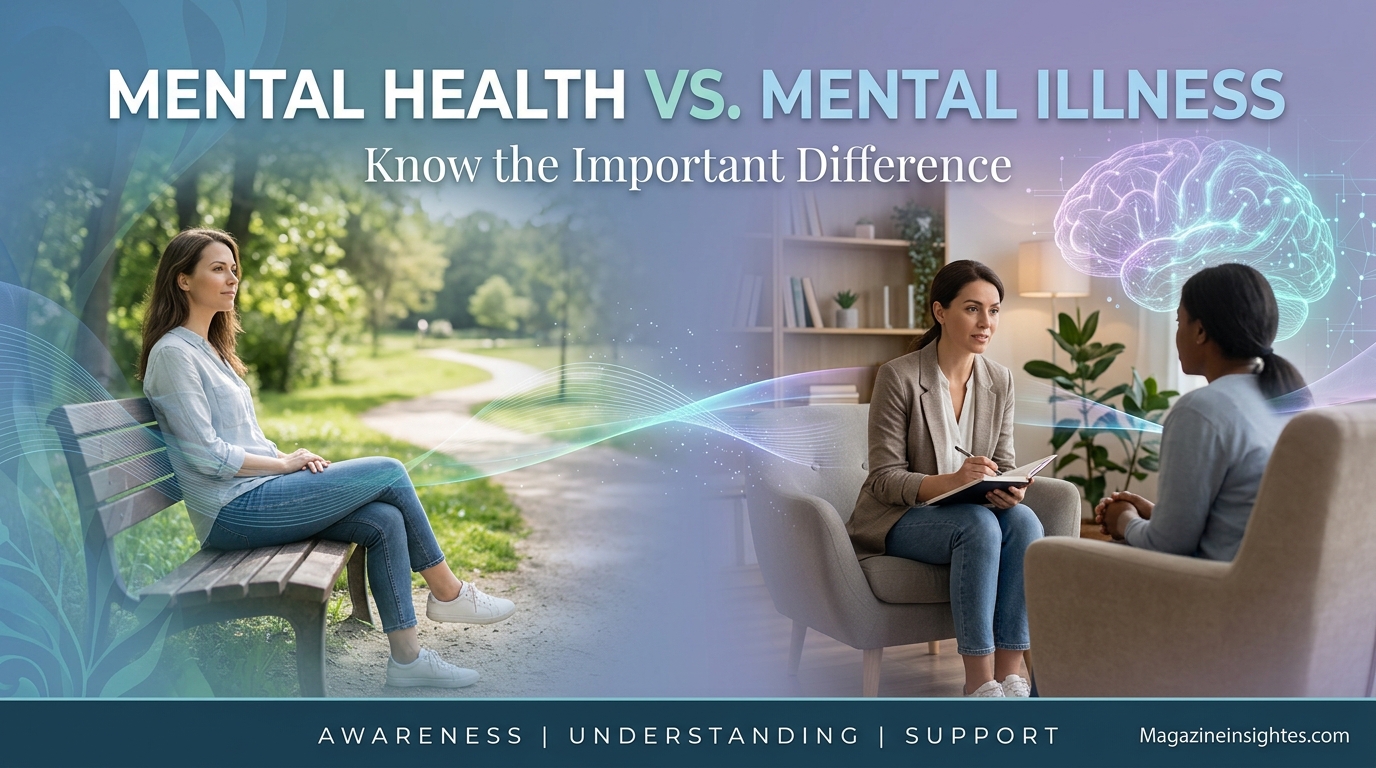
Mental illness is not a synonym for mental health, and treating it as one is the most common word-choice error.
Mental health is a state of well-being on a continuum, per WHO (2022), and mental illness is a diagnosable condition.
Cambridge’s definition ties mental health to whether or not someone is suffering from a mental illness, which invites the confusion.
The WHO definition corrects that framing: mental health is more than the absence of mental disorders.
Writing “mental health” when “mental illness” is meant softens and confuses the meaning, and writing “mental illness” when “mental health” is meant pathologizes normal experience.
Use “mental health” for the continuum, “mental illness” or “mental disorder” for a diagnosable condition, and “mental health difficulties” for struggles, per TASO (UK).
Mental Health vs Mental Illness vs Wellbeing
Three terms are confused more than any others, and the table below separates them with their sources.
Comparison Table
| Term | Meaning | Scope | Source |
|---|---|---|---|
| Mental health | A state of mental well-being on a continuum, more than the absence of disorders | Emotional, psychological, social | WHO, 2022 |
| Mental illness / mental disorder | A diagnosable condition affecting thinking, feeling, or behavior | Clinical, diagnostic | NIMH, SAMHSA (context) |
| Wellbeing | How we are doing as individuals, communities, and a nation, across 10 dimensions | Physical, social, economic, personal | What Works Wellbeing via TASO, UK, 2024 |
| Emotional health | Feelings and emotional regulation specifically | Emotional only | Competitor consensus |
| Psychological well-being | Inner stability, self-awareness, emotional harmony | Psychological, inner | Competitor consensus |
| Wellness | Proactive, positive pursuit of health and balance | Holistic, positive | Competitor consensus |
Mental Health vs Mental Illness
Mental health is the continuum; mental illness is a point on the continuum where a diagnosable condition exists, per the WHO framing.
A person living with a mental illness can still have good mental health in other areas: strong relationships, purpose, and coping skills.
A person without a diagnosable condition can still have poor mental health: stress, loneliness, and difficulty coping.
The National Institute of Mental Health is the US federal authority on mental illnesses, and it was verified live on November 17, 2026.
Use “mental illness” only when a diagnosable condition is meant, and use person-first language: “a person living with depression,” not “a depressive.”
Mental Health vs Emotional Health
Emotional health is one part of mental health, covering feelings and emotional regulation, per the competitor consensus.
Mental health covers three parts: emotional, psychological, and social well-being, per the WHO framing.
Writing “emotional health” when the full scope is meant narrows the meaning, and writing “mental health” when only feelings are meant broadens it.
Use “emotional health” for feelings specifically, and “mental health” for the full continuum.
Mental Health vs Wellbeing (TASO, UK)
TASO defines wellbeing using What Works Wellbeing’s definition: how we are doing as individuals, communities, and a nation, per the TASO glossary.
Wellbeing has 10 dimensions: the natural environment, personal wellbeing, relationships, health, what we do, where we live, personal finance, the economy, education and skills, and governance.
Wellbeing is not simply the absence of mental illness, and mental health symptoms are not necessarily an indicator of poor wellbeing, per TASO.
Wellbeing includes wider physical, social, and economic experience, per Universities UK Stepchange guidance, cited by TASO.
TASO is a UK source, and its wellbeing framing is UK guidance, labelled by country here.
Use “wellbeing” for the broadest scope, and “mental health” for the emotional and mental state specifically.
Which Synonym Fits Your Context?
Context decides the right synonym, and the same word can fit one context and fail in another.
This section covers six contexts, with the best synonym for each, and a summary table.
Formal and Academic Writing
Use psychological well-being or cognitive health, per WordSelector’s formal guidance, named in plain text here.
Formal writing values precision over warmth, and “psychological well-being” is the most precise synonym.
Define the term on first use, with the WHO 2022 definition, so the reader knows the scope.
Avoid slang, rare words, and positive-only terms in formal writing, because they weaken precision.
Example: “The study measured psychological well-being using a validated scale, alongside academic performance.”
Workplace and Professional Writing
Use emotional wellness or mind wellness, per the competitor consensus on workplace wellness programs.
Workplace writing values warmth and accessibility, and “emotional wellness” fits wellness programs and HR documents.
Use “mental health” itself in policy documents, because it is the standard term, correct and inoffensive.
Avoid clinical terms in general workplace writing, because they can feel cold or pathologizing.
Example: “Our wellness program offers workshops on emotional wellness, stress management, and work-life balance.”
School and Essay Writing
Use mental wellness or mental well-being, with the WHO definition cited, for school and essay writing.
School writing values clarity and citation, and the WHO 2022 definition gives the essay its authority.
Define the term, give examples, and distinguish mental health from mental illness, per the comparison table above.
Avoid slang and stigmatizing words in essays, because they weaken the argument and harm readers.
Example: “Mental health, defined by the WHO as a state of mental well-being on a continuum, affects how students learn and relate.”
Personal Conversations
Use mental wellness, emotional health, or simply “how you are doing,” in personal conversations.
Personal conversations value warmth and listening, and the simplest words work best.
Ask open questions: “How is your mental wellness lately?” or “How are you doing, really?”
Avoid clinical terms, slang, and labels in personal conversations, because they create distance.
Listen without diagnosing, and encourage professional help when someone describes serious difficulties.
Healthcare and Clinical Settings
Use psychological well-being, psychological health, or “mental health” itself, in healthcare and clinical writing.
Clinical writing values precision and person-first language, and the formal synonyms fit that tone.
Use person-first language always: “a person living with depression,” not “a depressive” or “a mentally ill person.”
Use “mental health difficulties” for struggles, per TASO (UK), or “mental health challenges” in US usage, labelled by country.
Example: “The care plan supports the patient’s psychological well-being alongside medical treatment.”
Advocacy and Public Writing
Use mental wellness, emotional wellness, or “mental health” itself, in advocacy and public writing.
Advocacy writing values inclusivity and hope, and positive synonyms fit campaign and awareness messaging.
Use person-first language, avoid stigmatizing words, and include crisis resources, per the standing health-content rule.
Example: “Mental Health Awareness Month celebrates mental wellness and encourages open, stigma-free conversation.”
Context Table
| Context | Best synonym | Also good | Avoid |
|---|---|---|---|
| Formal and academic | Psychological well-being | Cognitive health, psychological health | Slang, rare words, positive-only terms |
| Workplace and professional | Emotional wellness | Mind wellness, mental wellness | Clinical terms in general writing |
| School and essay | Mental well-being | Mental wellness, psychological well-being | Slang, stigmatizing words |
| Personal conversations | Mental wellness | Emotional health, “how you are doing” | Clinical terms, labels, slang |
| Healthcare and clinical | Psychological well-being | Psychological health, mental health | Slang, labels, non-person-first language |
| Advocacy and public | Mental wellness | Emotional wellness, mental health | Stigmatizing words, clinical coldness |
Words to Avoid and What to Say Instead
Word choice can harm or heal, and the words below harm, because they stigmatize, trivialize, or label.
Every word below carries a replacement, so the reader can rewrite with confidence.
The stigma guidance comes from the competitor consensus, TASO (UK), and NAMI and APA as cited by competitors, labelled by source.
Stigmatizing Words Table
| Do not use | Why it harms | Say instead |
|---|---|---|
| Crazy, insane, mad | Stigmatizing slang, trivializes illness | A person living with a mental health condition; a person experiencing difficulties |
| Lunatic, psycho, deranged | Offensive labels, dehumanizing | A person living with a mental health condition |
| Mentally ill (as a label) | Labels the person by the condition | A person living with mental illness; a person with a mental health condition |
| Suffering from (as a default) | Implies constant suffering, removes agency | Living with; experiencing; managing |
| Committed suicide | Implies crime or sin, stigmatizing | Died by suicide; took their own life |
| Failed suicide attempt | Implies failure, shaming | Survived a suicide attempt; non-fatal suicide attempt |
| Mental health problems (as a default) | Can sound blaming, per TASO (UK) | Mental health difficulties (TASO, UK); mental health challenges (US usage) |
| Normal vs abnormal | Implies a binary, stigmatizing | Typical; common; on the continuum |
Person-First Language
Person-first language puts the person before the condition: “a person living with depression,” not “a depressive.”
Research by the American Psychological Association (2024) confirms that person-first, respectful language enhances patient trust, per coursereps.upsu.net.
That APA claim is competitor-reported, labelled here, and it was not verified on the APA site.
Research from NAMI highlights that stigma often stems from outdated or harsh language, per coursereps.upsu.net, labelled low authority here.
That NAMI claim is also competitor-reported, labelled here, and it was not verified on the NAMI site.
Person-first language is the standard in US health writing, and it is recommended by APA, NAMI, and SAMHSA, per the competitor consensus.
Some people prefer identity-first language (“autistic person”), and the person’s own preference always wins, per inclusive-language guidance.
The TASO Preferred Language (UK)
TASO’s preferred language is to refer to “mental health difficulties,” as opposed to problems, issues, struggles, challenges, disorders, or conditions.
TASO prefers referring to persons experiencing a diagnosis as “living with” a diagnosis, per the TASO glossary, October 15, 2024.
TASO follows non-clinical understandings of mental health and wellbeing, with mental health as a spectrum not necessarily determined by a diagnosis.
TASO is a UK source, focused on students, and its guidance is labelled UK throughout this page.
US usage commonly uses “mental health challenges” as the respectful alternative, labelled by usage here.
Both “difficulties” and “challenges” beat “problems” and “issues,” because they describe experience, not blame.
“Issues,” “Problems,” and “Difficulties”
“Mental health issues” is the most common compound phrase in everyday writing, per the competitor consensus.
“Issues” is vague: it can mean anything from stress to a diagnosable condition, and vagueness weakens writing.
“Problems” can sound blaming, per TASO (UK), as if the person is the problem, rather than experiencing a difficulty.
“Difficulties” describes experience without blame, per TASO (UK), and it is the preferred term in the TASO glossary.
“Challenges” is the common US alternative, labelled by usage, and it frames the experience as something to navigate, not a flaw.
Choose the most specific word available: name the difficulty when known, and use “difficulties” or “challenges” when it is not.
Antonyms, With Care
Antonyms answer the question “what is the opposite?” but they need care, because most antonyms stigmatize.
This section lists the Cambridge antonyms with a warning, and gives the respectful opposites.
Cambridge Antonyms Table
| Antonym | Source | Care warning |
|---|---|---|
| Insanity | Cambridge / Roget’s | Legal and stigmatizing; do not use about a person |
| Insaneness | Cambridge / Roget’s | Archaic and stigmatizing; do not use |
| Madness | Cambridge / Roget’s | Stigmatizing slang; do not use about a person |
| Derangement | Cambridge / Roget’s | Offensive and outdated; do not use |
| Irrationality | Cambridge / Roget’s | Judgmental; use “difficulty thinking clearly” instead |
| Incoherence | Cambridge / Roget’s | Clinical in tone; use “difficulty communicating” instead |
Why Antonyms Need Care
The Cambridge antonyms come from Roget’s 2000, and they reflect the language of an earlier era, not modern health writing.
Modern health writing uses “poor mental health” and “mental health difficulties” as the respectful opposites of good mental health.
“Poor mental health” describes a point on the continuum, per the WHO framing, without labeling the person.
“Mental health difficulties” describes experience, per TASO (UK), without blame or stigma.
Antonyms belong in dictionary and thesaurus discussions, with warnings, not in writing about real people.
Compound Phrases: Mental Health Issues, Problems, Crisis
“Mental health” usually comes before another noun, making it a compound adjective, per WordSelector, named in plain text here.
This section covers the common compounds and the better phrasing for each.
How “Mental Health” Modifies Nouns
Common compounds include mental health issues, problems, crisis, awareness, care, professional, support, and resources, per WordSelector.
Technically, “mental health” modifies the noun coming after it, making it a compound adjective, per WordSelector.
The compound framing matters because it shows “mental health” as a descriptor, not just a standalone noun.
Compounds like “mental health crisis” describe a situation, not a person, and they are accurate when the situation is a crisis.
Compounds like “mental health professional” describe a role, and the role titles (therapist, counselor, psychologist, psychiatrist) are not interchangeable.
Better Phrasings for Each Compound
| Common compound | Better phrasing | Why |
|---|---|---|
| Mental health issues | Mental health difficulties / challenges | More specific, less vague, less blaming |
| Mental health problems | Mental health difficulties / challenges | Less blaming, per TASO (UK) |
| Mental health struggles | Mental health difficulties; emotional struggles | “Difficulties” is preferred; “struggles” validates feeling |
| Mental health crisis | Mental health crisis (keep) | Accurate for a crisis situation; include 988 |
| Mental health awareness | Mental health education / literacy | “Education” and “literacy” are more active than “awareness” |
| Mental health care | Behavioral health care; mental health support | “Behavioral health” is the US health-system term |
| Mental health professional | Name the role: therapist, counselor, psychologist | Each title has a different credential |
When to Use “Mental Health” Itself
The best synonym is sometimes no synonym, because “mental health” itself is the standard term.
This section explains when to keep the phrase and when a synonym helps.
“Mental Health” Is Correct and Inoffensive
“Mental health” is correct and inoffensive, so it is one of the best phrases to use, per WordSelector, named in plain text here.
WHO, NIMH, SAMHSA, and NAMI all use “mental health” as their standard term, per the competitor consensus.
Using a synonym to avoid saying “mental health” can imply that the phrase itself is shameful, which increases stigma.
Normalizing the phrase, by using it plainly and often, reduces stigma more than any euphemism.
When a Synonym Helps and When It Hurts
A synonym helps when the context calls for a specific shade: formal, positive, workplace, or clinical.
A synonym helps when repetition weakens writing, and a varied word keeps the reader engaged.
A synonym hurts when it narrows the meaning: “cognitive health” for the full continuum, or “emotional health” for social well-being.
A synonym hurts when it euphemizes: using “wellness” to avoid naming a difficulty, or “challenges” to avoid naming an illness.
A synonym hurts when it stigmatizes: using “sanity,” “crazy,” or “insane” as if they were neutral words.
When in doubt, use “mental health” itself, with the WHO definition behind it, and let precision beat variety.
Related Health Guides on This Site
This site covers when men’s mental health awareness month is, with the June and November answers, the Movember story, and the by-country table.
This site covers how social media affects teens’ mental health, with the Surgeon General advisory, the evidence, and the skeptic counterpoint.
This site covers whether health insurance is needed, with the mandate jurisdictions, the 2026 costs, and the open enrollment dates.
This site covers what HMO means in health insurance, with the network rules, the referral rules, and the cost-sharing details.
This site covers whether Prosper Health is legit, a legitimacy review with the verdict first and every figure labelled by source and date.
This site covers why Signify Health is calling, with the verification numbers and the free evaluation explanation.
All six internal links were curl-verified live with real titles on November 17, 2026, before this article was written.
Frequently Asked Questions
1. What is another word for mental health?
Psychological well-being is the best general synonym, mental wellness is the best everyday synonym, and emotional wellness is the best positive synonym.
No single word fully replaces “mental health,” because the phrase covers emotional, psychological, and social well-being on a continuum, per WHO (2022).
2. What is a synonym for mental health?
Psychological well-being, emotional wellness, mental wellness, emotional health, psychological health, mental well-being, cognitive health, emotional well-being, mind wellness, and mental resilience.
Each synonym carries a different shade of meaning, and the context decides which one fits, per the context table above.
3. What is the opposite of mental health?
Cambridge lists insanity, madness, derangement, irrationality, and incoherence as antonyms, but all of them stigmatize and must not be used about a person.
The respectful opposites are “poor mental health” and “mental health difficulties,” per the WHO continuum and TASO (UK).
4. What is the difference between mental health and mental illness?
Mental health is a state of well-being on a continuum, per WHO (2022), and it is more than the absence of mental disorders.
Mental illness is a diagnosable condition, and a person can have a mental illness and still have good mental health in other areas.
5. What is the difference between mental health and emotional health?
Mental health covers emotional, psychological, and social well-being, per WHO, while emotional health covers feelings and emotional regulation specifically.
Emotional health is one part of mental health, not a full synonym, because mental health also covers thinking and social well-being.
6. What is psychological well-being?
A state of inner stability, self-awareness, and emotional harmony, per the competitor consensus, favored in clinical psychology and research for its precision.
Use it in formal, academic, and clinical writing, where precision matters more than warmth.
7. What is emotional wellness?
The ability to manage emotions healthily, navigate stress, and maintain positive relationships, per the competitor consensus.
It is widely used in workplace wellness programs and self-care resources, and it is the best positive synonym.
8. What is mental wellness?
A direct, accessible synonym for mental health that avoids medical jargon, per WordSelector, named in plain text here.
It is the best everyday synonym, because it is short, warm, and understood by every reader.
9. What is a positive word for mental health?
Emotional well-being, mind wellness, inner harmony, mental resilience, and emotional fitness, per Impactful Ninja’s top-10 positive list.
Each positive synonym carries a different shade, and the positive framing can miss the difficulty side of the continuum.
10. What words should you avoid when talking about mental health?
Crazy, insane, madness, deranged, lunatic, and psycho, plus “mentally ill” as a label for a person, and “committed suicide.”
Use person-first language, “a person living with” a condition, and the TASO preferred term “mental health difficulties” (UK, 2024).
11. Is mental wellness the same as mental health?
Not exactly: mental wellness emphasizes the positive, proactive side, while mental health covers the full continuum, including difficulties.
They overlap heavily and are often used interchangeably in everyday writing, but the scope differs.
12. Is sanity a synonym for mental health?
Only in the legal and archaic sense: Cambridge and Roget’s list “mental health” under SANITY, but sanity words belong to a legal sense.
Sanity implies a binary, sane or insane, which contradicts the WHO continuum, so sanity must not be used as a health synonym.
13. What is cognitive health?
The health of thinking, memory, and reasoning, a formal synonym for one part of mental health, per WordSelector.
It covers cognition only, not emotion or social well-being, so it is narrower than mental health.
14. What is the WHO definition of mental health?
“Mental health is a state of mental well-being that enables people to cope with the stresses of life, realise their abilities, learn well and work well, and contribute to their community.”
“Mental health is more than the absence of mental disorders. It exists on a complex continuum,” per WHO, 2022, quoted by TASO.
15. What is the difference between mental health and wellbeing?
Wellbeing is broader, covering physical, social, and economic experience across 10 dimensions, per What Works Wellbeing via TASO (UK, 2024).
Mental health is the emotional and mental state specifically, and wellbeing includes mental health but is not the same thing.
16. What is another word for mental health issues?
“Mental health difficulties” is the preferred term, per TASO (UK, 2024), over problems, issues, struggles, challenges, disorders, or conditions.
“Mental health challenges” is a common US alternative, labelled by usage, and both beat “problems” and “issues.”
17. What is a formal word for mental health?
Psychological well-being or cognitive health, per WordSelector, both suited to academic, clinical, and professional writing.
Define the term on first use, with the WHO 2022 definition, so the reader knows the scope.
18. What is person-first language?
Language that puts the person before the condition: “a person living with depression” instead of “a depressed person” or “a depressive.”
Person-first language is the standard in US health writing, recommended by APA, NAMI, and SAMHSA, per the competitor consensus.
19. Why does word choice matter for mental health?
Language shapes perception, per every competitor, and outdated or harsh language can alienate people seeking help.
Inclusive, precise language normalizes conversation and encourages help-seeking, per WHO as cited by competitors, labelled here.
20. Why does WordHippo list “marbles” and “wits”?
Because WordHippo mixes the sanity context with the well-being context, and “marbles,” “wits,” “daylights,” and “gray matter” are slang for sanity or intellect.
Slang words are not synonyms for mental health, and this page flags them as traps, not recommendations.
21. What is another word for mental health care?
Behavioral health care, psychological care, or mental health support, with “behavioral health” as the common US health-system term.
Each term fits a different setting: health systems use “behavioral health,” and general writing uses “mental health support.”
22. What is another word for mental health professional?
Therapist, counselor, psychologist, psychiatrist, or behavioral health provider, depending on the role and credential.
Each title has a different credential, and the titles are not interchangeable, so name the specific role when known.
23. Where can I get help for a mental health crisis?
Call or text 988 to reach the 988 Suicide and Crisis Lifeline, free and confidential, 24 hours a day, 7 days a week, in the US.
Text HOME to 741741 to reach the Crisis Text Line, and call 911 for an emergency.
24. Is “mental health” itself offensive?
No. “Mental health” is correct and inoffensive, per WordSelector, and it is the standard term used by WHO, NIMH, SAMHSA, and NAMI.
A synonym helps only when the context calls for a different shade of meaning, and normalizing the phrase reduces stigma.
25. When should I use a synonym instead of “mental health”?
When the context calls for a specific shade: “psychological well-being” for formal writing, “emotional wellness” for workplace wellness, and “mental wellness” for everyday writing.
When in doubt, use “mental health” itself, with the WHO definition behind it, and let precision beat variety.
Conclusion
Another word for mental health is psychological well-being in formal writing, mental wellness in everyday writing, and emotional wellness for a positive tone.
No single word fully replaces “mental health,” because the phrase covers emotional, psychological, and social well-being on a continuum, per WHO (2022).
The 40 synonyms on this page cover every shade: balance, strength, clarity, state, and the rare literary words, each with its context.
The traps matter as much as the synonyms: sanity words belong to a legal sense, intellect words mean intelligence, and slang words trivialize.
Mental illness is not a synonym for mental health, wellbeing is broader than mental health, and emotional health is one part of mental health.
Word choice can harm or heal, and the stigma table on this page gives every harmful word a respectful replacement.
Person-first language, the TASO preferred term “mental health difficulties” (UK), and the US alternative “mental health challenges” all beat “problems” and “issues.”
When in doubt, use “mental health” itself, because it is correct and inoffensive, and normalizing the phrase reduces stigma.
Every definition on this page was checked on November 17, 2026, against WHO, Cambridge, Oxford, NIMH, SAMHSA, and TASO.
Low-authority claims are labelled as competitor-reported, UK guidance is flagged by country, and no statistic was invented.
If you or someone you know is struggling, call or text 988 to reach the 988 Suicide and Crisis Lifeline, or text HOME to 741741 to reach the Crisis Text Line.
General information only: this page is about word choice, not medical advice, and it does not diagnose or treat any condition.