When Is Men’s Mental Health Awareness Month? June, November, and the Full Answer
When is men’s mental health awareness month? In the United States, the answer most often given is June.
November is the second answer, because Movember runs all through November and puts men’s mental health at the centre.
Neither month is an official federal observance, so the honest answer is two months, not one.
Last checked November 10, 2026. Every date and statistic below carries its source and its year.
If you or someone you know is in crisis, call or text 988 in the United States, or text HOME to 741741.
The Short Answer: Two Months, Not One
June is the US answer. Men’s Health Month runs all of June, and many groups call it Men’s Mental Health Month too.
November is the Movember answer. The global Movember campaign runs November 1 to 30, and International Men’s Day falls on November 19.
There is no single official month. No federal law names a men’s mental health awareness month, and no single month is standard worldwide.
That is why search results give two answers, and why both answers are right for different reasons.
The rest of this page explains which month applies where, what each campaign does, and how to take part.
June Is the US Answer
Men’s Health Month is observed every June in the United States, sponsored by the Men’s Health Network and other advocates.
Many groups use June to talk about men’s mental health, alongside physical health, prevention, and early detection.
Mental Health America recognises June as part of its men’s health work, and clinics, employers, and schools run June campaigns.
June is also the month most US searchers mean when they ask when men’s mental health awareness month is.
November Is the Movember Answer
Movember is a global men’s health campaign that runs every November, from the 1st to the 30th.
It focuses on men’s mental health and suicide prevention, plus prostate cancer and testicular cancer.
International Men’s Day falls on November 19 every year, and in 2026 it lands on a Thursday.
In the United Kingdom and Australia, November is the month most people name when they are asked the same question.
There Is No Single Official Month
No single month holds the official title of Men’s Mental Health Awareness Month, in the US or anywhere else.
The name itself has no single owner, and different groups use it for June, for November, or for both.
That does not make the observance less real, but it does mean you should check which month a source means.
The best answer is the one that fits your country and your campaign, and the table below makes that choice simple.
When Is Men’s Mental Health Awareness Month in 2026 and 2027?
The dates are the same every year, because both observances run on fixed calendar months.
June runs June 1 to 30, and Movember runs November 1 to 30, in 2026, 2027, and every year after.
Only the weekdays and the Father’s Day date change, and those are listed below.
| Observance | 2026 dates | 2027 dates |
|---|---|---|
| Men’s Health Month | June 1 to 30, 2026 | June 1 to 30, 2027 |
| Men’s Health Week | June 15 to 21, 2026 | Week leading up to Father’s Day, June 20, 2027 |
| Father’s Day | June 21, 2026 | June 20, 2027 |
| Wear BLUE Day | Friday before Father’s Day, June 19, 2026 | Friday before Father’s Day, June 18, 2027 |
| Movember | November 1 to 30, 2026 | November 1 to 30, 2027 |
| International Men’s Day | Thursday, November 19, 2026 | November 19, 2027 |
| Mental Health Awareness Month (general, US) | May 1 to 31, 2026 | May 1 to 31, 2027 |
2026 Dates
June 2026 has already passed, with Men’s Health Week running June 15 to 21 and Father’s Day on June 21.
Movember 2026 is running right now, from November 1 to 30, 2026.
International Men’s Day 2026 falls on Thursday, November 19, nine days from today.
If you are reading this in November, Movember is the month in front of you, and the next June observance is seven months away.
2027 Dates
The next June observance runs June 1 to 30, 2027, with Men’s Health Week leading up to Father’s Day on June 20, 2027.
Movember 2027 runs November 1 to 30, 2027, and International Men’s Day falls on November 19, 2027.
Put both months in your calendar now, because the gap between them is when most men are forgotten.
The Year at a Glance
May is Mental Health Awareness Month generally in the US, and it is not men’s specific.
June is Men’s Health Month, and November is Movember.
October is Australia’s broader Mental Health Month, and October 10 is World Mental Health Day.
Four months a year carry a mental health observance, and any of them is a good time to check in.
June: Men’s Health Month in the United States
June is the month most US groups call Men’s Mental Health Month, because it sits inside the larger Men’s Health Month.
The month covers physical and mental health together, from checkups and cancer screening to stress, sleep, and mood.
That breadth is both its strength and its weakness, because mental health can get lost among the physical health messages.
Men’s Health Week and Father’s Day
Men’s Health Week is the week leading up to Father’s Day in June, and it is the sharpest part of the month.
In 2026 it ran June 15 to 21, with Father’s Day on Sunday, June 21.
The timing is deliberate, because Father’s Day puts fathers, sons, and grandfathers in the same conversation.
Employers, clinics, and schools often run their June events during that week, rather than across the whole month.
Who Runs June: Men’s Health Network
The Men’s Health Network sponsors Men’s Health Month every June, and it is the main US organiser.
Mental Health America also recognises June in its men’s health work, and many local groups follow its lead.
Neither organisation owns the month, and neither can declare it official on its own.
The month works because many groups act at once, not because one group controls it.
Wear BLUE Day
Wear BLUE Day falls on the Friday before Father’s Day in June, and people wear blue to raise awareness of men’s health.
In 2026 it fell on Friday, June 19, two days before Father’s Day.
Blue is the colour of the Men’s Health Network campaign, and it is different from the green ribbon of mental health.
Wearing blue is a small act, but it starts conversations, and starting conversations is the point of the month.
The 2026 Theme: Partners in Care
The 2026 theme for Men’s Health Month was “Partners in Care: Advancing Men’s Health Through Connection, Education, and Advocacy.”
The theme comes from recovered.org, and it is labelled by source because themes change every year.
Its message is that men do better when partners, families, and friends are involved, not when they face health alone.
Connection is the first word of the theme for a reason, because isolation is one of the biggest risks men face.
November: Movember and International Men’s Day
November is the loudest month for men’s mental health worldwide, because Movember is visible in a way June is not.
A moustache on a colleague’s face is a conversation starter, and that is exactly what the campaign is designed to do.
Movember runs November 1 to 30 every year, in the United States, the United Kingdom, Australia, Canada, and dozens of other countries.
What Is Movember?
Movember is a global charity campaign for men’s health, run by the Movember Foundation.
It began in Australia in 2003, when a group of friends grew moustaches to raise money for prostate cancer.
It later broadened to cover mental health and suicide prevention, plus testicular cancer, alongside prostate cancer.
The name is a mix of “mo,” Australian slang for a moustache, and “November.”
Movember says the moustaches have funded more than 1.8 billion Australian dollars in work on mental health, suicide prevention, and both cancers.
The Movember Foundation is a registered 501(c)(3) nonprofit in the United States, and it runs a US site at us.movember.com.
Movember’s own words sum up the mission: men are dying too young, and the campaign exists to change that.
How to Take Part: Grow, Move, Host, Donate
Movember offers four official ways to take part, and you can do one of them or all four.
Grow means growing a moustache for the month, starting clean shaven on November 1 and growing it all month.
Move means running or walking 60 miles over the month, in one go or bit by bit, at your own pace.
The 60 miles stand for the 60 men lost to suicide every hour around the world, according to Movember.
Host means holding an event, at work, at school, or at home, to raise money and start conversations.
Donate means giving money directly, or sponsoring someone who is growing or moving, through the Movember site.
Sign up on the Movember site for your country, and the campaign will track your miles and your fundraising.
International Men’s Day, November 19
International Men’s Day falls on November 19 every year, in the middle of Movember.
In 2026 it falls on a Thursday, November 19, and the global theme is “The Future Is Everyone.”
The theme comes from vo.care, and it is labelled by source because themes change every year.
The day celebrates positive male role models and raises awareness of men’s health and wellbeing.
It is not a public holiday anywhere, and it is marked by events, talks, and social media, not by time off.
The 2026 Theme: The Future Is Everyone
“The Future Is Everyone” is the 2026 global theme for International Men’s Day, per vo.care.
Its message is that men’s health is everyone’s business, not a problem for men alone.
The theme fits the Movember month well, because Movember also asks friends, families, and workplaces to act.
Movember vs No-Shave November: Not the Same Campaign
Movember and No-Shave November are two different campaigns, run by two different charities, for different causes.
Both happen in November, and both involve facial hair, which is why people confuse them.
Mixing them up sends money to the wrong cause, so the difference matters.
| Detail | Movember | No-Shave November |
|---|---|---|
| Run by | Movember Foundation | Fight Colorectal Cancer, since 2024 |
| Started | Australia, 2003 | United States, 2009 |
| What you do | Grow a moustache, or Move 60 miles | Stop shaving for the month |
| Causes | Men’s mental health, suicide prevention, prostate cancer, testicular cancer | Every type of cancer, through education, advocacy, and research |
| Money raised | More than AUD 1.8 billion, per Movember | Varies by year, per Fight CRC |
| Main month | November 1 to 30 | November 1 to 30 |
What Each One Is
Movember asks men to grow a moustache for the month, or to take on the Move 60 challenge, or to host an event.
No-Shave November asks people to stop shaving for the month and to donate the money they would have spent on grooming.
Movember is men’s health only, while No-Shave November covers every type of cancer.
What Each One Raises Money For
Movember funds men’s mental health and suicide prevention, plus prostate cancer and testicular cancer.
No-Shave November funds cancer education, advocacy, and research across all cancers, through Fight Colorectal Cancer.
Check which campaign a fundraiser belongs to before you donate, because the names sound alike and the causes differ.
Which One Should You Join?
Join Movember if you want your money to go to men’s mental health, suicide prevention, and men’s cancers.
Join No-Shave November if you want your money to go to cancer generally, across all types and all people.
You can join both, and many people do, but count them as two separate campaigns.
Which Month Is It Where You Live?
The answer changes by country, and the table below gives the short version for each one.
If your country is not listed, the safe answer is both months, because June and November both carry campaigns almost everywhere.
| Country | Main month | Who leads it | Main focus |
|---|---|---|---|
| United States | June | Men’s Health Network | Preventable health problems, early detection, treatment |
| United States | November | Movember | Mental health, suicide prevention, prostate and testicular cancer |
| United Kingdom | November | Movember, CALM, Andy’s Man Club | Mental health, suicide prevention |
| Australia | November | Movember | Mental health, suicide prevention, prostate and testicular cancer |
| Australia | October | Mental Health Month Australia | Broader mental health, including men |
| Canada | June | Canadian Men’s Health Foundation | Men’s physical and mental health |
United States: June
In the United States, June is the month most groups name, because Men’s Health Month is a June observance.
November is the second window, through Movember, and it is growing every year.
May is Mental Health Awareness Month generally, and it is not men’s specific, so do not confuse it with June.
United Kingdom: November
In the United Kingdom, November is the main awareness month, aligned with Movember.
June has Men’s Health Week, run by the Men’s Health Forum, but November carries the national campaigns.
UK charities such as CALM and Andy’s Man Club run their biggest pushes in November.
Australia: November, Plus October and June
In Australia, November is the most recognised time, because Movember began there in 2003.
October is Australia’s broader Mental Health Month, with campaigns that include men.
June brings Men’s Health Week, which highlights physical and mental fitness together.
Three months a year carry a men’s health message in Australia, and November is the biggest of the three.
Canada: June
In Canada, June is Men’s Health Month, championed largely by the Canadian Men’s Health Foundation.
The foundation designates the entire month of June, going beyond the internationally observed Men’s Health Week.
In 2026 the Government of Canada is developing the country’s first ever Men and Boys’ Health Strategy, set for release in fall 2026.
More than 5,000 Canadians completed an online survey to help shape that strategy, per WellSession.
Why Two Months? A Short History
The two months come from two different histories, and neither one replaced the other.
June comes from government and health organisations, while November comes from a charity campaign that grew on its own.
1994: Congress and Men’s Health Week
Congress began National Men’s Health Week in June 1994, according to recovered.org.
Some sources say the formal observance began in June 1994 through the Men’s Health Network, so the starter is reported two ways, by source.
The week later expanded to a full month, and June became Men’s Health Month in the United States.
One claim to avoid is that Mental Health America recognised June since 1949, because 1949 is Mental Health Awareness Month generally, in May, not men’s specific.
2003: Movember Begins in Australia
Movember began in Australia in 2003, when friends grew moustaches to raise money for prostate cancer.
It spread from Australia to the United Kingdom, the United States, and Canada, and it kept growing every year.
It later added mental health and suicide prevention to its causes, alongside prostate cancer and testicular cancer.
Movember is now the biggest single driver of November awareness, and it is why November appears in search results at all.
2015: The Hashtag Arrives
The first documented use of a men’s mental health month hashtag on Instagram dates to June 2015, per hashpedia.org.
Social media gave the June observance a name people could search, and the phrase “men’s mental health month” spread from there.
The hashtag helped June, but it also helped November, because Movember was already built for social media.
Why the Name “Awareness Month” Has No Owner
No government, charity, or health body owns the exact phrase “Men’s Mental Health Awareness Month,” and no law defines it.
WellSession notes that there is no single official designation by that exact name, even though the phrase is widely used.
Its growing popularity signals a cultural shift, because more people now connect men’s health with mental health, not just physical checkups.
That shift is the real story of the awareness month, more than any single date on a calendar.
The Numbers: Men’s Mental Health in the US
The numbers explain why the awareness month exists, and they are all labelled by source and year below.
Figures from different years and different surveys must never be merged, so each row names its source.
| Figure | Number | Source and year |
|---|---|---|
| Adult men with any mental illness in the past year | 19.7 percent | NIMH, NSDUH 2022 |
| Adult men with any mental illness, 2023 | 19.0 percent | SAMHSA, 2024 report |
| Adult men with a major depressive episode, 2023 | 6.3 percent | SAMHSA, 2024 report |
| Men with mental illness who received treatment | 41.6 percent | NIMH, NSDUH 2022 |
| Women with mental illness who received treatment | 56.9 percent | NIMH, NSDUH 2022 |
| People who died by suicide in the US, 2024 | 48,824 | CDC, 2024 |
| Male age-adjusted suicide rate, 2023 | 22.7 per 100,000 | CDC, 2025 |
| Female age-adjusted suicide rate, 2023 | 5.9 per 100,000 | CDC, 2025 |
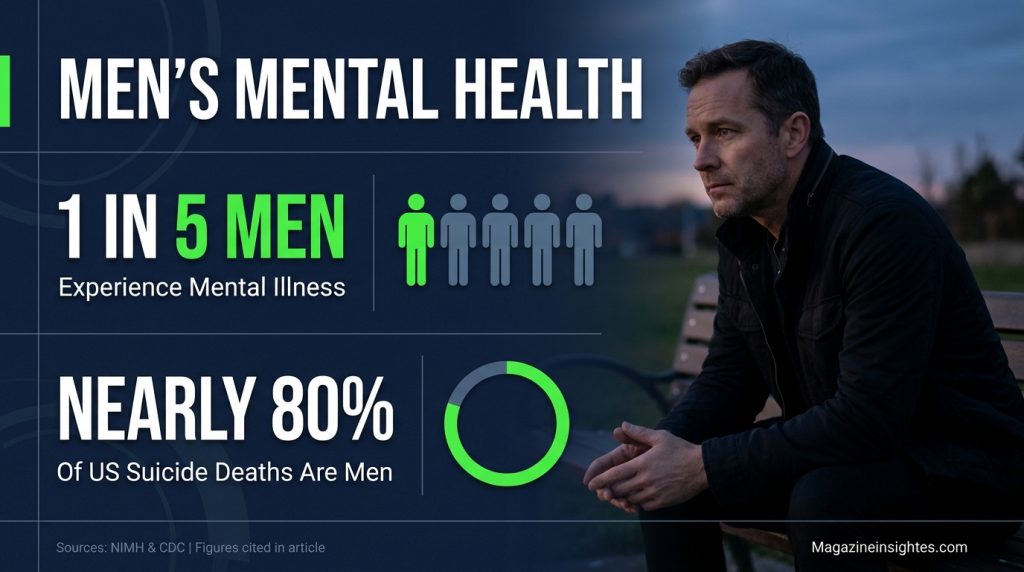
| Share of US suicide deaths that are men | Nearly 80 percent | CDC, 2023 |
| Men with alcohol use disorder, 2024 | 12.9 percent | NIAAA, 2025 |
| Male high school students reporting persistent sadness, 2023 | 27.7 percent | CDC, 2024 |
How Common Is Mental Illness in Men?
About one in five adult men in the United States had any mental illness in the past year, per NIMH figures from NSDUH 2022.
The figure was 19.7 percent for men, compared with 26.4 percent for women, using the same survey definitions.
SAMHSA estimated 19.0 percent for men in 2023, in a separate release, so the two years are close but not the same number.
Over 6 million men in the United States experience depression each year, per the Anxiety and Depression Association of America.
About one in eight men will experience depression in their lifetime, per NIMH figures cited in awareness materials.
The Treatment Gap
Men with mental illness get treatment less often than women, and the gap is wide.
NIMH reports that 41.6 percent of men with any mental illness received treatment in the past year, compared with 56.9 percent of women.
Only about one in four men who need mental health help seek treatment, per awareness materials citing NIMH and SAMHSA.
Stigma, cost, and the expectation to be strong and silent all keep men from asking for help.
Health insurance shapes access too, and our health insurance guide explains what coverage does and does not do.
Knowing what an HMO means also helps, and our HMO explainer covers the basics in plain language.
Suicide: The Hardest Number
Men make up about half the population but nearly 80 percent of suicide deaths, per CDC data for 2023.
The male suicide rate was 22.7 per 100,000 in 2023, close to four times the female rate of 5.9 per 100,000.
CDC reported 48,824 suicide deaths in the United States in 2024, with the male rate nearly four times the female rate.
Suicide rates are highest among men aged 75 and over, but suicide is also a leading cause of death for men aged 15 to 34.
About one man dies by suicide every 11 minutes in the United States, per the American Foundation for Suicide Prevention.
Sixty percent of the men who died had no documented mental health condition, per CDC suicide data cited by the Anxiety and Depression Association of America.
What the Numbers Do and Do Not Mean
Population numbers describe groups, not individuals, and they cannot predict any one person’s future.
A rate four times higher does not mean any single man is four times more likely to die, because risk depends on the person, not the average.
Survey figures also change when questions change, and SAMHSA warns that 2022 treatment figures should not be compared with 2021.
Use the numbers to understand the scale of the problem, not to judge any one man, including yourself.
Signs of Depression and Anxiety in Men
Depression in men does not always look like sadness, and that is why it is so often missed.
Knowing the signs helps you spot trouble in yourself and in the men around you, before it becomes a crisis.
Signs That Do Not Look Like Sadness
The National Institute of Mental Health lists anger, irritability, and aggressiveness among the symptoms men may experience.
High-risk activities, misuse of alcohol or drugs, and working too much can also be signs, not just bad habits.
Aches, headaches, and digestive problems without a clear cause are listed by NIMH as symptoms men report.
Changes in sleep, energy, and appetite matter too, especially when they last more than two weeks.
Persistent sadness and hopelessness do appear in men, but they are often hidden behind anger or withdrawal.
Social media can make things worse for young men, and our social media and teen mental health guide covers that link in detail.
When to Get Help
Get help if symptoms last more than two weeks, or if they interfere with work, sleep, or relationships.
Get help at once if you are thinking about suicide, or if someone you know says they are.
Asking someone directly whether they are thinking about suicide does not put the idea in their head, per NIMH research.
A doctor, a therapist, or a crisis line can all be a first step, and you do not need a diagnosis to call one.
What the Green Ribbon Means
Green is the colour associated with mental health awareness, and the green ribbon is its symbol.
People wear green ribbons in June to mark men’s mental health, and all year round for mental health generally.
Green for Mental Health
The green ribbon stands for mental health awareness, hope, and the fight against stigma.
It is worn for men’s mental health in June, and for mental health awareness in May and October too.
Wearing one is a small, visible way to say it is okay to talk, and that help is available.
Blue for Men’s Health
Blue is the colour of Men’s Health Month and Wear BLUE Day, and it is different from green.
Wear blue on the Friday before Father’s Day in June, and wear green when the message is mental health specifically.
Both colours are used in June, and both are correct, because they mark different parts of the same month.
June Is Also Pride Month: Do Not Confuse the Two
June is Pride Month as well as Men’s Health Month, and the two observances share the same calendar month.
They are separate observances with separate histories, and neither one cancels the other.
Same Month, Different Observance
Pride Month marks LGBTQ+ history, rights, and celebration, and it is the more widely recognised June observance.
Men’s Health Month marks men’s physical and mental health, and it is the less widely known of the two.
Some people first hear about men’s health month in June and assume it is a response to Pride Month, but the June date comes from Congress in 1994, decades before the confusion.
Both observances can be marked in the same month, and many workplaces and schools mark both.
How to Mark Men’s Mental Health Awareness Month
Marking the month means doing something, not just posting about it, and the ideas below are all practical.
Pick one action from each list, and you will have done more than most awareness posts ever do.
If You Are a Man
Book the checkup you have been putting off, and tell the doctor how you have been sleeping and feeling.
Talk to one person about how you are really doing, a friend, a brother, a partner, or a therapist.
Move your body every day, even a short walk counts, and keep your sleep regular.
Join Movember in November, or mark June with a Wear BLUE Day photo, and use it to start a conversation.
Cut back on alcohol if you have been drinking more than usual, because it makes low mood worse, not better.
If You Want to Help a Man
Check in directly, with a specific question, not a vague “how are you,” and listen to the answer without fixing it.
Do not say “man up” or “toughen up,” because those words are the stigma itself.
Offer practical help, such as booking an appointment or going with him, because practical help is easier to accept than advice.
Keep checking in after the month ends, because the hardest weeks are the ones with no campaign.
Learn the signs listed above, so you can spot trouble early, and act on what you see.
At Work and at School
Run a June or November event, a talk, a walk, or a fundraiser, and invite men to speak honestly.
Share the crisis numbers in a place everyone can see, not buried in a handbook nobody reads.
Train managers to ask directly about wellbeing, and to know what to do with the answer.
For young people, teach boys early that talking is strength, not weakness, and that asking for help is normal.
Phone calls about health can be confusing, and scams exist, so our Signify Health calls explainer shows how to tell a real health call from a fake one.
Where to Get Help Right Now
Help is available now, in every country, and it does not depend on the month, so use these resources whenever you need them.
General information only, not medical advice: these lines connect you to trained people, not to a diagnosis.
In a Crisis: Call or Text 988
In the United States, call or text 988 to reach the Suicide and Crisis Lifeline, at any hour, for free.
Trained counsellors answer, listen, and help you make a safety plan, and they can connect you to local help.
You do not need to be in crisis to call, and you can call for someone else too.
The 988 Lifeline site explains what happens when you call, so you know what to expect before you dial.
Text HOME to 741741
Text HOME to 741741 to reach the Crisis Text Line in the United States, if you would rather type than talk.
A trained crisis counsellor replies by text, and the conversation is free and confidential.
Texting suits people who find phone calls hard, and it works from anywhere with a mobile signal.
Finding Longer Term Help
The National Institute of Mental Health statistics page is the best starting point for understanding how common mental illness is and how treatment works.
Mental Health America offers screening tools and local resources, and its home page is the front door to them.
To take part in Movember, sign up on the Movember US site, where you can grow, move, host, or donate.
For a therapist, ask your doctor for a referral, or search the directories run by NAMI and the Anxiety and Depression Association of America.
Before you trust any health company or service, check it first, as our Prosper Health legitimacy review shows how to do.
The CDC publishes the suicide data behind the numbers in this page, and it is named in plain text here.
Its site returned a 403 error to our check on November 10, 2026, so it is not linked.
Frequently Asked Questions
When is men’s mental health awareness month?
In the US it is most often June, during Men’s Health Month. November is the second window, for Movember and International Men’s Day.
Neither month is an official federal observance, so the full answer is both months, for different reasons.
Is men’s mental health awareness month in June or November?
Both, for different reasons. June is the US Men’s Health Month, and November is Movember.
US sources name June first, while UK and Australian sources name November first, and both are correct for their country.
Is there an official men’s mental health awareness month?
No. No single month holds that official title in the US, and no single month is standard worldwide.
Congress began National Men’s Health Week in June 1994, but that was a health week, not a mental health month.
What month is men’s mental health awareness month in the US?
June, as part of Men’s Health Month, run by the Men’s Health Network and other advocates.
November is the second US window, through Movember, and it grows bigger every year.
What month is men’s mental health awareness month in the UK?
November, aligned with Movember. June has Men’s Health Week, but November carries the national campaigns.
UK charities such as CALM and Andy’s Man Club run their biggest pushes in November, not June.
What month is men’s mental health awareness month in Australia?
November, through Movember, which began in Australia in 2003. October is Australia’s broader Mental Health Month, and June has Men’s Health Week.
What month is men’s mental health awareness month in Canada?
June, championed by the Canadian Men’s Health Foundation. Canada is developing its first Men and Boys’ Health Strategy, due in fall 2026.
When is men’s mental health awareness month 2026?
June 1 to 30, 2026, and Movember November 1 to 30, 2026, with International Men’s Day on Thursday, November 19, 2026.
When is men’s mental health awareness month 2027?
June 1 to 30, 2027, with Men’s Health Week leading up to Father’s Day on June 20, 2027, and Movember November 1 to 30, 2027.
What is Movember?
A global charity campaign every November. Men grow a moustache, or run or walk 60 miles, to raise money and awareness for men’s mental health, suicide prevention, prostate cancer, and testicular cancer.
When does Movember start and end?
November 1 to November 30, every year, in the United States, the United Kingdom, Australia, Canada, and dozens of other countries.
Is Movember the same as No-Shave November?
No. Movember is run by the Movember Foundation, founded in Australia in 2003. No-Shave November is a different campaign, now run by Fight Colorectal Cancer since 2024, for all cancers.
What is International Men’s Day?
November 19 every year. In 2026 it falls on a Thursday, and the global theme is “The Future Is Everyone.”
What is Men’s Health Week?
The week leading up to Father’s Day in June. In 2026 it ran June 15 to 21, with Father’s Day on June 21.
When is Father’s Day 2027?
June 20, 2027. Men’s Health Week 2027 leads up to that date.
What color is men’s mental health awareness month?
Green is the colour associated with mental health awareness, and the green ribbon is its symbol. Blue is worn on Wear BLUE Day in June.
What is Wear BLUE Day?
The Friday before Father’s Day in June, when people wear blue to raise awareness of men’s health. In 2026 it fell on June 19.
What is the 2026 theme for men’s health month?
“Partners in Care: Advancing Men’s Health Through Connection, Education, and Advocacy,” per recovered.org, labelled by source.
What is the 2026 International Men’s Day theme?
“The Future Is Everyone,” per vo.care, labelled by source.
When did men’s health month start?
Congress began National Men’s Health Week in June 1994, per recovered.org. Some sources credit the Men’s Health Network instead, so the starter is kept by source.
When did Movember start?
In Australia in 2003, as a moustache-growing charity campaign for prostate cancer, later broadening to mental health.
How much money has Movember raised?
Movember says the moustaches have funded more than 1.8 billion Australian dollars in work on mental health, suicide prevention, prostate cancer, and testicular cancer.
What is Move 60?
Movember’s challenge to run or walk 60 miles over November. The 60 miles stand for the 60 men lost to suicide every hour around the world.
How do I take part in Movember?
Grow a moustache, Move 60 miles, Host an event, or Donate, through the Movember site for your country.
How common is mental illness in men?
NIMH, from NSDUH 2022: an estimated 19.7 percent of adult males in the US had any mental illness in the past year. SAMHSA estimated 19.0 percent for 2023.
What share of men with mental illness get treatment?
NIMH 2022: 41.6 percent of males with any mental illness received treatment in the past year, compared with 56.9 percent of females.
How many men die by suicide in the US?
CDC: 48,824 people died by suicide in the US in 2024, and the male rate was nearly four times the female rate.
What is the male suicide rate?
CDC 2023: 22.7 per 100,000 for males, compared with 5.9 per 100,000 for females, close to four times higher.
What share of US suicide deaths are men?
Men make up about half the population but nearly 80 percent of suicide deaths, per CDC 2023 data.
What are the signs of depression in men?
NIMH lists persistent sadness, anger, irritability, aggressiveness, high-risk activities, alcohol or drug misuse, and aches, headaches, or digestive problems without a clear cause, plus sleep, energy, and appetite changes.
Why do men not seek help?
Stigma, the expectation to be strong and silent, and symptoms that do not look like sadness, so they go unrecognised by the man himself and by others.
Is June Pride Month or men’s health month?
Both. June is Pride Month and Men’s Health Month. They are separate observances in the same month.
Is May mental health awareness month?
Yes. May is Mental Health Awareness Month generally in the US, since 1949. It is not men’s specific.
What is the difference between men’s health month and men’s mental health month?
Men’s Health Month covers physical and mental health together. Men’s mental health is the mental health part of that month, and the focus of Movember in November.
How can I support men’s mental health awareness month?
Check in on the men in your life, start a conversation, share resources, wear green or blue, donate to Movember, or join a Move 60 challenge.
How do I talk to a man about his mental health?
Ask directly, listen without fixing, do not say “man up,” and offer practical help such as booking an appointment or going with him.
What should I do if a man says he is thinking about suicide?
Take it seriously, stay with him, ask directly, and call or text 988 in the US, or your local crisis line. Asking does not put the idea in his head, per NIMH.
Where can men get help for mental health?
In the US: call or text 988, text HOME to 741741, or find a therapist through NIMH, NAMI, or the Anxiety and Depression Association of America.
Is men’s mental health awareness month only for men?
No. Anyone can take part, support, donate, or start a conversation. The month is about men’s health, not only for men.
Does men’s mental health awareness month actually help?
Awareness months raise conversation and donations, but they do not replace treatment. The test is whether more men get help, not how many posts appear.
Conclusion
When is men’s mental health awareness month? In the United States, it is June, and in November, Movember carries the same message around the world.
Neither month is official, and neither month is enough on its own, because the need does not follow a calendar.
The numbers are the reason the months exist: about one in five men had a mental illness in the past year.
Fewer than half got treatment, and men account for nearly 80 percent of suicide deaths, per the sources named above.
The campaigns are the tools, not the cure: a moustache, a 60 mile walk, a blue shirt, a green ribbon, and a conversation.
Use June to check in, use November to fundraise, and use every other month to keep checking in, because the men you know need you all year, not only in June and November.
If you need help now, call or text 988, or text HOME to 741741. No tip is too small, and no conversation is too small either.
Last checked November 10, 2026. The dates repeat every year, but the statistics should be re-checked before you quote them again.