Why Did the Steelers Bench Aaron Rodgers? 6 Reasons, Stats, What’s Next
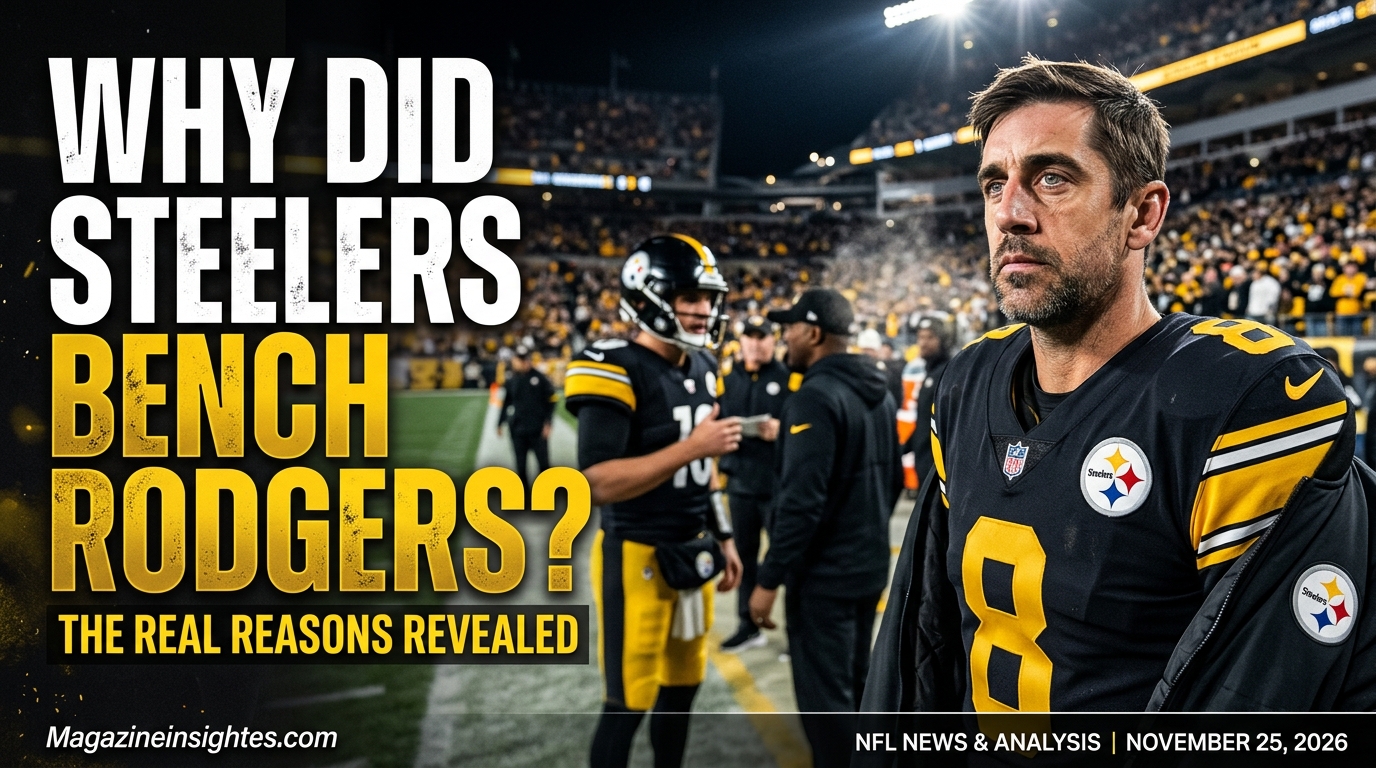
Why did the Steelers bench Aaron Rodgers? The Steelers benched Aaron Rodgers because the offense stopped moving, the losses piled up, and head coach Mike McCarthy decided a spark was needed.
The decision came late Tuesday night, November 24, 2026, less than 24 hours after McCarthy had publicly backed Rodgers as the starter. Mason Rudolph starts Friday against Denver, and Rodgers will be inactive.
Rodgers is 42, turns 43 on December 2, and has already said the 2026 season will be his last.
That timing makes the benching heavier than a normal quarterback change, because it may have ended his career.
Readers will find the answer first, then the timeline, then each reason with the numbers behind it. The comparison with Rudolph, the full game log, and the options for what happens next follow.
Facts checked November 25, 2026, against Reuters, the Associated Press, Sports Illustrated, theScore, the Steelers, and the NFL. Next update after the Broncos game on Friday, November 27.
The Short Answer: Six Reasons in One Place
The Steelers benched Aaron Rodgers for six reasons, and they stack on top of each other. No single reason explains the call, but together they make the decision easy to understand.
First, the performance collapsed. Rodgers posted the worst numbers of his career as a starter, with a 60.9 percent completion rate and an 86.6 passer rating through 10 starts.
Second, the offense stopped moving. Pittsburgh gained only 477 total yards across the last two games, and the passing game produced almost no chunk plays down the field.
Third, age and hits caught up. Rodgers is 42, has been sacked 31 times, and now gets rid of the ball faster than almost any quarterback in the league.
Fourth, the supporting cast shares blame. The offensive line has struggled, and the receiving corps has been thinned by injury and by a disqualification.
Fifth, the playoff clock is ticking. Pittsburgh holds the final wild card spot by one game, and the division race is tight enough that one loss changes the order.
Sixth, the backup has done this before. Mason Rudolph went 3-0 down the stretch in 2023, and the locker room trusts him to spark the offense on a short week.
The table below puts all six reasons in one place, with the key number for each. Every section after it explains one reason in full, with sources and dates.
| Reason | What happened | Key number |
|---|---|---|
| 1. Performance collapsed | Worst season of his career as a starter | 86.6 passer rating, 19th in the NFL |
| 2. Offense stopped moving | Almost no chunk plays in two losses | 477 total yards in two games |
| 3. Age and hits | 42 years old, sacked constantly | 31 sacks, 257 yards lost |
| 4. Supporting cast | Line struggles, receivers thin | 5 sacks in the Eagles loss |
| 5. Playoff clock | Final wild card spot, one game lead | 6-4, ahead of New England at 5-5 |
| 6. Rudolph has sparked before | Won three straight to reach the 2023 playoffs | 118.0 rating in the 2023 run |
One fact matters before the detail: the benching was a coach’s decision, not an injury move. Rodgers was not on the Tuesday injury report, and the team gave no medical reason.
What Happened: The Timeline From Monday to Tuesday Night
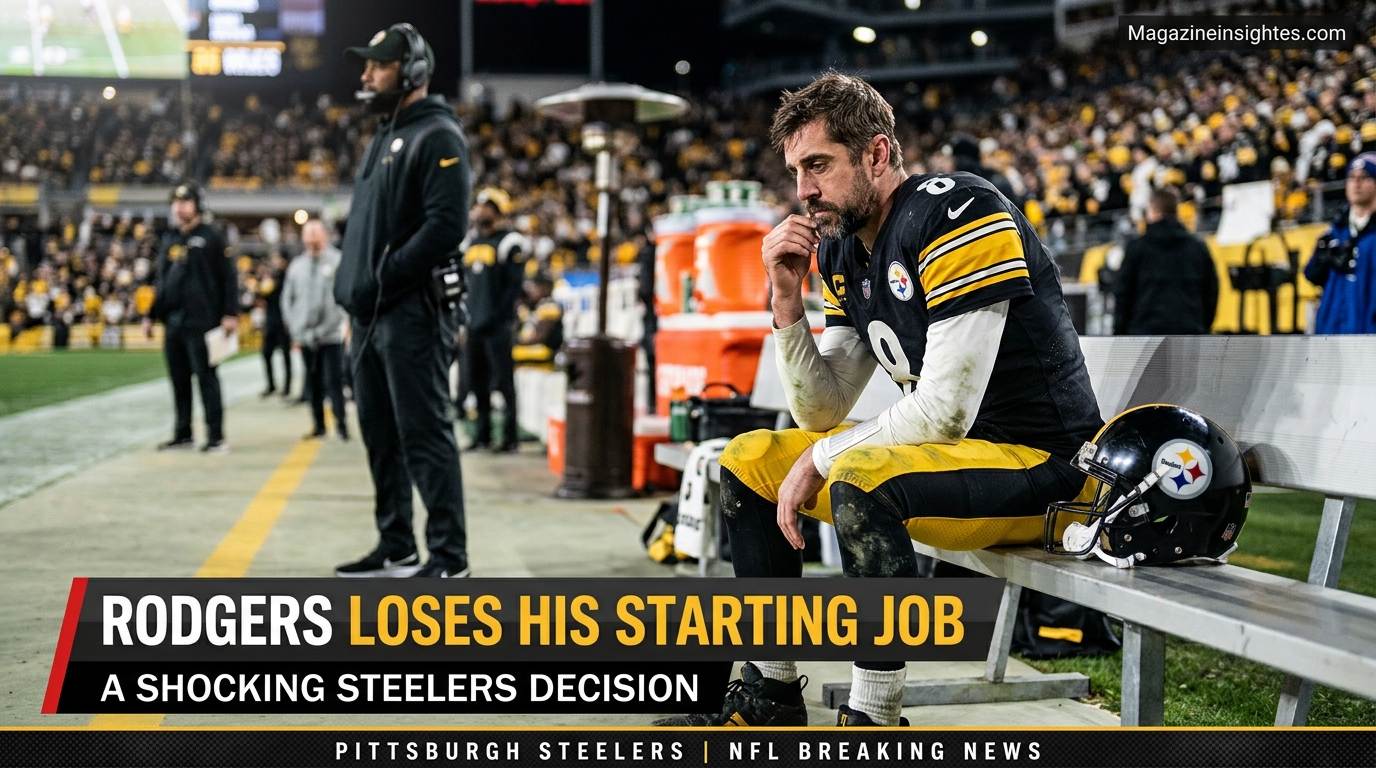
The story moved in about 36 hours, from a public vote of confidence to a late-night announcement. The speed is part of why the move shocked the league, and the timeline below lays it out.
| Date | Event | Source |
|---|---|---|
| May 20, 2026 | Rodgers says 2026 will be his last season: “This is it” | NFL.com, Fox Sports |
| May 2026 | Rodgers re-signs with Pittsburgh on a one-year deal | Sports Illustrated |
| September 13, 2026 | Season opens with a 20-13 win over Atlanta | Team schedule |
| November 15, 2026 | Steelers crushed 38-18 at Cincinnati on Sunday Night Football | Sportradar, Associated Press |
| November 22, 2026 | Steelers lose 19-16 at Philadelphia to a backup quarterback | Sportradar, Associated Press |
| November 23, 2026 | McCarthy says “Aaron Rodgers is our quarterback” | ESPN, Brooke Pryor |
| November 24, 2026 | Decision made during the day, per ESPN reporting | ESPN, Brooke Pryor |
| November 24, 2026, 11:10 PM | Steelers announce Rudolph starts Friday, Rodgers inactive | Steelers on X, Burt Lauten |
| November 27, 2026, 3:00 PM ET | Steelers host Denver on Black Friday, Prime Video | NFL schedule |
Monday: “Aaron Rodgers Is Our Quarterback”
On Monday, November 23, McCarthy shut down the benching talk in blunt terms. ESPN reporter Brooke Pryor asked if he had considered turning to Rudolph, and McCarthy answered with one line.
“Aaron Rodgers is our quarterback,” McCarthy said. The quote ran everywhere within the hour, and it read as a final answer to the question.
McCarthy also owned the struggles that day. He said the team had not played well on offense for two weeks, and added that he starts with himself when the unit fails.
“We haven’t played well the last two weeks on offense,” McCarthy said. “When you’re in that spot, I start with myself. We have a lot of work to do.”
After the Eagles loss, McCarthy had said the offense needed to take a step back and look at some things. Nothing in his Monday words hinted that the step back would be a quarterback change.
Tuesday: The Decision Made During the Day
On Tuesday, the decision was made during the day, according to ESPN reporting from Brooke Pryor. The move was a coaching decision, and it took shape as the hours passed.
NFL insider Tom Pelissero reported the same point after the announcement. Sources told him the call was McCarthy’s alone, and that Rodgers had struggled enough to force it.
“Sources say this was a coach’s decision,” Pelissero wrote. “But Rodgers has struggled and now Mike McCarthy is making a change.”
Rodgers spoke to reporters after practice Tuesday, and he was not on the injury report. Nothing about his health explains the move, which is why the performance case carries the weight.
Reuters noted the whiplash in its report. The benching came a little over 24 hours after team brass had laughed the idea off, which is how fast a season can turn.
Tuesday Night, 11:10 PM: The Announcement
The Steelers announced the change late Tuesday night in a statement from senior director of communications Burt Lauten, posted on the team’s official X account at about 11:10 PM.
“The Pittsburgh Steelers have named Mason Rudolph the starting quarterback for the game this Friday against the Denver Broncos,” the statement said. “Aaron Rodgers will be inactive for the game on Friday.”
The statement gave no reason for the change. It named the starter, it named the inactive player, and it stopped there, which left the reporting to fill in the why.
Breaking stories move this fast now, and a Monday denial can become a Tuesday night announcement before most fans wake up.
The guide to why Mexico cartel news is trending shows the same pattern, with a story changing hour by hour and each update carrying its own source and date.
Pelissero added the line that framed the night. He noted that the 42-year-old may have played the final snaps of his Hall of Fame career, which turned a roster move into a legacy question.
Reason 1: The Worst Stretch of Rodgers’ Career as a Starter
Rodgers has started for 19 seasons, and the 2026 numbers sit at the bottom of that run.
Every major rate stat is the worst of his career as a starter, and the drop from 2025 is sharp.
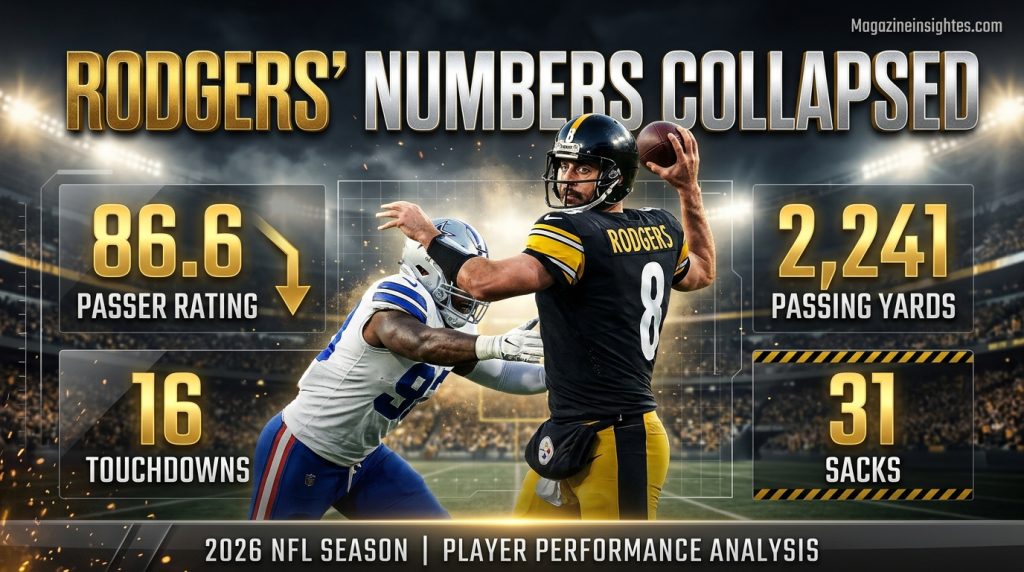
Through 10 starts, Rodgers has completed 220 of 361 passes for 2,241 yards, 16 touchdowns, and six interceptions. His completion rate is 60.9 percent, and his passer rating is 86.6.
That rating ranks 19th in the NFL, and it is the lowest of his career in a season with multiple starts, according to the Associated Press.
The 60.9 percent completion rate is the 10th worst among 32 qualified passers.
His 6.2 yards per pass attempt ranks 26th in the league, and his minus 66.2 EPA ranks third worst among qualified passers, per Next Gen Stats.
EPA measures expected points added, so a deep negative total means the passing game cost points.
His minus 0.11 EPA per dropback ranks 28th among 32 qualified quarterbacks. Only four starters have been less efficient on a per-play basis this season, which is the core of the coaching case.
The Two Losses That Ended It
The benching followed two straight losses after a 6-2 start, and both exposed the same problem. The Steelers lost 38-18 at Cincinnati in Week 10, then 19-16 at Philadelphia in Week 11.
Against Cincinnati, Rodgers completed 15 of 29 passes for 143 yards, two touchdowns, and no interceptions. The Steelers had only 33 total yards of offense after three quarters, and most of the production came late.
Against Philadelphia, Rodgers completed 30 of 44 passes for 227 yards, one touchdown, and no interceptions. He was also the team’s leading rusher, with 29 yards on five carries, including a 12-yard scamper.
Pittsburgh fell behind 13-0 in Philadelphia, and the first four drives ended in a turnover on downs and three punts.
Rodgers never guided the team out of that hole, and the loss stung more because of who beat them.
The Eagles were starting backup quarterback Joe Milton, with Jalen Hurts out, and they had lost seven straight games before Sunday.
Losing to a backup-led 3-7 team was the final straw for McCarthy, per the reporting that followed.
In the two defeats, Rodgers averaged under 5.5 yards per attempt in consecutive games for just the second time in the past 10 seasons.
The first time was Weeks 4 and 5 of the 2024 season, and he has never had such a streak span three games.
The Numbers Behind the Call
The table below carries the season line, with each number labeled by its source. The pattern is consistent: the volume looks fine, and the efficiency does not.
| Stat, 2026 season | Figure | League rank or note | Source |
|---|---|---|---|
| Completions and attempts | 220 of 361 | 60.9 percent completion | NFL.com, ESPN |
| Passing yards | 2,241 | 224.1 yards per game | NFL.com, ESPN |
| Touchdowns and interceptions | 16 touchdowns, 6 interceptions | Not a turnover problem | NFL.com, ESPN |
| Passer rating | 86.6 | 19th in the NFL, career low as a starter | NFL.com, Associated Press |
| Yards per attempt | 6.2 | 26th in the NFL | ESPN, CBS Sports |
| Completion rate | 60.9 percent | 10th worst of 32 qualified passers | Sports Illustrated |
| Expected points added | Minus 66.2 | Third worst of 32 qualified passers | Next Gen Stats |
| EPA per dropback | Minus 0.11 | 28th of 32 qualified quarterbacks | CBS Sports |
| Off-target pass rate | 13.6 percent | Eighth worst in the league | TruMedia |
| Time to throw | 2.85 seconds | Sixth fastest in the NFL | CBS Sports |
| Deep passes, 20-plus yards | 11 of 52 | 21.2 percent completion on deep balls | SumerSports |
| Sacks taken | 31 | League worst 257 yards lost | NFL.com, Associated Press |
| Adjusted QBR | 45.6 | Below league average | ESPN |
| Rushing | 19 attempts, 51 yards | 2.7 yards per carry | ESPN |
The most telling row is the touchdown-to-interception line. Rodgers threw three touchdowns and no interceptions across the two losses, so turnovers did not cause the benching. The offense simply could not gain yards in chunks.
His 13.6 percent off-target rate ranks eighth worst in the league, per TruMedia, which means more than one throw in eight misses its target entirely. Accuracy, not decision-making, is the visible decline.
His 2.85-second average time to throw ranks sixth fastest in the NFL, which sounds good until it is read with the sack total.
He is getting rid of the ball fast because pressure arrives fast, and the quick throws go nowhere.
Reason 2: The Offense Stopped Moving
The Steelers rank 23rd in total yards, at 310.4 per game, and 22nd in passing, at 198.6 per game. They average 21.4 points per game, which is not enough to carry a playoff push.
The last two games produced 477 total yards combined, per Sports Illustrated, which is about 238 yards per game.
An NFL offense cannot win on that output, and the Steelers lost both games by a combined 23 points.
Pittsburgh scored 18 points or less in each of the last two games, and the pattern started right after the Week 9 bye.
The break was supposed to refresh the offense, and the offense came back worse.
No Chunk Plays, Not a Turnover Problem
The two losses produced 370 passing yards on 73 attempts, which is about 5.1 yards per attempt. Rodgers threw three touchdowns and no interceptions in those games, so the problem was never ball security.
Chunk plays are the missing piece. A chunk play gains 20 yards or more, and it flips field position, opens the playbook, and forces the defense to defend the whole field. Pittsburgh stopped producing them.
Rodgers completed only 11 of his 52 passes that travelled 20-plus yards in the air, per SumerSports.
That is a 21.2 percent completion rate on deep balls, and it tells defenses they can crowd the line.
When defenses stop fearing the deep ball, they press the short routes and attack the run. The Steelers then face stacked boxes and tight coverage on every down, which shrinks the offense further.
The Deep Ball Disappeared
The decline is visible across the season arc.
Rodgers had a four-game stretch in the middle of the year with 11 touchdown passes and at least 235 passing yards in each outing, and then the production fell off a cliff.
In his last four starts, Rodgers failed to reach 235 yards in any outing, and he recorded only four touchdowns across that stretch. The four starts were the Saints, Browns, Bengals, and Eagles games.
The 2025 comparison makes the drop plain. In his first Pittsburgh season, Rodgers completed 327 of 498 passes for 3,322 yards, 24 touchdowns, and seven interceptions, with a 94.8 rating.
The table below puts the two years side by side.
| Stat | 2025 season | 2026 season, 10 starts |
|---|---|---|
| Record as starter | 10-6, wild card loss 30-6 to Houston | 6-4, final wild card spot |
| Completions and attempts | 327 of 498 | 220 of 361 |
| Completion rate | 65.7 percent | 60.9 percent |
| Passing yards | 3,322 | 2,241 |
| Yards per attempt | 6.7 | 6.2 |
| Touchdowns and interceptions | 24 touchdowns, 7 interceptions | 16 touchdowns, 6 interceptions |
| Passer rating | 94.8 | 86.6 |
| Games played | 16 regular season games | 10 starts |
The 2025 numbers were not elite, but they were functional. The 2026 numbers are the worst of his starting career, and the gap between the two years is the gap McCarthy acted on.
Rodgers also threw for under 200 yards three times in his first nine games, and he was held under 200 yards in both of the final two losses before the benching.
The floor of the offense kept dropping.
Reason 3: Age, Mobility, and the Hits

Rodgers is 42 years old, and he turns 43 on December 2, 2026.
He is the oldest player on the Steelers roster, and he is playing the hardest position in the sport at an age when almost no quarterback still starts.
Age alone does not end a career, and public figures in every field keep performing past the age when most people retire.
The record of Bill Clinton’s health at 80 shows a public figure staying active through serious heart disease, with a bypass at 58 and stents at 64.
The difference is the hits. A quarterback takes contact that no other public job delivers, and Rodgers has taken 31 sacks this season, the most sack yardage lost in the league at 257 yards.
Watching the tape explains the benching better than the box score. Rodgers now plays the position not to get hit anymore, which means shorter drops, quicker throws, and fewer chances taken down the field.
Thirty-One Sacks
Rodgers has been sacked 31 times in 10 starts, which is more than three sacks per game. The Eagles sacked him five times on Sunday, and the Bengals added to the total the week before.
Eight of those sacks came in the last two games, which tracks with the offensive collapse. Pressure arrived faster, Rodgers had less time, and the quick throws that followed went for almost nothing.
The sack total is a shared failure, and the offensive line owns part of it. But a quarterback who cannot move in the pocket turns pressure into sacks, and Rodgers’ mobility is gone at 42.
His rushing line tells the same story. Rodgers has 19 carries for 51 yards this season, at 2.7 yards per carry, and his longest run is 12 yards.
He led the team in rushing against Philadelphia with 29 yards, which says more about the run game than about him.
The Fastest Release in the League
Rodgers’ average time to throw is 2.85 seconds, the sixth fastest in the NFL. He is getting the ball out quickly, which limits sacks in theory, but the quick throws are short throws.
Short throws keep the chains from moving.
A two-yard pass on third and eight is a punt, and a five-yard pass on first down leaves second and five with a defense that knows what is coming.
The deep ball is the casualty. Only 11 of 52 passes travelling 20-plus yards found their target, and the 21.2 percent rate is the number that changed how defenses play Pittsburgh.
Age shows up first in the legs, then in the arm, and the tape shows both.
Rodgers cannot escape pressure the way he once did, and he cannot drive the deep ball the way he once did.
Age Is Part of the Story
Rodgers has already said this is his final season, and he said it in May, before the year began.
He told reporters “This is it” on May 20, and he doubled down on that plan during the summer.
A final season changes how a benching lands. A 28-year-old benched quarterback gets another chance next week, but a 42-year-old in his last season may never take another snap.
That is why the reporting keeps returning to the same line.
Pelissero noted that Rodgers may have played the final snaps of his Hall of Fame career, and Yahoo Sports wrote that he may have played his last NFL game.
Reason 4: The Supporting Cast Shares the Blame
The benching is not all on Rodgers, and the honest version of the story says so.
The offensive line and the receiving corps have not done him any favors, and one insider made that point the same day.
Steelers Wire argued the change may target the wrong problem, writing that the line and the lack of pass catcher help have not done Rodgers any favors.
The team is willing to admit the offense is broken, but the fix may be aimed at the wrong man.
That counter-argument deserves space, because it is the strongest case against the benching. If the line cannot block and the receivers cannot separate, then a new quarterback inherits the same problems.
The Offensive Line
The line has allowed 31 sacks in 10 games, and the pressure has grown worse as the season went on. Five sacks against Philadelphia and steady pressure against Cincinnati broke the rhythm of both games.
Six Steelers missed the Eagles game, among them offensive linemen Dylan Cook and Mason McCormick, per the depth chart update after Week 11.
Injuries forced changes up front, and the replacements could not hold the pocket.
The run game has been the line’s one bright spot. Jaylen Warren ran for 143 yards and a touchdown against Cleveland, and Rico Dowdle added 56 yards and a score in the same game.
Warren also turned a short dump-off into an 80-yard touchdown against Indianapolis, which shows the line can open space when the play works. The problem is consistency, not a total absence of talent.
Rudolph will face the same line on Friday, and the same pressure, against a Denver defense that ranks among the best in the league.
If the line fails again, the quarterback change will look like a scapegoat move.
The Depleted Receiving Corps
The receiving corps has been thinned all season, starting in the preseason. Rodgers did not suit up for any preseason game, because his top two receivers were hurt.
DK Metcalf and Michael Pittman both carried hamstring injuries in August, and McCarthy tied the decision to rest Rodgers to their health.
He said he would only have used Rodgers if both men were available to play.
Pittman missed the Week 2 loss at New England with a foot injury, and the passing game struggled badly without him. Bernard and Metcalf turned 17 combined targets into just 62 yards that day.
Metcalf was disqualified during the Eagles game, which forced rookie Max Hurleman into his first NFL action.
Hurleman stepped up late, catching the 20-yard touchdown with 1:21 left, but the team played most of the game short-handed.
The depth behind the starters is young. Rookie Germie Bernard has made plays, including the overtime winner against Tampa Bay, and Roman Wilson and Ben Skowronek have caught touchdowns.
Youth brings energy, and it also brings mistakes.
Pat Freiermuth and Darnell Washington have been the reliable targets, with Freiermuth catching touchdowns in three different games. The tight ends have carried the passing game when the wide receivers were unavailable.
Reason 5: The Playoff Clock
The Steelers are 6-4, and they hold the final wild card spot in the AFC, one game ahead of New England at 5-5.
The margin is thin enough that one more loss could drop them out of the playoff picture entirely.
The division race is just as tight. Cincinnati leads the AFC North at 7-3, Cleveland and Pittsburgh sit at 6-4, and Baltimore trails at 4-7.
One week changes the order, and Pittsburgh has already split with both Ohio rivals.
The table below shows the division as it stands after Week 11, with the records that decide the tiebreakers.
Pittsburgh is 2-2 in the division, while Cleveland is 2-1, which matters if the two finish level.
| Team | Record | Notes |
|---|---|---|
| Cincinnati Bengals | 7-3 | Leads the AFC North |
| Cleveland Browns | 6-4 | Split with Pittsburgh, owns the tiebreaker edge at 2-1 in the division |
| Pittsburgh Steelers | 6-4 | Holds the final AFC wild card spot, 2-2 in the division |
| Baltimore Ravens | 4-7 | Two games left against Pittsburgh |
The Wild-Card Spot
Pittsburgh sits in seventh place in the AFC standings, which is the last playoff spot.
New England sits one game back at 5-5, and the gap is small enough that a loss to Denver could erase it.
The Steelers have split with both rivals so far. They beat Cincinnati 30-27 and lost 38-18, and they lost 27-24 at Cleveland before winning the rematch 27-6.
Head-to-head will not break a tie with either team.
That puts more weight on the two games left with Baltimore, and on the division record. Every remaining game carries playoff weight, which is why McCarthy acted now instead of waiting.
The Division Race
Cincinnati leads at 7-3, and the Bengals just beat Pittsburgh by 20 points. The gap is one game, but the head-to-head loss means Pittsburgh needs help to catch them.
Cleveland sits level with Pittsburgh at 6-4, and the Browns own the better division record at 2-1. If the two finish tied, the tiebreaker math favors Cleveland, which adds urgency to every remaining game.
Baltimore trails at 4-7, but the Ravens play Pittsburgh twice more. A struggling rival with two chances to hurt you is still dangerous, and the Steelers cannot afford to drop either game.
Denver arrives as one of the best teams in the AFC, at 8-2 and tied with Kansas City atop the AFC West.
The Broncos beat the Raiders 38-24 on Sunday, and rookie running back Jonah Coleman ran 24 times for 111 yards and three touchdowns.
Reason 6: Mason Rudolph Has Sparked This Team Before
Rudolph is not an unknown quantity in Pittsburgh, and that familiarity is the heart of the decision.
He has started 19 games in seven seasons, most of them with the Steelers, and he has rescued this team before.
His career line is modest: 64.2 percent completions, 4,927 yards, 30 touchdowns, and 22 interceptions, with an 84.3 passer rating. His record as a starter is 9-9-1, which is exactly average.
Average is the point, in a strange way. Rodgers has been below average this season by every efficiency measure, so an average quarterback who moves the offense is an upgrade, not a gamble.
ESPN reporting says the locker room factor mattered most.
Rudolph’s past experience and his rapport in the locker room were critical in making the decision to start the 31-year-old on a short week, according to sources.
The 2023 Run: 3-0, No Interceptions
In 2023, Rudolph took over for the final three regular-season games and the Steelers won all three to reach the playoffs. He filled in for Kenny Pickett, and the team caught fire behind him.
He completed 55 of 74 passes for 719 yards, three touchdowns, and no interceptions across those four appearances, with a 118.0 rating. The run included road wins at Seattle and Baltimore.
His best game came at Baltimore in Week 18, where he completed 18 of 20 passes for 152 yards, one touchdown, and a 115.0 rating.
The Steelers won, clinched a playoff spot, and Rudolph became a folk hero in Pittsburgh.
He also started the wild-card game, a 31-17 loss at Buffalo. The playoff loss does not erase the run, and it is the run that McCarthy is betting on now.
The table below carries his year-by-year line, from the official Steelers roster page. The 2023 row is the one that explains why Pittsburgh trusts him.
| Season | Team | Games | Completions and attempts | Yards | Touchdowns and interceptions | Rating |
|---|---|---|---|---|---|---|
| 2019 | Pittsburgh | 10 | 176 of 283 | 1,765 | 13 touchdowns, 9 interceptions | 82.0 |
| 2020 | Pittsburgh | 5 | 25 of 43 | 324 | 2 touchdowns, 1 interception | 87.7 |
| 2021 | Pittsburgh | 2 | 35 of 58 | 277 | 1 touchdown, 1 interception | 70.8 |
| 2023 | Pittsburgh | 4 | 55 of 74 | 719 | 3 touchdowns, 0 interceptions | 118.0 |
| 2024 | Tennessee | 8 | 146 of 228 | 1,530 | 9 touchdowns, 9 interceptions | 80.1 |
| 2025 | Pittsburgh | 5 | 38 of 52 | 310 | 2 touchdowns, 2 interceptions | 84.6 |
| 2026 | Pittsburgh | 4 | 1 of 4 | 2 | 0 touchdowns, 0 interceptions | 39.6 |
| Career | Both teams | 38 | 476 of 742 | 4,927 | 30 touchdowns, 22 interceptions | 84.3 |
The full career line is available on the official Mason Rudolph page on the Steelers site, which carries the season-by-season table and the game splits.
The 2023 row is the strongest in the table by a wide margin.
The 2025 Chicago Start
Rudolph started at Chicago on November 23, 2025, while Rodgers was out with a broken left wrist.
He completed 24 of 31 passes for 171 yards, one touchdown, and one interception, and the Steelers lost 31-28.
One outlet dates that start to Week 12 of the 2026 season, which cannot be right, because Week 12 of 2026 is the Denver game.
The Associated Press, the Steelers’ own recap, and the year-by-year table all place the Chicago start in 2025.
The 2025 start matters because it was recent, and because Rudolph played well in a loss.
A 77.4 percent completion rate on the road, in relief, is the kind of performance that sticks in a coach’s mind.
His 2024 season in Tennessee was the opposite story. He started five of eight games for the Titans, threw for 1,530 yards, and finished with nine touchdowns against nine interceptions.
The risk in the change is real, and the 2024 line is the evidence.
Why the Short Week Favors the Backup
Friday’s game comes on a short week, with only three days between the announcement and kickoff. Rudolph gets a short week of practice with the first team, which would be a problem for an outsider.
Rudolph is not an outsider. He was drafted by Pittsburgh in 2018, in the third round with the 76th overall pick, and six of his seven NFL seasons have been with the Steelers.
He knows the building, the playbook, and the locker room.
He signed a two-year deal with Pittsburgh last offseason, knowing Rodgers would start ahead of him.
Both general manager Omar Khan and the coaching staff, from former coach Mike Tomlin to current coach Mike McCarthy, have publicly expressed confidence in him if needed.
ESPN reporting says that confidence decided it.
The team thought the offense could use a spark, and it wanted to give Rudolph an opportunity, because his past ability to spark the Steelers is on the record.
Rudolph will make his 20th career start on Friday, in his 39th game played.
He has thrown only four passes this season, completing one for two yards, so the rust question is real, and Friday will answer it.
It Was Not an Injury
The benching was not about an injury, and every source agrees on that point. Rodgers was not on the Tuesday injury report, and the team’s statement gave no medical reason for the change.
Rodgers spoke to reporters after practice on Tuesday, hours before the announcement. A hurt quarterback does not take practice reps and meet the press, and then get benched for health reasons the same night.
The distinction matters because it changes the question. An injured starter returns when he heals, but a benched starter returns only when the coach changes his mind, and that is a harder road back.
Rodgers will be a healthy inactive on Friday, which means he will not dress for the game while the team plays.
One report called it the first healthy inactive of his storied career, and the phrase captures how unusual the moment is.
The McCarthy Factor: The Coach Who Built Rodgers
The most jarring part of the benching is who made the call. Mike McCarthy coached Rodgers for 13 seasons in Green Bay, from 2006 to 2018, and the two won a Super Bowl together.
The coach who built the quarterback just benched him.
McCarthy developed Rodgers into a four-time NFL MVP and a Super Bowl MVP, and their partnership defined both careers. That history makes the decision harder to read, and harder to dismiss as a panic move.
One syndicated report says McCarthy coached Rodgers for 14 seasons, but the years 2006 to 2018 add to 13, and the Associated Press and Sports Illustrated both use 13.
The 13-season figure is the one used here.
Thirteen Seasons in Green Bay
McCarthy took over in Green Bay in 2006, and Rodgers was his quarterback for the entire run until McCarthy was fired in December 2018. The partnership lasted longer than most coaching marriages in the league.
Rodgers won two of his four MVP awards under McCarthy, in 2011 and 2014, and he added two more in 2020 and 2021 after McCarthy left.
The two men made each other, and neither career looks the same without the other.
McCarthy replaced Mike Tomlin as the Steelers’ coach in January 2026, after Tomlin stepped down following 19 years in Pittsburgh. The hire changed the Rodgers picture instantly, because a reunion became possible.
Rodgers played a role in McCarthy’s hiring, according to the Associated Press, which makes the benching even more striking. The quarterback helped bring in the coach, and the coach has now benched the quarterback.
Super Bowl XLV, Over Pittsburgh
The pair won Super Bowl XLV together after the 2010 season, beating Pittsburgh 31-25 in the title game. Rodgers was the game’s MVP, and the win came against the very franchise he now plays for.
The irony is hard to miss. McCarthy and Rodgers beat the Steelers for a championship in 2011, and now McCarthy coaches the Steelers while Rodgers plays for them.
The benching adds another twist to that shared history.
Rodgers returned for a second season in Pittsburgh because the reunion with McCarthy made sense to him. The coach he trusted most was the reason he came back, and that trust is now the story.
The Favre Transition Parallel
McCarthy has managed a franchise quarterback transition before, and it is the most famous one in modern football.
He was entering his third season as Packers coach when the team moved from Brett Favre to Rodgers in 2008.
The Favre transition was messy, public, and painful, and McCarthy navigated it to a Super Bowl within three years. He knows what a quarterback change costs, and he knows what it can deliver.
That experience cuts both ways for Rodgers. McCarthy has seen a legend leave and a young quarterback rise, so he will not hesitate to make the call.
He has also seen how badly it can go when the timing is wrong.
Rodgers’ Role in Hiring McCarthy
The Associated Press reported that Rodgers played a role in McCarthy’s hiring, which adds a personal layer to the football decision.
The quarterback vouched for the coach, and the coach has now made the hardest call of their shared history.
That personal layer is why the benching shocked the league. Coaches bench quarterbacks they inherited, not quarterbacks they built and quarterbacks who helped hire them. The relationship makes the football reasons look stronger, not weaker.
Aaron Rodgers vs Mason Rudolph: The Comparison
The comparison is lopsided on paper, and that is the point. Rodgers is one of the greatest quarterbacks ever, and Rudolph is a career backup with a 9-9-1 record.
The benching is not about who is better in history.
The benching is about who is better right now, in this offense, on this week. Rodgers has been below average in 2026 by every efficiency measure, and Rudolph has been average across his career.
Average beats below average.
The table below puts the two side by side, on career numbers and on 2026 numbers. Read the career column for the legacy, and read the 2026 column for the decision.
| Measure | Aaron Rodgers | Mason Rudolph |
|---|---|---|
| Age | 42, turns 43 on December 2, 2026 | 31 |
| NFL seasons | 22nd season | 7th season |
| Career record as starter | 169 wins, fifth all time | 9-9-1 |
| Career passing yards | 68,515, fifth all time | 4,927 |
| Career touchdowns | 543, third all time | 30 |
| Career interceptions | 129 | 22 |
| Career passer rating | 101.6, fourth all time | 84.3 |
| MVP awards | 4, second all time | 0 |
| Pro Bowl selections | 10 | 0 |
| Super Bowl wins | 1, Super Bowl XLV MVP | 0 |
| 2026 completion rate | 60.9 percent | 25.0 percent, 1 of 4 passes |
| 2026 passing yards | 2,241 | 2 |
| 2026 touchdowns and interceptions | 16 touchdowns, 6 interceptions | 0 touchdowns, 0 interceptions |
| 2026 passer rating | 86.6 | 39.6 |
| 2026 yards per attempt | 6.2 | 0.5 |
Rodgers wins every career row by a wide margin, and Rudolph wins only the age row.
The 2026 rows are closer than the career rows, because Rodgers has fallen to near the bottom of the league by efficiency.
Rudolph’s career rating of 84.3 sits just below Rodgers’ 2026 rating of 86.6, which shows how far Rodgers has fallen.
A career backup’s lifetime average is now within three points of a four-time MVP’s current season.
The case for Rudolph is not that he is better. The case is that he is functional, he knows the team, and he has sparked this offense before.
The case for Rodgers is his history, and history does not score points on Friday.
Aaron Rodgers 2026: The Full Game Log
The game log tells the season as a story, with a cold start, a hot middle, and a cold finish.
Rodgers opened with two poor games, caught fire for four weeks, and then faded across the final four starts.
The table below carries all 10 starts, with the result and the passing line for each.
The bye fell in Week 9, between the Browns win and the Bengals loss, and the offense never recovered after it.
| Week | Opponent | Result | Rodgers passing line |
|---|---|---|---|
| Week 1 | vs Atlanta Falcons | Won 20-13 | 24 of 40, 221 yards, 1 touchdown, 0 interceptions |
| Week 2 | at New England Patriots | Lost 3-20 | 23 of 39, 187 yards, 0 touchdowns, 1 interception |
| Week 3 | vs Cincinnati Bengals | Won 30-27 | 19 of 34, 292 yards, 3 touchdowns, 1 interception |
| Week 4 | at Cleveland Browns, Thursday | Lost 24-27 | 22 of 40, 299 yards, 3 touchdowns, 2 interceptions |
| Week 5 | vs Indianapolis Colts | Won 34-22 | 22 of 31, 235 yards, 3 touchdowns, 0 interceptions |
| Week 6 | at Tampa Bay Buccaneers | Won 26-19, overtime | 33 of 49, 253 yards, 2 touchdowns, 1 interception |
| Week 7 | at New Orleans Saints, Paris | Won 16-10 | 19 of 30, 212 yards, 1 touchdown, 0 interceptions |
| Week 8 | vs Cleveland Browns | Won 27-6 | 13 of 25, 172 yards, 0 touchdowns, 1 interception |
| Week 9 | Bye week | No game | No line |
| Week 10 | at Cincinnati Bengals, Sunday night | Lost 18-38 | 15 of 29, 143 yards, 2 touchdowns, 0 interceptions |
| Week 11 | at Philadelphia Eagles | Lost 16-19 | 30 of 44, 227 yards, 1 touchdown, 0 interceptions |
The hot stretch ran from Week 3 to Week 6, when Rodgers threw 11 touchdowns and topped 235 yards in every game.
The Week 3 win over Cincinnati was the turning point, with 8.6 yards per attempt and five completions of 22 yards or more.
The Week 4 loss at Cleveland showed the uneven side, with 299 yards and three touchdowns against two interceptions.
Rodgers ran in a game-tying two-point conversion, but the defense could not hold, and the Steelers lost 27-24.
The Week 5 win over Indianapolis was his most efficient game, at 71.0 percent completions, with three touchdowns and no interceptions.
Jaylen Warren turned a short pass into an 80-yard touchdown on the first score of the day.
The Week 6 overtime win at Tampa Bay was his toughest win, with the Steelers down 16-3 to start the fourth quarter.
Rodgers led three straight field-goal drives, then a 12-play, 70-yard overtime drive capped by a six-yard score to Germie Bernard.
The Week 7 win in Paris was a grind, with the offense leaning on the run game.
Warren and Rico Dowdle combined for 36 touches and 223 scrimmage yards, and Rodgers produced the only touchdown on a four-yard toss to Darnell Washington.
The Week 8 win over Cleveland was his quietest game, with season lows in completions, attempts, completion rate, and yards.
The defense and the run game carried the day, and Rodgers threw no touchdown for the first time since Week 2.
The cold stretch ran from Week 7 to Week 11, when Rodgers failed to reach 235 yards in any start and recorded only four touchdowns across four games.
The decline was gradual, then sudden, and the benching followed the two worst games of the run.
Has a Four-Time MVP Ever Been Benched Before?
No four-time MVP has been benched mid-season before, which is what makes this move historic.
Rodgers owns four MVP awards, second only to Peyton Manning’s five, and no player with that resume has ever lost his starting job to a backup in November.
The closest parallel is Peyton Manning in 2015, and it is close enough to matter.
Manning was benched for Brock Osweiler during the season, then returned for the playoffs and won Super Bowl 50 with Denver. The parallel gives Rodgers a path back, and it gives the Steelers a precedent.
The table below lists the famous veteran benchings, with what happened next.
Every case is different, but the pattern is the same: a legend fades, a younger man steps in, and the team finds out fast whether the change worked.
| Quarterback | Year and team | What happened | How it ended |
|---|---|---|---|
| Peyton Manning | 2015, Denver Broncos | Benched for Brock Osweiler during the season | Returned for the playoffs, won Super Bowl 50 |
| Drew Bledsoe | 2001, New England Patriots | Injured, replaced by Tom Brady | Brady never gave the job back, won the Super Bowl |
| Brett Favre | 2008, Green Bay Packers | Team moved to Aaron Rodgers | Rodgers became the starter, Favre went to the Jets |
| Joe Montana | 1991 to 1992, San Francisco 49ers | Injury opened the door for Steve Young | Young kept the job, Montana was traded to Kansas City |
| Aaron Rodgers | 2026, Pittsburgh Steelers | Benched for Mason Rudolph in Week 12 | Undecided, team says it will revisit the call |
Peyton Manning, 2015: Benched, Then a Super Bowl
Manning was 39 in 2015, and his arm was gone. He threw nine touchdowns against 17 interceptions before the benching, and the Broncos turned to Osweiler to save the season.
The numbers were worse than Rodgers’ 2026 line, and the move was less surprising.
Manning returned for the playoffs, managed the games, and won Super Bowl 50 behind a great defense.
The benching did not end his career, and it did not stain it, because the ending was a championship.
Rodgers has no such defense to lean on, and no such ending guaranteed.
The Steelers’ defense is solid, but the path to a Super Bowl from the seventh seed is far longer than Denver’s path was in 2015.
The Other Veteran Benches
Drew Bledsoe lost his job to injury, not to performance, and Tom Brady never gave it back.
The parallel is weaker than Manning’s, because Bledsoe never got a fair chance to win the job back on the field.
Brett Favre lost his job to a plan, not to a benching, when Green Bay committed to Rodgers in 2008. McCarthy managed that transition himself, which is why his name keeps appearing in this story.
Joe Montana lost his job to injury and to time, and Steve Young kept it.
Montana was traded to Kansas City, where he played two more good seasons, which is the path Rodgers may now consider.
What Happens Next for Aaron Rodgers
Four options sit in front of Rodgers now, and each one leads somewhere different. The team has said it will revisit the decision, but it has not said when, and the clock is short.
Option 1: The Steelers revisit the decision. NFL insider Jordan Schultz reported that Pittsburgh intends to revisit the benching in the near future, which means the door is open if Rudolph struggles on Friday.
Option 2: Rodgers asks for his release. The Associated Press noted that it is uncertain whether Rodgers will ask for his release, so he can join another team to close out his career.
A release would make him a free agent immediately.
Option 3: Rodgers retires now. He has already said 2026 is his final season, so retiring a few weeks early costs him nothing in legacy terms.
The risk is regret, because a final season that ends on a bench is a hard ending.
Option 4: Rodgers returns and finishes the season. If Rudolph struggles, or if he gets hurt, McCarthy can turn back to Rodgers for the final stretch.
The reporting says going back would be far easier said than done, but it remains possible.
The team informed Rodgers of the news, according to Schultz, but it is unsure what he will do next.
That uncertainty is the story now, and it will stay the story until Rodgers speaks or the team acts.
Daniel Jones is also a free agent, after the Indianapolis Colts released him last week, per the Associated Press.
Jones is a reminder that the quarterback market moves fast, and that teams looking for a veteran have options beyond Rodgers.
What Happens Next for the Steelers
The Steelers play Denver on Friday, November 27, at 3:00 PM ET, at Acrisure Stadium in Pittsburgh.
The game airs on Prime Video, and it is the only NFL game that day, so the whole league will be watching Rudolph.
One early listing said the game was Thursday, but that listing was wrong. The game is Friday, November 27, which is Black Friday, and the 3:00 PM ET kickoff is confirmed by the NFL schedule.
Denver is 8-2, tied with Kansas City atop the AFC West, and the Broncos are one of the best teams in the conference.
The matchup is brutal for a backup making his first start of the season on a short week.
Friday vs Denver: The Black Friday Test
Rudolph gets a short week of practice with the first team, and he faces a Denver defense that has carried the Broncos all season.
The test is as hard as a first start can be, which is either cruel timing or a fair trial.
A win changes everything. If Rudolph beats an 8-2 team on national television, the quarterback question answers itself, and McCarthy looks like a genius. A loss keeps the question open, and the pressure returns.
The model gives Pittsburgh a 39 percent chance to win, with an expected score of 18-21, per the depth chart model updated after Week 11.
The number is a model estimate, not a betting line, and it reflects the quarterback change.
The Remaining Schedule
After Denver, the Steelers host Houston on Sunday, December 6, at 8:20 PM, then play at Jacksonville on Monday, December 14, at 8:15 PM.
Two prime-time games in a row will give McCarthy a long look at whatever he decides after Friday.
| Week | Opponent | Date and time | Notes |
|---|---|---|---|
| Week 12 | vs Denver Broncos | Friday, November 27, 3:00 PM ET | Black Friday, Prime Video, Rudolph starts |
| Week 13 | vs Houston Texans | Sunday, December 6, 8:20 PM ET | Prime time, home game |
| Week 14 | at Jacksonville Jaguars | Monday, December 14, 8:15 PM ET | Monday Night Football, road game |
The two Baltimore games will decide the division race, and the Houston and Jacksonville games will decide the wild card race.
The schedule is hard enough that the quarterback decision cannot wait, which is why McCarthy acted now.
The Depth Chart Behind Rudolph
Will Howard likely steps into the backup role, and rookie Drew Allar potentially moves up to third on the depth chart. Howard is a second-year pro, and Allar was a third-round rookie pick.
Howard started the preseason game against the Jets, and Allar received snaps after Howard exited. Both impressed in August, but neither has started a regular-season game, and Friday is not the day to test them.
The depth chart lists four quarterbacks, with Rodgers first until Tuesday night.
The order now is Rudolph, Howard, Allar, and Rodgers as the inactive veteran, which is a strange sight for a future Hall of Famer.
How to Follow the Story
Breaking stories change by the hour, and the best way to follow one is a neutral daily briefing that links back to the original reporting.
The guide to what 1440 News is explains how a free digest summarizes the day’s top stories in about five minutes, without opinion.
Ratings matter when choosing a news source, because a briefing is only as good as its source mix.
The verdict on whether 1440 News is conservative is no, with three independent raters placing it at the political center, which is why its summaries are a useful check.
Friday’s result will change the story, and the next quarterback decision will change it again. Readers should check the update stamp on any page they trust, and treat a page without one as stale.
Fantasy Football and Betting Impact
The benching moves fantasy rosters and betting lines, even though the game itself is the real story. Rudolph is the pickup, Rodgers is the drop, and the Steelers’ playoff odds take a hit either way.
Mason Rudolph Waiver-Wire Outlook
Rudolph is a waiver-wire pickup in superflex leagues, where a starting quarterback has value even on a bad offense. He is not a pickup in standard one-quarterback leagues, because the ceiling is too low.
His 2023 run shows the ceiling, with a 118.0 rating and no interceptions across four appearances. His 2024 Titans stint shows the floor, with nine touchdowns against nine interceptions in eight games.
Friday is a bad matchup for a debut, against an 8-2 Denver team on a short week.
Fantasy managers should treat Rudolph as a bench stash, not a starter, until he proves the 2023 version is the real one.
Aaron Rodgers Fantasy Value
Rodgers ranks 17th among quarterbacks in total fantasy points, with 148.7 points, and 21st in points per game, at 14.9, per RotoBaller. Those ranks are replacement level, and they match the real-world decline.
He is droppable in every format now, because an inactive quarterback scores zero points. Managers holding him should drop him for Rudolph in superflex leagues, or for any starting quarterback in standard leagues.
The only reason to hold Rodgers is the revisit report. If the Steelers turn back to him, he regains streaming value against soft defenses, but the odds of a return fall with every Rudolph win.
The Betting Line
No betting line is stated here, because lines move with the news and a printed line goes stale within hours.
Readers should check the line on a licensed sportsbook’s own page at the time they bet, not in a news article.
Denver opened as the favorite before the benching, and the quarterback change moves the line further toward the Broncos.
A backup making his first start on a short week is the hardest spot in the sport.
Bet responsibly, and treat the game as entertainment. A quarterback controversy makes a game fun to watch, and it makes the betting line volatile, which is a bad combination for large wagers.
What the Locker Room and the League Are Saying
ESPN reporting says the move was made as the day progressed, and that it was done with hopes Rudolph can provide a much-needed spark on offense.
The wording is careful, and it credits both the struggles and the backup’s history.
“As much as this was about Rodgers’ and the offensive struggles over the last two games, the move to Rudolph also because of his past ability to spark the Steelers,” Pryor wrote.
That quote is the fullest insider account of the decision, and it credits both the struggles and the backup’s history.
Pelissero’s report framed the legacy question, noting that Rodgers may have played his final snaps. The line travelled further than any other sentence from Tuesday night, because it named what everyone was thinking.
Schultz reported the two facts that keep the story open: the Steelers intend to revisit the decision, and the team is unsure what Rodgers will do next.
Both facts matter, because either one can change the story by Monday.
Steelers Wire pushed back on the move itself, arguing that the line and the receivers share the blame, and that the team may have benched the wrong man.
The counter-argument is the honest one, and it deserves to be heard.
Sports Illustrated noted the finality in the air, writing that the organization’s resolution feels like it may have drawn a finite line in the sand.
The sentence is an opinion, not a report, and it is labeled as one here.
No player quotes have surfaced yet, and the locker room reaction is the missing piece of the story. Teammates will speak after Friday’s game, and their words will matter more than any insider report.
Frequently Asked Questions
Why did the Steelers bench Aaron Rodgers?
The Steelers benched Rodgers because the offense stopped moving, the team lost two straight, and coach Mike McCarthy wanted a spark. Rodgers posted career-low efficiency numbers, and Mason Rudolph has sparked the team before.
Is Aaron Rodgers injured?
No, Rodgers is not injured. He was not on the Tuesday injury report, he spoke to reporters after practice, and the team gave no medical reason. The benching was a coach’s decision based on performance.
Who decided to bench Aaron Rodgers?
Head coach Mike McCarthy decided to bench Rodgers, according to NFL insider Tom Pelissero, who cited sources. Pelissero wrote that the call was a coach’s decision, made because Rodgers had struggled.
Who is starting at quarterback for the Steelers now?
Mason Rudolph is starting at quarterback for the Steelers. The team named him the starter for Friday’s game against Denver, and Rodgers will be inactive for the game.
Is the benching permanent?
The benching is not necessarily permanent. NFL insider Jordan Schultz reported that the Steelers intend to revisit the decision in the near future, which means a return is possible if Rudolph struggles.
Will Aaron Rodgers play again for the Steelers?
Rodgers may play again if the Steelers revisit the decision, but no return is guaranteed. He will be inactive on Friday, and the team has not said when or whether he will start again.
Will Aaron Rodgers ask for his release?
It is uncertain whether Rodgers will ask for his release, according to the Associated Press. A release would make him a free agent, free to join another team to close out his career.
What did Mike McCarthy say about benching Aaron Rodgers?
McCarthy said “Aaron Rodgers is our quarterback” on Monday, then benched him on Tuesday. He has not explained the move publicly since the announcement, and the team statement gave no reason.
What is Aaron Rodgers’ passer rating in 2026?
Rodgers’ passer rating in 2026 is 86.6, which ranks 19th in the NFL. It is the lowest rating of his career in a season with multiple starts, according to the Associated Press.
What are Aaron Rodgers’ 2026 stats?
Rodgers has completed 220 of 361 passes for 2,241 yards, with 16 touchdowns and six interceptions in 10 starts. His completion rate is 60.9 percent, and he averages 6.2 yards per attempt.
How many times has Aaron Rodgers been sacked in 2026?
Rodgers has been sacked 31 times in 10 starts, losing a league-worst 257 yards. Eight of those sacks came in the last two games, against Cincinnati and Philadelphia.
How old is Aaron Rodgers?
Rodgers is 42 years old, and he turns 43 on December 2, 2026. He is the oldest player on the Steelers roster, and he is playing his 22nd NFL season.
What is Mason Rudolph’s record as a starter?
Rudolph’s record as a starter is 9-9-1 across 19 career starts. He went 3-0 down the stretch in 2023, and he went 1-4 as a starter for Tennessee in 2024.
What are Mason Rudolph’s career stats?
Rudolph has completed 476 of 742 passes for 4,927 yards, with 30 touchdowns and 22 interceptions across 38 games. His career completion rate is 64.2 percent, and his rating is 84.3.
Has Mason Rudolph started for the Steelers before?
Yes, Rudolph has started for the Steelers many times before. He started the final three games of 2023, winning all three, and he started at Chicago in November 2025 while Rodgers was hurt.
When do the Steelers play the Broncos?
The Steelers play the Broncos on Friday, November 27, 2026, at 3:00 PM ET, at Acrisure Stadium in Pittsburgh. The game is the only NFL game that day, and it airs on Prime Video.
What channel is the Steelers vs Broncos game on?
The Steelers vs Broncos game airs on Prime Video, the streaming service that carries the Black Friday game. Kickoff is 3:00 PM ET on Friday, November 27, 2026.
Can the Steelers still make the playoffs?
Yes, the Steelers can still make the playoffs. They hold the final wild card spot at 6-4, one game ahead of New England at 5-5, with the division race still tight.
What is the Steelers’ record in 2026?
The Steelers’ record in 2026 is 6-4 after 10 games. They started 6-2, then lost two straight after the Week 9 bye, falling to Cincinnati and Philadelphia.
How much is Aaron Rodgers paid by the Steelers?
Rodgers signed a one-year deal with a base value of 22.5 million dollars, according to Sports Illustrated. Other reports differed on the value, so the figure is reported, not confirmed.
Who is the Steelers’ backup quarterback now?
Will Howard likely steps in as the backup quarterback now, with rookie Drew Allar moving up to third on the depth chart. Rodgers will be inactive, not the backup, on Friday.
Has a four-time MVP ever been benched before?
No four-time MVP has ever been benched mid-season before Rodgers. The closest parallel is Peyton Manning, benched by Denver in 2015, who returned for the playoffs and won Super Bowl 50.
Is Aaron Rodgers a Hall of Famer?
Rodgers is a certain future Hall of Famer. He owns four MVP awards, a Super Bowl MVP, 543 touchdown passes, and 68,515 passing yards, which rank among the best totals in history.
How many touchdown passes does Aaron Rodgers have in his career?
Rodgers has 543 career touchdown passes, third most in NFL history. He also owns the best touchdown-to-interception ratio ever, at 543 touchdowns against 129 interceptions.
Should I pick up Mason Rudolph in fantasy football?
Pick up Rudolph only in superflex leagues, where a starting quarterback has value. He is not a starter in standard leagues, and Friday’s matchup against Denver is one of the hardest possible debuts.
Conclusion: The End, or Just a Pause?
Why did the Steelers bench Aaron Rodgers? Because the offense stopped moving, the losses piled up, the hits piled up, and the coach who built him decided a spark was needed more than a legacy.
The numbers support the call, and the counter-argument deserves respect. Rodgers has been below average by every efficiency measure, and the line and the receivers share the blame. Both things are true at once.
Friday will answer the only question that matters now. If Rudolph beats an 8-2 Denver team on national television, the change looks inspired.
If he struggles, the revisit report becomes the story, and Rodgers may return.
The Manning parallel is the hope for Rodgers, and the Bledsoe parallel is the warning. One legend returned from a benching to win a Super Bowl, and another never got his job back.
Rodgers now waits to learn which story is his.
Updates will follow after Friday’s game, with the result, the Rudolph line, and the next quarterback decision.
The latest-news format tracks each official update as it lands, with the source and the date attached, and the Rodgers story will be updated the same way.
Facts checked November 25, 2026, against Reuters, the Associated Press, Sports Illustrated, theScore, the Steelers, and the NFL. Next update after the Broncos game on Friday, November 27, 2026.