Does Bill Clinton Have Health Issues? Full History, Verified 2026
Health history checked November 25, 2026, against USA Today, the Times of India, the New Straits Times, Health Digest, and Geo TV. Next update after any new hospitalization or official statement.
Does Bill Clinton have health issues? Yes. He has a documented cardiac history, a sepsis hospitalization, and recent flu and COVID episodes, but no confirmed new diagnosis as of November 25, 2026.
The public record is clear on the major events. He had quadruple bypass surgery in 2004, two coronary stents in 2010, a sepsis hospitalization in 2021, COVID-19 in 2022, and a flu hospitalization in 2024.
He turned 80 on August 19, 2026. He campaigned in Florida on October 20, 2026, spoke for about 33 minutes, and was seen at dinner in New York City on November 6, 2026.
Two stories drive this question right now, and both are unverified. The portable defibrillator sighting is from 2025, and the funeral planning reports come from tabloid insider claims.
Readers will find the verdict first, then the dated timeline, then the verified facts separated from the rumors. Every event carries its source and its date.
General information only. Nothing here is medical advice, and nothing here diagnoses any person. Only the doctors who treat a patient know that patient’s current health.
The Short Answer: Yes, With a Serious Cardiac History, and No New Diagnosis
Bill Clinton has documented health issues, and the most serious are cardiac. His heart disease was found in 2004, when doctors discovered nearly complete blockages in several arteries.
He has lived with that history for more than two decades. He had open heart surgery at 58, stents at 64, and a life threatening infection at 75.
He has also recovered from every episode so far. He left each hospital stay on his own feet, and he returned to public life each time.
His current status is active but selective. He appears at fundraisers, foundation events, and campaign stops, and he no longer keeps the daily schedule of a president.
No new diagnosis has been confirmed as of November 25, 2026. No hospital has announced a new admission since December 2024, and no official statement has announced a new condition.
Photographs and video cannot establish a medical diagnosis. A frail appearance in a photograph is an observation, not a finding, and only a doctor with test results can diagnose.
| Key fact | Detail |
|---|---|
| Full name | William Jefferson Clinton, 42nd President of the United States, 1993 to 2001 |
| Born | August 19, 1946, Hope, Arkansas |
| Age | 80, as of August 19, 2026 |
| Major cardiac events | Quadruple bypass surgery, 2004; two coronary stents, 2010 |
| Major infection | Sepsis from a urinary tract infection, October 2021 |
| Recent illnesses | COVID-19, November 2022; flu, December 2024 |
| Latest hospitalization | MedStar Georgetown University Hospital, December 23 to 24, 2024, flu |
| Latest public activity | Florida campaign, October 20, 2026; New York dinner, November 6, 2026 |
| New diagnosis | None confirmed as of November 25, 2026 |
Bill Clinton Health Timeline, 1996 to 2026
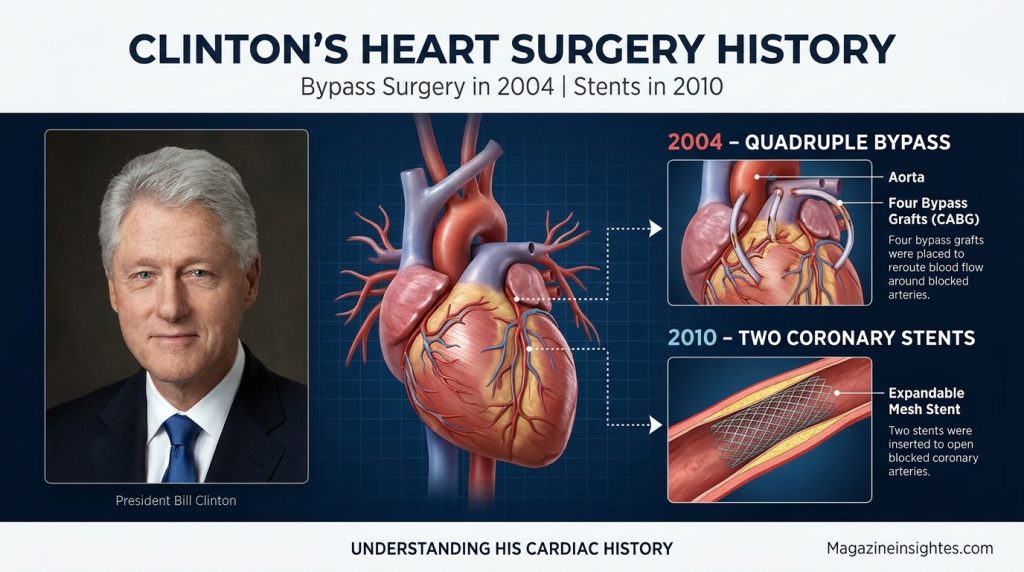
The timeline below puts every public health event in date order, with the place and the source. Two conflicts stay by source, and both are labelled in the notes.
Read the timeline first if you want the facts without the commentary. The sections after it explain what each event means in plain language.
| Date | Event | Place | Source |
|---|---|---|---|
| May 24, 1996 | Physical exam: reflux disease, allergies, lower back pain, left hand stiffness | White House, Washington | White House press briefing, Mike McCurry |
| January 2001 | Basal cell carcinoma lesion removed from back | Washington | White House spokesman Jake Siewert, via the Guardian |
| September 2004 | Quadruple bypass surgery, age 58 | New York-Presbyterian Hospital, New York | ABC News, New York Times |
| March 2005 | Surgery for fluid and scar tissue, partially collapsed lung | New York | Health Digest, reporting the follow up |
| February 2010 | Two coronary stents placed after chest pain | New York | ABC News |
| 2010 | Plant based diet adopted, about 30 pounds lost | Not applicable | Clinton interviews, PETA |
| October 12 to 17, 2021 | Sepsis from a urinary tract infection, IV antibiotics | UC Irvine Medical Center, California | Associated Press, UC Irvine statements |
| November 2022 | COVID-19, mild case | Home | Clinton on X, New Straits Times |
| December 23 to 24, 2024 | Flu hospitalization, fever, observation | MedStar Georgetown University Hospital, Washington | Angel Urena, CNN, New Straits Times |
| June 2025 | Stumble on a New York City sidewalk outside 92NY | New York City | Fox News, Times of India |
| August 2025 | Companion seen carrying what appeared to be a Propaq MD bag | Hamptons, New York | New York Post, via Fox News |
| November 2025 | Bandage on the end of his nose at the New York City marathon | New York City | Health Digest |
| February 2026 | Closed door deposition with the House Oversight Committee | Washington | OK Magazine, House Oversight Committee |
| August 19, 2026 | 80th birthday | Not applicable | Geo TV, OK Magazine |
| September 2026 | Clinton Global Initiative Annual Meeting, onstage with Hillary Clinton | New York Hilton Midtown | Christian News Alerts |
| October 20, 2026 | Florida campaign for David Jolly, spoke about 33 minutes | Koinonia Worship Center, Pembroke Park, Florida | USA Today, October 21, 2026 |
| November 6, 2026 | Dinner in New York City after a Broadway show | Vinile Chophouse, Union Square, New York | Page Six, November 9, 2026 |
Two conflicts stay by source and are never merged.
The 2021 hospital stay is five nights in some reports and six days in others, and the diet is called near vegan, vegetarian, and plant based by different sources.
1996: Reflux, Back Pain, and Allergies
The earliest public health record in the timeline comes from a White House press briefing on May 24, 1996. Press secretary Mike McCurry described the president’s annual physical exam in detail.
Clinton had reflux disease, a condition where stomach acid irritates the vocal cords and the upper chest. His doctors prescribed Prilosec, a strong acid blocking drug, for the condition.
He also had allergies, which aggravated the reflux, and extensive use of his voice made it worse. The briefing named allergies as a standing condition, not a one off complaint.
Doctors examined stiffness in his left hand and X-rayed it after he reported discomfort. They found no bone damage and concluded it was probably a muscle pull linked to golf.
He also reported lower back pain and back stiffness, which doctors linked to wear and tear from jogging. They found the joints were fine and told him to keep exercising.
The exam had a positive note too. His doctors recommended that he continue his exercise regimen, because it had improved his cholesterol and his overall cardiovascular health.
2001: Basal Cell Carcinoma
Clinton’s first health scare came in January 2001, just days before he handed the White House to George W. Bush. A final medical exam spotted a skin lesion on his back.
Doctors removed the lesion, and tests found it was basal cell carcinoma, the most common form of skin cancer. It is usually linked to sun exposure, and it rarely spreads.
White House spokesman Jake Siewert said at the time that the lesion was removed and Clinton no longer had it. He added that tissue around the lesion was treated by scraping and burning.
Basal cell carcinoma is the least dangerous common skin cancer, because it grows slowly and is usually cured by removal. Early detection made the treatment simple in Clinton’s case.
The same final exam found a warning sign for the future. His cholesterol levels had risen dramatically, which foreshadowed the cardiovascular problems that followed three years later.
The National Cancer Institute explains that basal cell carcinoma forms in the basal cells of the skin, and that sunlight exposure is the main risk factor. Surgery is the standard treatment.
The 2004 Quadruple Bypass, Explained
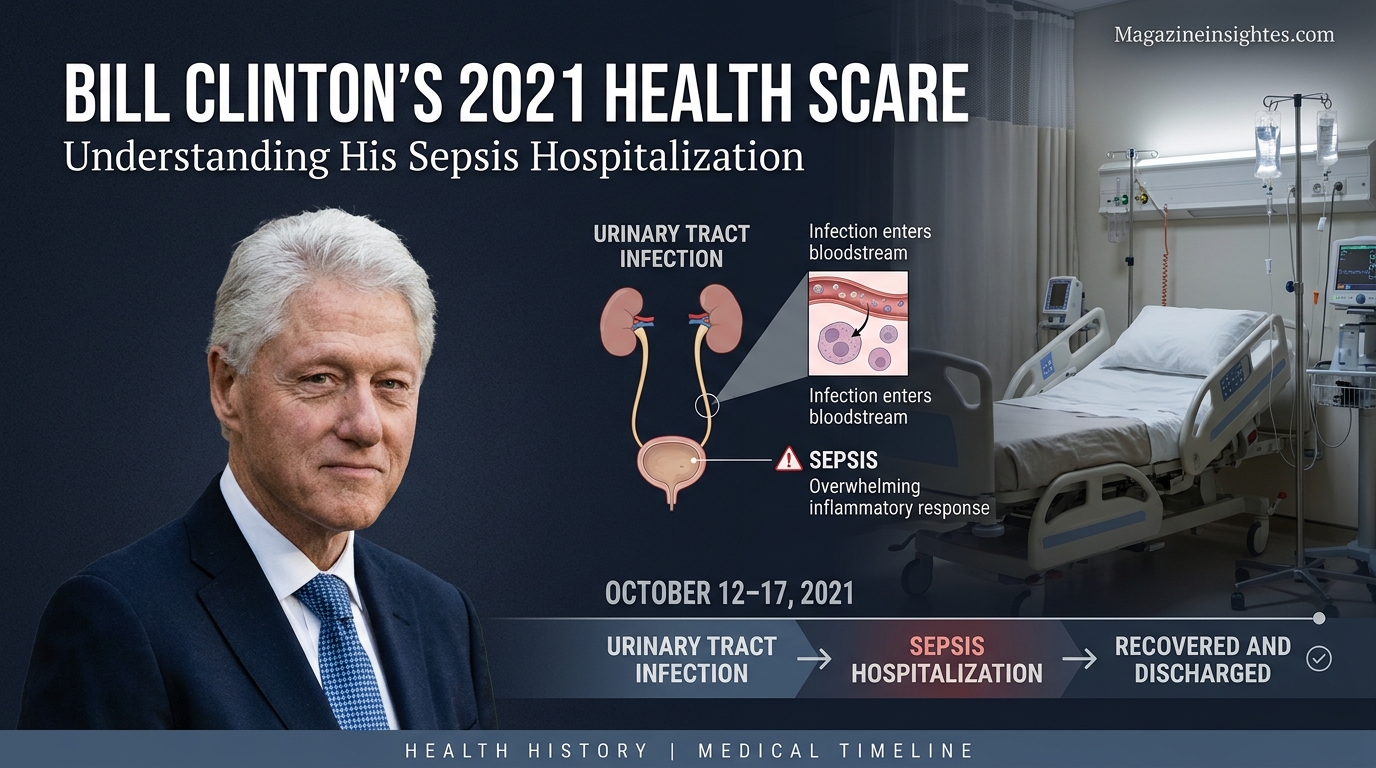
The defining health event of Bill Clinton’s life happened in September 2004, three years after he left office. He was 58, and he nearly had a major heart attack.
He had felt chest pain and sudden shortness of breath, and he first thought the cause was acid reflux or stress. An examination found almost complete blockages in several arteries.
Some arteries were nearly 100 percent blocked, according to ABC News reporting at the time.
Cardiologist Allan Schwartz told the New York Times that Clinton faced a substantial likelihood of a substantial heart attack in the near future.
Surgeon Craig Smith performed a quadruple bypass at New York-Presbyterian Hospital. The operation replaced four blocked arteries with healthy blood vessels taken from his torso and his lower body.
Clinton was eight years younger than the average bypass patient, whose age is 66. His family history played a role, because cardiovascular disease runs in his maternal lineage, and he admitted he had ignored it.
He also admitted that his eating habits were reckless. The man famous for jogging to fast food restaurants had built a diet on burgers, fries, and rich Southern cooking.
What a Quadruple Bypass Does
A coronary artery bypass graft, called CABG, is open heart surgery that builds a detour around blocked arteries.
The surgeon takes a healthy blood vessel from elsewhere in the body and connects it past the blockage.
The new vessel restores blood flow to the heart muscle, which relieves chest pain and lowers the risk of a heart attack.
The number in the name counts the bypasses, so a quadruple bypass builds four detours.
Surgeons usually take the graft from the chest wall, the leg, or the arm. The internal mammary artery from the chest is the most common choice, and the saphenous vein from the leg is another.
The operation typically lasts three to six hours, and the hospital stay runs five to seven days. Recovery takes weeks, and cardiac rehabilitation follows the surgery.
The American Heart Association guideline for bypass surgery says the operation improves survival for patients with blockages in three major arteries, and for patients with a blocked left main artery.
Bypass surgery does not cure heart disease. It treats the blockages that exist at the time, and the patient must still manage cholesterol, blood pressure, weight, and smoking risk afterward.
What Clinton Said Afterward
Clinton spoke openly about the surgery in an interview with Diane Sawyer on Good Morning America. He took responsibility for the warning signs he had ignored for years.
That was my fault, he said. I do not blame my doctors or anybody else. I was insufficiently vigilant. The quote became the most repeated line from his recovery.
He urged people with a family history of heart disease to get tested. He was 58 at the time, and he said the experience had changed how he thought about his own health.
His doctors placed him on a medication regimen after the surgery, reportedly including a beta blocker, an ACE inhibitor, aspirin, and a statin. Those are the standard drugs after a bypass.
A beta blocker slows the heart rate and lowers blood pressure. An ACE inhibitor relaxes blood vessels, aspirin prevents clots, and a statin lowers cholesterol.
The surgery saved his life in the judgment of his cardiologist, and it also started the health transformation that defined the next decade of his public life.
The 2005 Lung Surgery
Within six months of the bypass, Clinton needed another operation. Fluid had collected around his lungs, and scar tissue had formed after the open heart surgery.
The fluid affected the normal function of his lungs, and doctors operated in March 2005 to clean it up. The condition is called a pleural effusion, and the lung was partially collapsed.
A pleural effusion is fluid in the space between the lung and the chest wall. It can follow major chest surgery, and it makes breathing harder until the fluid is removed.
The 2005 surgery was a complication of the bypass, not a new disease. It was the last of the three chest operations in his record, and no further lung surgery has been reported since.
Clinton recovered from the lung surgery and returned to public life. The episode is often left out of short summaries, but it belongs in any complete history of his health.
The 2010 Stents and the Diet Change
Six years after the bypass, Clinton felt chest pain again. Doctors found that the veins used in the bypass had begun to develop blockages of their own.
They inserted two stents into a coronary artery in February 2010. He was 64, and the procedure was far smaller than the open heart surgery of 2004.
Cardiologist Jon Resar explained at the time that stents six years after a bypass are not unusual. He said the procedure would likely never need repeating.
Across the board, there is an 80 to 90 percent chance this deals with the problem permanently, Resar said to ABC News. The figure is his estimate, not a guarantee.
The 2010 procedure became the turning point of his health story. Clinton changed his diet completely afterward, and he has spoken about that change more than about any surgery.
What a Coronary Stent Is
A coronary stent is a small mesh tube that props open a narrowed artery. A doctor threads it into place through a catheter, usually from the wrist or the groin.
The stent holds the artery open so blood can flow freely to the heart. It is far less invasive than bypass surgery, and most patients leave the hospital the next day.
Stents are used when one or two arteries are blocked, while bypass surgery is used when three or more are blocked. Clinton had bypass first, then stents when the grafts narrowed.
A stent can narrow again over time, which is why patients take blood thinning drugs afterward. The drugs keep clots from forming inside the mesh tube.
The Plant Based Diet
After the stents, Clinton adopted a plant based diet and kept it for years. He cut out meat, dairy, and eggs, and he built his meals around vegetables, beans, grains, and fruit.
Physicians Dean Ornish and Caldwell Esselstyn influenced the change. Both had written that a low fat plant based diet could reverse heart disease, and Clinton followed their approach.
He lost about 30 pounds after the diet change, and he said he felt more energetic. The weight loss was visible in public appearances, and it drew as much comment as the surgery.
He told AARP that he wanted to live to be a grandfather. The line explained the change better than any medical argument, because it named the reason in one sentence.
PETA named him its 2010 Person of the Year for the diet change.
The award came from an animal rights group, not a medical body, and it should be read as recognition, not as medical evidence.
Different sources describe the diet differently, and the labels conflict. Some call it near vegan, some call it vegetarian, and some call it plant based.
The honest label is plant based with fish and occasional dairy, which is how Clinton himself described it in later interviews. The strict vegan phase lasted for a long time, then loosened.
| Before 2010 | After 2010 |
|---|---|
| Fast food, burgers, fries, rich Southern cooking | Vegetables, beans, grains, fruit, plant based meals |
| Katz’s Delicatessen order: two hot dogs, pastrami sandwich, fries, diet ginger ale, decaf coffee | No meat, no dairy, no eggs in the strict phase |
| Weight higher, cholesterol rising | About 30 pounds lost, more energy reported |
| Jogging to fast food restaurants | Plant based eating as a daily routine |
A diet change does not reverse a bypass or a stent. It lowers cholesterol and blood pressure, which lowers the risk of new blockages, and that is the honest claim to make.
The 2021 Sepsis Hospitalization, Explained
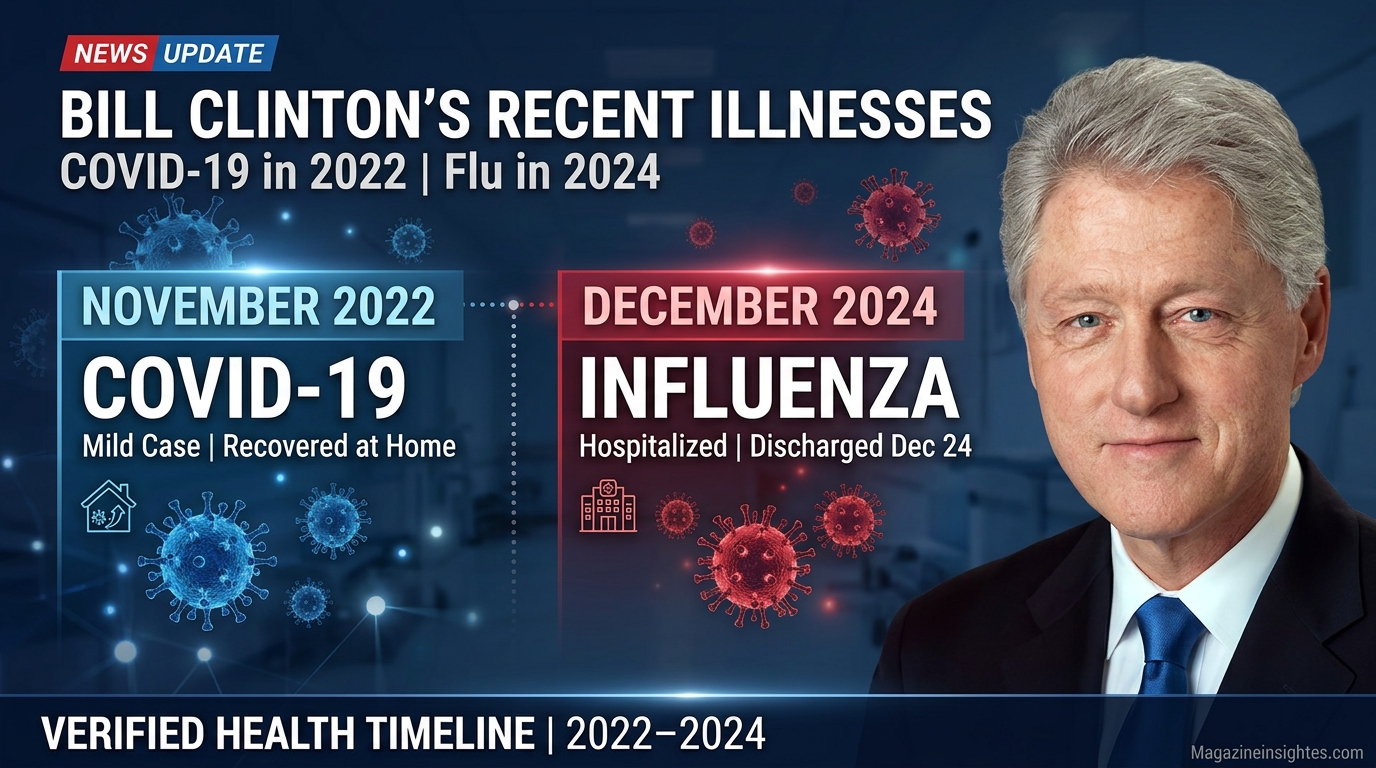
The most frightening episode after the heart surgeries came in October 2021, and it had nothing to do with his heart. Clinton was 75, and he developed a urinary tract infection.
The infection did not clear with the normal course of antibiotics. It moved into his bloodstream, and he developed sepsis, a condition where the body overreacts to an infection.
He was admitted to UC Irvine Medical Center in Orange County, California, on October 12, 2021. He stayed for five nights according to some reports, and six days according to others.
The length conflict stays by source and is never merged. The New Straits Times and the Daily Advent say five nights, while the Saudi Gazette and Diffsense say six days.
He was treated with intravenous antibiotics, and his white blood cell counts were checked every few hours. Physician Alpesh Amin led his care at UC Irvine.
He was discharged on October 17, 2021, and he walked out of the hospital on his own feet. He looked thinner in the photographs, and he waved to the cameras as he left.
What Sepsis Is
Sepsis is the body’s extreme response to an infection. The immune system overreacts, and the reaction can damage tissue, cause organ failure, and lead to death.
The Centers for Disease Control and Prevention lists the warning signs as fever, shivering, confusion, shortness of breath, high heart rate, clammy skin, and extreme pain.
Sepsis is a medical emergency, and it is treated immediately with intravenous fluids and broad spectrum antibiotics. Early recognition is the difference between recovery and organ failure.
Emergency physician Robert Glatter told USA Today that early recognition and intervention with intravenous fluids and broad spectrum intravenous antibiotics can be lifesaving. The quote is about sepsis in general, not about Clinton alone.
Sepsis kills an estimated 11 million people each year worldwide, according to Health Digest. The figure is an estimate, and it shows why a sepsis admission is taken seriously at any age.
Infections that lead to sepsis most often start in the lung, the urinary tract, the skin, or the gut. Clinton’s infection started in the urinary tract, which is the second most common source.
How a Urinary Tract Infection Becomes Sepsis
A urinary tract infection, called a UTI, is an infection in the bladder, the urethra, or the kidneys. It is more common in women, but it also occurs in men, especially older men.
Most UTIs clear with a short course of antibiotics. A UTI becomes sepsis when the bacteria enter the bloodstream and the immune system overreacts to the spread.
Clinton followed the normal course of antibiotics for his UTI, and the infection did not fully clear. The bacteria reached his blood, and sepsis followed.
Age raises the risk. Sepsis hits harder after 65, because the immune system responds more slowly and chronic conditions leave less room for error. Clinton was 75 at the time.
He was in the intensive care unit for monitoring and privacy, not because he was in critical condition. Reports differ on whether he spent the full stay in the unit, so the detail stays labelled.
His office said he was in good spirits during the stay, and the Secret Service stood guard in the hallways. The hospital stay ended with a full recovery, and no lasting damage was reported.
| Hospitalization | Date | Hospital | Reason | Length | Outcome |
|---|---|---|---|---|---|
| Sepsis | October 12 to 17, 2021 | UC Irvine Medical Center, California | Urinary tract infection that spread to the blood | Five nights (some sources) or six days (others) | Discharged, recovered |
| Flu | December 23 to 24, 2024 | MedStar Georgetown University Hospital, Washington | Fever, flu, testing and observation | One night, discharged Christmas Eve | Discharged, recovered |
| COVID-19 | November 2022 | Home, no hospital stay | COVID-19, mild case | Not applicable | Recovered at home |
COVID-19 in 2022 and the Flu in 2024
Two viral illnesses followed the sepsis episode, and both were milder than the infection that put him in the hospital. Each one still drew headlines, because his heart history makes any fever a red flag.
Clinton tested positive for COVID-19 in November 2022, when he was 76. He announced the result himself on X, and he said his case was mild.
I am doing fine overall and keeping myself busy at home, he wrote. He added that he was grateful to be vaccinated and boosted, which he credited for the mild course.
COVID-19 hits older adults harder than younger ones. Health Digest notes that 81 percent of all deaths related to COVID-19 happened in people older than 65.
Clinton had two risk factors for a severe case: his age and his heart disease history. The vaccine and the booster lowered the risk, and the mild course fits that picture.
The December 2024 Flu Hospitalization
Clinton was admitted to MedStar Georgetown University Hospital on December 23, 2024, after developing a fever. He was 78, and he was at his home in Washington when the fever started.
Deputy chief of staff Angel Urena announced the admission on X. He wrote that Clinton was admitted for testing and observation after developing a fever, and that he remained in good spirits.
Urena told CNN that the president is fine, and that he was hopeful to be home by Christmas. An aide described Clinton as awake and alert, and said he was not in a critical situation.
Doctors treated him for the flu, and he was discharged on December 24, 2024, Christmas Eve. The stay lasted one night, and it was observation and treatment, not emergency surgery.
The New Straits Times reported the discharge on December 24, 2024, and quoted Urena’s gratitude for the care at MedStar Georgetown. The report is the clearest single source for the dates.
Flu hits older adults harder than younger ones, and heart disease raises the risk further. Clinton had both risk factors, which is why a fever meant a hospital stay instead of rest at home.
A hospital stay for flu at 78 is precaution, not crisis, when the patient is awake, alert, and discharged the next day. The one night stay fits that reading, and the record supports it.
Hospital stays raise a question many readers ask next, which is what counts as comprehensive health coverage.
The guide to what comprehensive health insurance means explains the term, and the guide to having two health insurances explains how dual coverage works when two plans share a bill.
The 2025 Sightings: Stumble, Bag, and Bandage
Clinton’s health came back into the public eye in 2025 through photographs and video, not through hospital announcements. Three sightings drove the coverage, and none of them involved a hospital stay.
In June 2025, a video showed him lightly stumbling on a New York City sidewalk outside 92NY, a cultural center. He grabbed a pole to steady himself, and he looked visibly frail in the clip.
He was attending an event for his book First Gentleman, co written with James Patterson. The stumble lasted a second, and he continued into the event afterward.
In August 2025, photographs showed him leaving the Hamptons with his wife Hillary, and a person with them was carrying a bag that looked like medical equipment. The photographs set off the defibrillator story.
In November 2025, he was seen hugging his daughter Chelsea after she finished the New York City marathon. He wore a bandage on the end of his nose, and his team never explained it.
None of the three sightings produced a diagnosis, a hospital visit, or an official statement about his health. They produced photographs, and the photographs produced speculation.
The Defibrillator Sighting, Verified
The most repeated claim about Bill Clinton’s health in 2025 and 2026 is that he was seen with a portable defibrillator. The photographs are real, and the claim needs careful handling.
Photographs from the Hamptons in August 2025 show a person travelling with Clinton and Hillary carrying a bag. The New York Post reported that it resembled a Propaq MD Air Medical Bag.
A Propaq MD Air Medical Bag is a bag used to transport defibrillators or other emergency cardiac equipment. It is a carrier, not a device, and the bag does not prove what was inside it.
Fox News reported the sighting in September 2025, and the Times of India repeated it the same month. Both described the device as what appeared to be a portable defibrillator, not as a confirmed device.
Clinton’s office has never confirmed that he carries a defibrillator, and no photograph shows the device itself. The bag is the only thing visible, and a bag is not a diagnosis.
The Times of India report adds a useful explainer, and it also contains an error worth naming. It says Clinton was hospitalized for influenza in 2025, but the flu hospitalization was in December 2024.
The Times of India article on the Hamptons defibrillator sighting is the fullest single source for the photographs, the bag, and the diet history, and its 2025 flu date is wrong.
What a Defibrillator Is
A defibrillator is a medical device that restores a normal heart rhythm by delivering a controlled electric shock. It is used when the heart beats irregularly or stops, in ventricular fibrillation or cardiac arrest.
A portable defibrillator carried by a traveller is usually an automated external defibrillator, called an AED.
It is a precaution for someone at risk of a sudden cardiac event, not a treatment for a current condition.
An implantable defibrillator, called an ICD, is different. It is placed inside the chest by surgery, and it shocks the heart automatically when it detects a dangerous rhythm.
No source has reported that Clinton has an implanted defibrillator, and no source has confirmed that he carries a portable one. The distinction matters, and the reporting should keep it.
A person with a bypass and stents in his history is a candidate for cardiac precautions. That fact makes the bag plausible, and it does not make the defibrillator confirmed.
Why the Story Is Circulating Again in November 2026
The Fox News defibrillator story is being re circulated on November 25, 2026, with a new publication date. The sighting itself is from August and September 2025, fourteen months earlier.
No new sighting has been reported since the 2025 photographs. The November 2026 republication presents the same photographs and the same facts with a fresh date.
A searcher who reads only the publication date will believe something new happened, when nothing new happened. The date on the page is the republication date, not the event date.
The same pattern appears in other news stories, where old events are republished with new dates.
The guide to the latest news on Nancy Guthrie shows the same trap, and it separates official updates from recycled stories in a table.
Check the event date inside the story, not the date on the page. If the photographs are from August 2025, the story is from August 2025, no matter what the page header says.
The Epstein-Stress Health Claims
A second claim about Clinton’s health appeared on his 80th birthday, August 19, 2026. OK Magazine reported that stress over the Epstein scrutiny could put his heart at risk.
The warning came from internal medicine doctor Stuart Fischer, who has not treated Clinton. He said extreme psychological stress damages the cardiovascular system, and severe stress can trigger sudden heart rhythm issues.
Fischer pointed to the portable defibrillator sighting as an indicator of potential life threatening heart arrhythmias. The sighting is the same unverified 2025 bag, and the warning is general medical commentary.
A doctor who has not treated a patient cannot diagnose that patient. Fischer’s warning is a general statement about stress and the heart, not a finding about Clinton’s heart.
Stress does affect the heart, and the claim is true in general. Chronic stress raises blood pressure, raises heart rate, and raises the risk of arrhythmia in people with heart disease.
The general truth does not make the specific claim true. No doctor who treats Clinton has said that Epstein stress has harmed his heart, and no test result has been published.
When stress affects health, professional support is the practical step.
The guide to how to become a mental health therapist explains the training and the license, and it lists the crisis line 988 for anyone in crisis in the United States.
The Deposition Behind the Claims
The House Oversight Committee subpoenaed Clinton on August 5, 2025, to appear for a deposition about his past association with Jeffrey Epstein. The deposition took place behind closed doors in February 2026.
Clinton testified under oath that he did not witness any of Epstein’s crimes. He has said the same in public statements for years, and the deposition repeated it on the record.
Epstein was a financier who died in custody in 2019 while facing sex trafficking charges. Clinton knew him socially in the past, and the association has drawn public scrutiny ever since.
The deposition is a legal event, not a medical event. It created stress, and stress affects health, but the deposition itself says nothing about Clinton’s heart.
The Funeral-Planning and Will Stories
A third claim appeared in August 2026, around the same 80th birthday. RadarOnline reported that Hillary Clinton was planning her husband’s future funeral, and Morning Honey repeated the report.
Insiders claimed the service could take place at Washington National Cathedral, and presidential historian Leon Wagener suggested Clinton might be buried at his presidential library rooftop garden.
The same report claimed Clinton might have changed his 120 million dollar will. The figure comes from insiders, and no document, lawyer, or family member has confirmed it.
Nothing in the report has been confirmed by the family, the foundation, or any official statement. Funeral planning for a living former president is also normal, because the plans exist for every president.
Every living former president has funeral plans on file, because the state funeral is planned years in advance. The existence of a plan says nothing about a person’s current health.
The honest label for the funeral story is tabloid insider claims, unverified. A page that states the plans as fact is repeating a rumor, not reporting a fact.
| Claim | Status | Source |
|---|---|---|
| Portable defibrillator carried in 2025 | Unverified: bag photographed, contents never confirmed | New York Post, via Fox News, September 2025 |
| Stress over Epstein scrutiny harmed his heart | Unverified: general warning from a doctor who has not treated him | OK Magazine, August 19, 2026, Dr. Stuart Fischer |
| Hillary Clinton planning his funeral | Unverified: tabloid insider claims | RadarOnline, via Morning Honey, August 2026 |
| Will changed, 120 million dollars | Unverified: insider claim, no document confirmed | RadarOnline, via Morning Honey, August 2026 |
| Frail appearance at a Long Island gallery, August 29, 2026 | Observation, not a diagnosis: appearance in photographs | OK Magazine, August 31, 2026 |
| Bandage on his nose, November 2025 | Unexplained: never addressed by his team | Health Digest, December 7, 2025 |
| Dementia or Parkinson disease | No evidence: no diagnosis reported by any source | No source; the question is a search artifact |
| Stroke | No evidence: no stroke reported in the public record | No source; the question is a search artifact |
How Bill Clinton Is Doing Now, November 2026
Clinton turned 80 on August 19, 2026, and the birthday set off a new round of health coverage. Geo TV marked the day, and OK Magazine published its Epstein stress warning the same day.
He joined Joe Biden, Donald Trump, and George W. Bush as living presidents who have turned 80. Barack Obama, at 65, remains the youngest living president by a wide margin.
Geo TV reported the birthday on August 19, 2026, and noted that Clinton held office from 1993 to 2001. The Geo TV birthday report is the clearest single source for the age frame.
Ten days later, on August 29, 2026, he visited an art gallery on Long Island. He attended the ACA Galleries exhibition at Ashawagh Hall in Springs, New York, and observers commented on his frail appearance.
The gallery visit produced jokes about his age on social media, and OK Magazine reported the reaction on August 31, 2026.
He enjoyed the exhibition, according to the same report, and the visit lasted as planned.
A frail appearance is an observation, not a diagnosis. An 80 year old man who has had open heart surgery will look 80, and the observation says nothing about his test results.
The Clinton Global Initiative, September 2026
In September 2026, Clinton spoke onstage with Hillary Clinton during the Clinton Global Initiative 2026 Annual Meeting at the New York Hilton Midtown. The foundation remains his main public platform.
The Clinton Global Initiative gathers leaders to make commitments on health, climate, and economic development. Clinton has led it since leaving office, and it is the work he does most often in public.
His role at the meeting was elder statesman, not campaigner. He introduced speakers, hosted panels, and closed sessions, which is a lighter schedule than a campaign trail.
The Florida Campaign, October 20, 2026
Clinton returned to the campaign trail on October 20, 2026, for the first time in the 2026 midterm cycle in Florida. He stumped for David Jolly, the Democratic nominee for Florida governor.
He spoke at an interfaith rally at the Koinonia Worship Center in Pembroke Park, near Hollywood, Florida.
He spoke for about 33 minutes, and USA Today noted the same charm and humor from his two terms.
He opened by addressing his age directly. One blessing of his age is you can say whatever you want, he told the crowd, adding that many people do not care anymore.
He attacked Donald Trump’s foreign policy, the White House renovations, and immigration enforcement, and he praised Jolly’s choice of Gwen Graham as running mate as brilliant.
The speech was a full campaign performance, not a brief appearance.
The Jolly campaign announced that Clinton headlined a fundraiser at a private residence that raised 3 million dollars. The Democratic Governors Association announced 1 million dollars in spending for Jolly the same day.
USA Today reported the Florida appearance on October 21, 2026, with the speech length, the fundraiser total, and the crowd quotes. The USA Today Florida report is the fullest single source for the event.
A 33 minute speech at 80, after a fundraiser the same day, is evidence of stamina.
It does not prove perfect health, and it does prove he can still do the job he came to do.
The New York Dinner, November 6, 2026
Clinton and Hillary spent a night out in New York City on Friday, November 6, 2026, after the midterm elections.
They saw a Broadway show, then dined with a large group at Vinile Chophouse in Union Square.
They were joined by 14 other people, including Bill’s brother Roger Clinton. The group shared filet mignon, ribeye, salmon, sea bass, boar ragu, shrimp cocktail, Caesar salad, and focaccia with tomato sauce.
Page Six reported the dinner on November 9, 2026, with the menu and the guest list.
A night out at a restaurant is a small fact, and it is the latest verified public activity in the record.
No hospitalization has been reported since December 2024, and no official statement has announced a new condition. The record from October 20 to November 6, 2026, shows an active 80 year old, not a patient.
Bill Clinton and the Other Living Presidents
Five former presidents are alive as of November 25, 2026, and their ages span 19 years. The table below puts Clinton in that group, with the known public health events for each man.
The comparison is useful because searchers ask it often, and no competitor page puts the five men side by side with dates. The ages are arithmetic from birth dates, as of November 25, 2026.
| President | Born | Age, Nov 25, 2026 | Known public health events |
|---|---|---|---|
| Barack Obama | August 4, 1961 | 65 | No major public hospitalization; former smoker, quit in office |
| Bill Clinton | August 19, 1946 | 80 | Bypass 2004, stents 2010, sepsis 2021, COVID 2022, flu 2024 |
| George W. Bush | July 6, 1946 | 80 | One coronary stent, August 2013, after a blockage found in a routine exam |
| Donald Trump | June 14, 1946 | 80 | COVID-19 hospitalization at Walter Reed, October 2020 |
| Joe Biden | November 20, 1942 | 84 | Brain aneurysm surgeries 1988, basal cell carcinoma lesion removed 2023, prostate cancer announced May 2025 |
Jimmy Carter, who died on December 29, 2024, at 100, is not in the table.
He was the longest lived president in the history of the United States, and his hospice stay lasted nearly two years.
Clinton is the middle of the group in age, and his cardiac history is the most serious of the five.
Bush also had a stent, and Biden’s prostate cancer announcement in May 2025 is the most recent major health news for any living president.
Age alone does not predict health, and the table proves it. Obama is 15 years younger than Clinton, and Biden is four years older, but the health events do not line up by age.
What We Do Not Know
Some facts about Clinton’s health are private, and no public source can supply them. A complete page says what it does not know, because the gap is part of the answer.
His current medications are not public. The post bypass regimen was reported in 2004, and no current medication list has been published since. Do not state a current drug list without a source.
His current test results are not public. No cholesterol reading, blood pressure reading, or cardiac scan result has been published for him in 2025 or 2026.
His current doctors’ assessments are not public. No treating physician has given a statement about his health since the 2021 and 2024 hospital statements, and the 2024 statements said only that he was fine.
Whether he carries a defibrillator is not confirmed. The bag was photographed, and the contents were never confirmed, so the question has no verified answer.
Whether the funeral plans and the will changes are real is not confirmed. The claims come from unnamed insiders, and no document or family member has confirmed them.
Whether stress has affected his heart is not known. No test result links the Epstein deposition to any cardiac finding, and the only warning comes from a doctor who has not treated him.
What Is False
Several claims about Clinton’s health circulate online, and the public record contradicts them. The table below lists the claim, the verdict, and the evidence.
| Claim | Verdict | Evidence |
|---|---|---|
| Bill Clinton had a heart attack in 2004 | False | He had bypass surgery to prevent a heart attack; cardiologist Allan Schwartz said he faced a substantial likelihood of one, not that he had one |
| Bill Clinton had a stroke | No evidence | No stroke appears in the public record, and no source has reported one |
| Bill Clinton has dementia | No evidence | No diagnosis has been reported, and he gave a 33 minute campaign speech on October 20, 2026 |
| Bill Clinton has Parkinson disease | No evidence | No diagnosis has been reported by any source |
| Bill Clinton died | False | He campaigned in Florida on October 20, 2026, and dined in New York on November 6, 2026 |
| Bill Clinton was hospitalized for flu in 2025 | False | The flu hospitalization was December 23 to 24, 2024; the Times of India dates it to 2025 in error |
| The defibrillator was confirmed | False | Only the bag was photographed; the contents were never confirmed by his office |
| The funeral plans were confirmed by the family | False | The claims come from unnamed insiders via RadarOnline; no family confirmation exists |
A claim with no evidence is not the same as a claim that is false.
Dementia and Parkinson disease sit in the no evidence column, because absence of a report is not proof of absence, and only a doctor can rule a condition out.
How to Check a Health Rumor in Five Steps
Health rumors about public figures spread faster than the facts, and the defibrillator story shows how. Five checks separate a verified fact from a recycled photograph.
- Find the event date inside the story, not the date on the page. A story republished in November 2026 can describe an event from August 2025, and the event date is the true date.
- Look for an official statement from the person’s office, the foundation, or the hospital. A statement with a name and a date beats ten anonymous reports, and no statement means no confirmation.
- Check whether the doctor quoted has treated the patient. A treating physician speaks from test results, while a commentator speaks from general knowledge, and the two are not equal.
- Compare two independent reports before believing a claim. If only one tabloid reports a funeral plan, and no mainstream outlet confirms it, the claim stays unverified.
- Watch for the words appeared to be, reportedly, and insiders claim. Those words signal that the writer does not know the fact, and the reader should not treat it as known either.
News digests help with the fourth check, because they gather many sources in one place.
The guide to what 1440 News is explains a free digest that curates from more than 100 sources, and the guide to whether 1440 News is conservative explains how independent raters score its bias.
The same five checks work for any health rumor, not only for Clinton. They work for any president, any celebrity, and any viral photograph, because the pattern is always the same.
Frequently Asked Questions
Does Bill Clinton have health issues?
Yes, Bill Clinton has documented health issues. He had quadruple bypass surgery in 2004, two coronary stents in 2010, a sepsis hospitalization in 2021, COVID-19 in 2022, and a flu hospitalization in 2024.
What health issues does Bill Clinton have?
His main issues are cardiac: heart disease found in 2004, bypass surgery, and stents in 2010. He also had sepsis in 2021, COVID-19 in 2022, flu in 2024, and basal cell carcinoma in 2001.
Is Bill Clinton in good health?
No new diagnosis has been confirmed as of November 25, 2026, and he remains publicly active at 80. His cardiac history is serious, and only his doctors know his current test results.
Is Bill Clinton sick?
No current illness has been reported as of November 25, 2026. His last reported illness was the flu in December 2024, and he was discharged the next day.
How old is Bill Clinton?
Bill Clinton is 80, born on August 19, 1946, in Hope, Arkansas. He turned 80 on August 19, 2026, and he is the 42nd President of the United States.
Did Bill Clinton have a heart attack?
No, he did not have a heart attack in 2004. He had bypass surgery to prevent one, because doctors found nearly complete blockages in several arteries.
When did Bill Clinton have bypass surgery?
He had quadruple bypass surgery in September 2004, at New York-Presbyterian Hospital. He was 58, and surgeon Craig Smith performed the operation.
Why did Bill Clinton have heart surgery?
Doctors found almost complete blockages in several coronary arteries after he reported chest pain and shortness of breath. Cardiologist Allan Schwartz said he faced a substantial likelihood of a major heart attack.
What happened to Bill Clinton in 2021?
He developed a urinary tract infection that spread to his bloodstream, causing sepsis. He was admitted to UC Irvine Medical Center on October 12, 2021, and discharged on October 17, 2021.
Why was Bill Clinton hospitalized in 2021?
A urinary tract infection did not clear with antibiotics, and the bacteria entered his bloodstream. The resulting sepsis needed intravenous antibiotics and several days of hospital monitoring.
Why was Bill Clinton hospitalized in 2024?
He developed a fever and was admitted to MedStar Georgetown University Hospital on December 23, 2024, for testing and observation. Doctors treated him for the flu, and he was discharged on December 24, 2024.
Does Bill Clinton have dementia?
No diagnosis of dementia has been reported by any source. He gave a 33 minute campaign speech in Florida on October 20, 2026, which shows no public sign of cognitive decline.
Does Bill Clinton have Parkinson disease?
No diagnosis of Parkinson disease has been reported by any source. The question appears in search because people ask about aging presidents, not because any doctor has reported it.
Does Bill Clinton have cancer?
He had basal cell carcinoma in 2001, when a skin lesion was removed from his back. Spokesman Jake Siewert said the lesion was removed and Clinton no longer had it.
Does Bill Clinton carry a defibrillator?
That has never been confirmed. Photographs from August 2025 show a companion carrying what appeared to be a Propaq MD bag, but the bag contents were never confirmed by his office.
What is a Propaq MD bag?
A Propaq MD Air Medical Bag is a bag used to transport defibrillators or other emergency cardiac equipment. It is a carrier, not a device, and it does not prove what was inside.
What is Bill Clinton’s diet?
He follows a plant based diet, adopted after his 2010 stent procedure. He cut out meat, dairy, and eggs in the strict phase, and he later loosened the diet to include fish and occasional dairy.
Is Bill Clinton vegan?
He was strictly vegan for a long time after 2010, and he is now described as plant based. The honest label is plant based with fish and occasional dairy, as he described it himself.
Did Bill Clinton stumble?
Yes, in June 2025, a video showed him lightly stumbling on a New York City sidewalk outside 92NY. He grabbed a pole to steady himself, then continued into the book event.
Is Bill Clinton dying?
No evidence supports that claim. He campaigned in Florida on October 20, 2026, spoke for about 33 minutes, and dined in New York City on November 6, 2026.
Is Bill Clinton still alive?
Yes, Bill Clinton is alive as of November 25, 2026. He turned 80 on August 19, 2026, and his latest verified public activity was a New York dinner on November 6, 2026.
Who is the oldest living president?
Joe Biden is the oldest living former president, born November 20, 1942, and 84 years old as of November 25, 2026. Clinton, Trump, and George W. Bush are all 80.
How old are the living presidents?
Barack Obama is 65, Bill Clinton is 80, George W. Bush is 80, Donald Trump is 80, and Joe Biden is 84, as of November 25, 2026.
Obama is the youngest living president by 15 years.
What did Bill Clinton die of?
He has not died. Bill Clinton is alive as of November 25, 2026, and the question appears in search because people ask it about every aging former president.
What is Bill Clinton doing now?
He leads the Clinton Foundation and the Clinton Global Initiative, campaigns for Democratic candidates, writes books with James Patterson, and spends time as a grandfather. He turned 80 on August 19, 2026.
The Verdict: A Serious History, an Active Present, and No New Diagnosis
Does Bill Clinton have health issues? Yes. The record is long, serious, and public: a bypass at 58, stents at 64, sepsis at 75, COVID at 76, and flu at 78.
The record is also a record of recovery. He left every hospital stay on his own feet, changed his diet, lost about 30 pounds, and kept working in public life into his 80s.
His current status is the part that matters most to the searcher.
He turned 80 on August 19, 2026, campaigned for 33 minutes in Florida on October 20, 2026, and dined in New York on November 6, 2026.
No new diagnosis has been confirmed as of November 25, 2026.
The defibrillator was never confirmed, the funeral plans were never confirmed, and the Epstein stress warning came from a doctor who has not treated him.
Check back after any new hospitalization or official statement, because a health page goes stale the day a new event happens.
The facts above were checked on November 25, 2026, and the next check follows the next event.
General information only. Nothing here is medical advice, and nothing here diagnoses any person. For official updates, follow the Clinton Foundation and the statements from Clinton’s office.