What Is Comprehensive Health Insurance? A Complete Guide

What is comprehensive health insurance?
It is a health plan that covers a wide range of medical services, from doctor visits and hospital stays to prescriptions and emergency care, rather than a narrow set of services.
The short name for the same idea is major medical insurance.
In the United States, new individual and small-group major medical plans sold since 2014 must cover the Affordable Care Act’s 10 essential health benefits, with no annual or lifetime caps on those benefits.
The content here is general information only, not insurance advice or financial advice.
Readers should check their own plan documents and talk to a licensed broker before enrolling, because the right plan depends on income, health needs, and state rules.
The Short Answer: What Comprehensive Health Insurance Means
Comprehensive health insurance means broad coverage of a wide range of health care services.
Physician visits, hospitalization, prescriptions, and emergency room visits are covered, and the care can be preventive or provided to treat an injury or illness.
The phrase is also used for major medical health insurance, and the two terms mean the same thing in practice.
A comprehensive plan is the opposite of a limited-benefit plan, which covers only specific conditions or services, or caps what it pays in dollars.
The most important fact about the term is also the most surprising one. “Comprehensive” is not an officially defined term in health insurance, and it has no particular marketing rules attached to its use.
That means a short-term health insurance plan, which is not minimum essential coverage and is not regulated by the Affordable Care Act, could still use marketing materials that describe it as comprehensive.
The label alone proves nothing, so the buyer has to check what the plan actually covers.
healthinsurance.org’s glossary entry on comprehensive coverage warns that the term is like the word “natural” on groceries. The comparison makes the point clearly: a word can sound reassuring while carrying no legal meaning at all.
The safe way to judge a plan is to check it against the terms that are legally defined.
Essential health benefits and minimum essential coverage are defined in law, so they give a buyer something solid to test a plan against.
A comprehensive plan is typically more costly than a limited-benefit plan, but it provides significantly more protection when a medical claim arrives.
Marketplace premium subsidies and employer subsidies can bring the price down substantially, sometimes to very little or even nothing, depending on income, age, and location.
The guide to whether you need health insurance on the site covers the first decision, which is whether coverage is needed at all.
The rest of the guide below explains what counts as comprehensive, what it costs, and how to check a plan before buying it.
The 10 Essential Health Benefits

Since 2014, new comprehensive health insurance policies issued in the individual and small-group markets must cover the Affordable Care Act’s ten essential health benefits.
The list sits in section 1302 of the Affordable Care Act, codified at 42 U.S.C. section 18022, and implemented by federal regulation at 45 CFR 156.110.
HealthCare.gov lists the 10 essential health benefits that every Marketplace plan must cover.
The same list applies to individual and small-group plans bought off the Marketplace, to Medicaid Alternative Benefit Plans, and to the Children’s Health Insurance Program.
The benefits are minimum requirements, not a ceiling, so a plan can cover more than the list.
The specific services inside each broad category can vary by state, because each state fills in the details through its own benchmark plan.
Plans must also cover birth control and breastfeeding support, according to HealthCare.gov.
Adult dental and vision coverage are not essential health benefits, so they are usually sold separately for adults, while pediatric dental and vision are included in the list.
| Benefit | What it covers in plain language |
|---|---|
| Ambulatory patient services | Outpatient care without a hospital admission, such as doctor visits and same-day surgery |
| Emergency services | Emergency room care, including ambulance transport, with no penalty for going out of network |
| Hospitalization | Inpatient care, including surgery, room and board, and care in a skilled nursing facility |
| Maternity and newborn care | Prenatal care, labor and delivery, post-delivery care, and care for newborn babies |
| Mental health and substance use disorder services | Behavioral health treatment, counseling, and psychotherapy, inpatient and outpatient |
| Prescription drugs | Medications prescribed by a doctor to treat an illness or condition |
| Rehabilitative and habilitative services and devices | Services and devices that help people gain or recover mental and physical skills |
| Laboratory services | Blood work, diagnostic tests, and other laboratory testing |
| Preventive and wellness services and chronic disease management | Screenings, vaccinations, and ongoing care for chronic conditions |
| Pediatric services, including oral and vision care | Care for children, including dental and vision services |
1. Ambulatory Patient Services
Ambulatory patient services are outpatient care, which means care received without being admitted to a hospital.
Doctor visits, clinic visits, and same-day surgery centers fall in this category, as do home health services and hospice care in some plans.
2. Emergency Services
Emergency services cover care for conditions that could lead to serious disability or death if not treated at once, such as accidents and sudden illness.
The trip to the emergency room is covered, including transport by ambulance, with no penalty for going out of network or for lacking prior authorization.
3. Hospitalization
Hospitalization covers care received as a hospital patient, including care from doctors, nurses, and other hospital staff.
Laboratory tests, medications received during the stay, room and board, surgeries, transplants, and care in a skilled nursing facility are included, though some plans limit skilled nursing stays.
4. Maternity and Newborn Care
Maternity and newborn care covers prenatal care during pregnancy, care throughout labor and delivery, and care after delivery.
Care for newborn babies is included in the same category, so a birth and the baby’s first care sit under one benefit.
5. Mental Health and Substance Use Disorder Services
Mental health and substance use disorder services cover inpatient and outpatient care to evaluate, diagnose, and treat a mental health condition or a substance use disorder.
Behavioral health treatment, counseling, and psychotherapy are included, and the guide to what color represents mental health on the site explains how color is used in mental health awareness.
6. Prescription Drugs
Prescription drugs cover medications that a doctor prescribes to treat an illness or condition.
Each plan has its own formulary, which is the list of drugs it covers, so two plans can cover the same category while covering different specific medicines.
7. Rehabilitative and Habilitative Services and Devices
Rehabilitative services help people recover skills, such as speech therapy after a stroke, while habilitative services help people develop skills, such as speech therapy for children.
Devices that help people gain or recover mental and physical skills are included in the same category.
8. Laboratory Services
Laboratory services cover the tests doctors order to diagnose and monitor illness, including blood work and other diagnostic testing.
The category is broad, and the specific tests covered depend on the plan and the state benchmark.
9. Preventive and Wellness Services and Chronic Disease Management
Preventive and wellness services cover the care that prevents illness and catches it early, including screenings and vaccinations.
GoodRx explains the essential health benefits in plain language, including the 22 preventive care benefits for adults, and chronic disease management covers ongoing care for long-term conditions.
10. Pediatric Services, Including Oral and Vision Care
Pediatric services cover care for children, and this is the only essential health benefit category that includes dental and vision care.
The dental and vision coverage inside this category is for children, while adult dental and vision coverage is usually a separate plan.
The CMS fact sheet on essential health benefits sets out the same 10 categories and explains the actuarial value and accreditation standards behind them.
The fact sheet dates from 2012, when the rules were first written, and the categories themselves have not changed since.
What Counts as Comprehensive Health Insurance
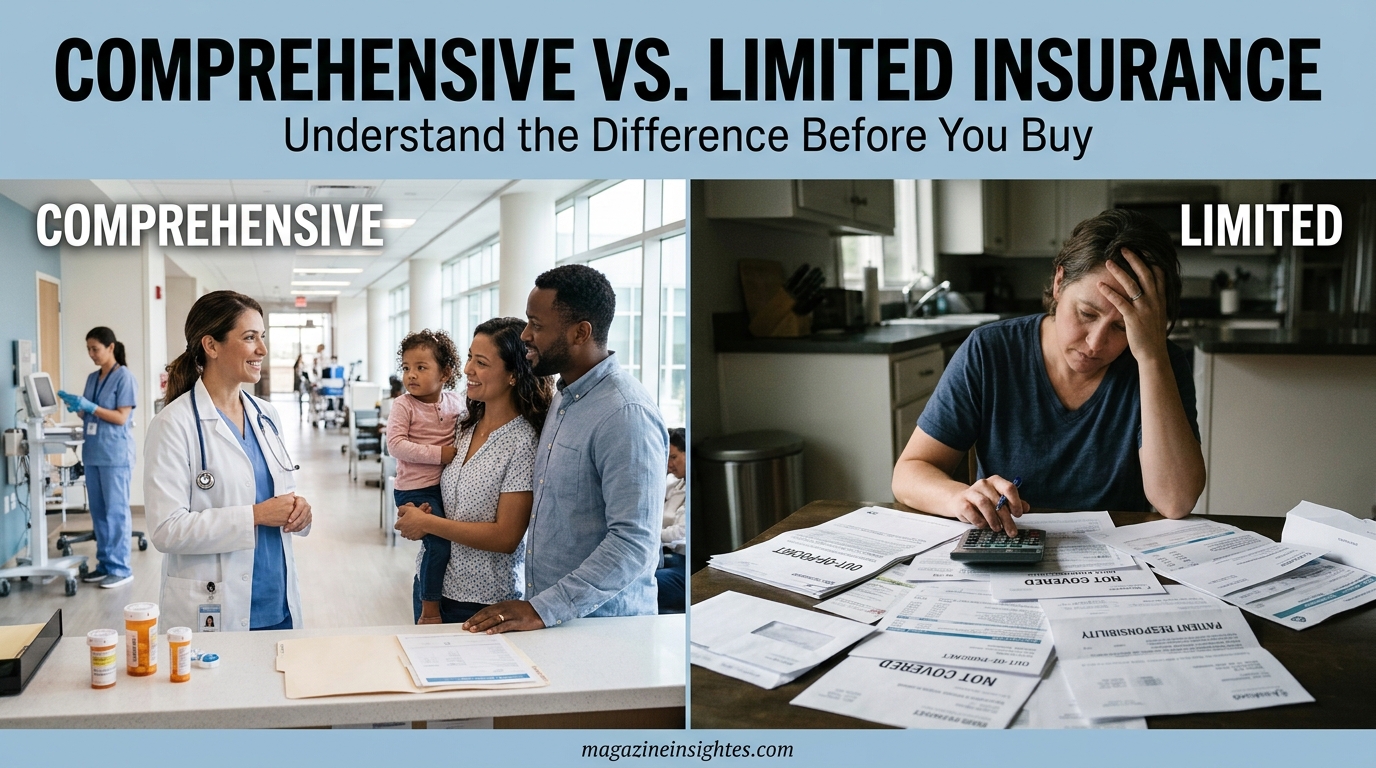
Comprehensive coverage is provided by several types of health plans, and the type matters less than the benefits inside it.
A plan counts as comprehensive when it covers the broad range of services described above, and the list below covers the main sources.
| Plan type | Counts as comprehensive? | Notes |
|---|---|---|
| Employer-sponsored health plan | Usually yes | All employer plans count as minimum essential coverage by definition |
| ACA Marketplace plan | Yes | Must cover all 10 essential health benefits with no annual or lifetime caps |
| Off-exchange ACA-compliant plan | Yes | Same benefit rules as Marketplace plans, bought directly from an insurer |
| Medicaid | Usually yes | Some people qualify only for limited-benefit Medicaid, which does not count |
| CHIP | Yes | Children’s Health Insurance Program covers the essential benefit categories |
| Medicare Advantage | Usually yes | Must cover at least what Original Medicare covers, often with more |
| Original Medicare alone | Only with additions | Needs a Medigap plan and a Part D drug plan for truly comprehensive coverage |
| Grandfathered and grandmothered plans | Mostly yes | Considered comprehensive, but less robust than post-2014 plans |
Employer-Sponsored Health Plans
Most employer-provided health plans provide comprehensive coverage, and all employer-sponsored plans are considered minimum essential coverage by definition.
Large employers can still choose to offer skimpy plans and pay the employer mandate penalty instead, but that is fairly rare in practice.
ACA Marketplace Plans
An ACA-compliant policy purchased in a state health insurance exchange, known as the Marketplace, is comprehensive by law.
Every Marketplace plan covers all 10 essential health benefits, with no annual or lifetime benefit caps on those benefits.
Off-Exchange ACA-Compliant Plans
An ACA-compliant plan purchased directly from an insurer, outside the Marketplace, follows the same benefit rules. The coverage is the same, but premium tax credits are only available for plans bought through the Marketplace.
Medicaid and CHIP
Medicaid and CHIP plans generally provide comprehensive coverage, with some exceptions for people who qualify only for limited-benefit Medicaid.
Medicaid rules changed in 2026, with work requirements of 80 hours a month for expansion adults aged 19 to 64 starting January 1, 2027, under Public Law 119-21.
Medicare, Medigap, and Part D
Medicare counts as comprehensive when it is complete, either as Medicare Advantage or as Original Medicare combined with a Medigap plan and a Part D drug plan.
Original Medicare on its own has no cap on out-of-pocket costs, which is why most beneficiaries add extra coverage.
What Does Not Count as Comprehensive Health Insurance
Several products look like health insurance but do not provide comprehensive coverage. They are still for sale in most states, and they are designed to supplement a major medical plan rather than replace it.
| Product | Is it insurance? | Why it is not comprehensive |
|---|---|---|
| Short-term medical plan | Yes, limited | Can exclude pre-existing conditions and skip essential benefits; not minimum essential coverage |
| Fixed-indemnity plan | Yes, limited | Pays a fixed dollar amount per service, not the full cost of care |
| Accident plan | Yes, limited | Covers only injuries from accidents, nothing else |
| Critical illness plan | Yes, limited | Pays a lump sum for one named illness, such as cancer |
| Health care sharing ministry | No | Members share costs voluntarily; it is not insurance and has no coverage guarantee |
| Direct primary care plan | No | Covers primary care visits for a monthly fee, not hospital or specialist care |
| Farm Bureau plan (some states) | No, in some states | Not considered insurance in the states where it is sold as a membership benefit |
Short-Term Medical Plans
Short-term medical plans are the most common non-comprehensive product, and they are the reason the buyer-beware warning matters.
They can exclude pre-existing conditions, skip essential health benefits, and still describe themselves as comprehensive in their marketing.
Fixed-Indemnity Plans
Fixed-indemnity plans pay a set dollar amount for each service, such as a fixed amount per hospital day, rather than covering the cost of care.
The payment is the same no matter how large the bill is, so a serious illness can leave a large balance unpaid.
Accident and Critical Illness Plans
Accident plans cover only injuries from accidents, and critical illness plans pay a lump sum when one named illness, such as cancer, is diagnosed.
Both are supplemental products, and neither one replaces a major medical plan.
Health Care Sharing Ministries
Health care sharing ministry plans are not insurance at all, even though they look similar. Members share each other’s medical costs voluntarily, and there is no contract that guarantees a bill will be paid.
Direct Primary Care Plans
Direct primary care plans cover primary care visits for a flat monthly fee, which can be useful for routine care.
They do not cover hospital stays, surgery, or specialist care, so they are not comprehensive coverage on their own.
The guide on whether you can have two health insurances on the site explains how two plans work together when one of them is limited.
About 43.1 million people in the United States, or 13.1 percent, were covered by more than one type of health insurance in 2021, according to the Census Bureau.
Comprehensive versus Basic, Limited, and Supplemental Plans
The difference between comprehensive and limited coverage is the breadth of what is covered and the size of the risk the buyer keeps.
A comprehensive plan spreads the risk across many services, while a limited plan leaves the buyer exposed to the services it does not cover.
| Feature | Comprehensive plan | Limited-benefit plan | Supplemental plan |
|---|---|---|---|
| Services covered | Wide range, including all 10 essential benefits | Only specific conditions or services | One named risk, such as an accident |
| Annual or lifetime caps | None on essential benefits | Dollar caps are common | Lump sum or fixed amount |
| Pre-existing conditions | Covered, with no denial or surcharge | Often excluded or limited | Often excluded |
| Minimum essential coverage | Yes | No | No |
| Premium | Higher | Lower | Low |
| Protection in a serious illness | Strong | Weak | Minimal |
| Subsidy eligible | Yes, through the Marketplace | No | No |
Comprehensive plans are typically more costly than limited-benefit plans, but they provide significantly more protection in the event of a medical claim.
A low-cost, limited-benefit option might not be a good deal in the long run, even when the monthly premium looks attractive.
The pros of a comprehensive plan are broad protection, no coverage caps on essential benefits, and coverage for pre-existing conditions.
The cons are a higher premium and, in many plans, a deductible that must be met before the plan starts paying for most care.
The pros of a limited plan are a low premium and simple terms.
The cons are coverage gaps, dollar caps, exclusions for pre-existing conditions, and no eligibility for Marketplace subsidies, which can leave a buyer with a large bill after a serious illness.
Comprehensive versus Catastrophic and Short-Term Plans
Catastrophic plans and short-term plans are the two products most often confused with comprehensive coverage. Both have a place, but neither one is comprehensive in the legal sense.
| Feature | Comprehensive plan | Catastrophic plan | Short-term plan |
|---|---|---|---|
| Essential health benefits | All 10 covered | All 10 covered | Not required |
| Who can buy it | Anyone eligible | People under 30, or with a hardship exemption | Anyone, where sold |
| Premium | Higher | Lower | Lowest |
| Deductible | Varies by metal tier | Very high | Varies, often high |
| Pre-existing conditions | Covered | Covered | Often excluded |
| Subsidy eligible | Yes | No | No |
| Duration | Year-round, renewable | Year-round, renewable | Months, not a full year |
A catastrophic plan is an ACA-compliant plan, so it does cover the 10 essential health benefits, but it has a very high deductible and a low premium.
It is available only to people under 30 or to people with a hardship exemption, and it does not qualify for premium tax credits.
A short-term plan is not ACA-compliant, so it is not required to cover the essential benefits at all.
It can exclude pre-existing conditions, and it is sold for months rather than a full year, which makes it a bridge product rather than a replacement for comprehensive coverage.
How Much Does Comprehensive Health Insurance Cost

The overall cost of a health insurance policy includes premiums and cost-sharing.
A premium is the amount paid each month for coverage, whether or not any care is used, and cost-sharing is the part of the bill the patient pays when care is received.
Cost-sharing takes three forms. A deductible is the amount paid before the plan starts paying for most care.
A copayment is a fixed amount per visit or prescription. Coinsurance is a percentage of the bill paid after the deductible is met.
The out-of-pocket maximum is the most a plan can make a person pay in a year for covered in-network care.
In 2026 the limit is $10,600 for one person and $21,200 for a family, and in 2027 it rises to $12,000 for one person and $24,000 for a family, according to HealthCare.gov.
| Coverage | 2025 | 2026 | 2027 | Source |
|---|---|---|---|---|
| Marketplace benchmark Silver, age 40, before credits | $497 a month | $625 a month | $703 a month | KFF |
| Marketplace average premium, all ages, before credits | Not published here | $741 a month | Not yet published | CMS |
| Marketplace average paid after tax credits | Not published here | $178 a month | Not yet published | CMS |
| Out-of-pocket maximum, one person | $9,200 | $10,600 | $12,000 | HealthCare.gov |
| Out-of-pocket maximum, family | $18,400 | $21,200 | $24,000 | HealthCare.gov |
KFF’s benchmark premium table gives the national average by year. The trend is clear.
The benchmark for a 40-year-old rose from $497 a month in 2025 to $625 a month in 2026, then to $703 a month in 2027.
The 2026 rise was about 26 percent, and the 2027 rise was about 13 percent on average.
The benchmark is the second-lowest-cost Silver plan for a 40-year-old in each county, and KFF weights the national average by plan selections.
Prices vary widely by state: in 2026 the benchmark ranged from $401 a month in New Hampshire to $1,299 a month in Vermont, before tax credits.
| Employer coverage, 2026 | Total premium | Worker pays | Employer pays |
|---|---|---|---|
| Single coverage | $9,804 a year ($817 a month) | $1,672 a year ($139 a month) | $8,132 a year |
| Family coverage | $28,303 a year ($2,359 a month) | $7,471 a year ($623 a month) | $20,832 a year |
The employer figures above come from KFF’s 2026 Employer Health Benefits Survey, published October 22, 2026.
Workers paid on average 18 percent of the premium for single coverage and 27 percent for family coverage.
In the same survey, 67 percent of firms with 10 or more workers offered health benefits to at least some workers.
Small firms pay more than large firms for the same family coverage.
Workers at firms with 10 to 199 employees paid $8,889 a year for family coverage, compared with $6,227 at larger firms, according to KFF.
In the same survey, 28 percent of small-firm workers faced a family contribution of $12,000 or more.
Older figures tell a different story and should not be mixed with the 2026 numbers.
Healthinsurance.org reported a Marketplace average after-subsidy premium of about $105 a month in 2024.
The average employer employee-only payment was about $114 a month in 2024, with KFF 2024 deductibles of $1,787 for employer single coverage and $3,057 on average across Marketplace plans.
The average single deductible in employer plans with a general deductible was $1,955 in 2026, according to KFF.
Silver plans with built-in cost-sharing reductions had much lower deductibles than the Marketplace average, which is why the metal tier and the subsidy status matter as much as the premium.
The Worked Cost Example: Premium Plus Deductible
A premium alone does not show what coverage really costs, because the deductible must also be paid before the plan covers most care.
A fair comparison adds the yearly premium and the deductible together into one figure.
Take a 40-year-old buying the benchmark Silver plan in 2026 at $625 a month, with no subsidy.
The yearly premium is $7,500, and with a Marketplace average deductible near $3,057, the combined figure is about $10,557 before the plan pays for most care, using the 2024 Marketplace average deductible as the illustration.
Take the same person with an employer plan in 2026, paying $1,672 a year as the worker share of a single premium, with the average single deductible of $1,955.
The combined figure is $3,627, which shows why employer coverage usually costs the worker less out of pocket than unsubsidized Marketplace coverage.
The two examples use different deductible years, so they are illustrations rather than exact quotes.
A real quote depends on age, ZIP code, income, family size, and the plan chosen, and no national average can replace a quote for a specific household.
| Cost term | What it means |
|---|---|
| Premium | The monthly charge for having coverage, paid whether or not care is used |
| Deductible | The amount paid out of pocket before the plan pays for most care |
| Copayment | A fixed amount paid per visit, service, or prescription |
| Coinsurance | A percentage of the bill paid after the deductible is met |
| Out-of-pocket maximum | The most paid in a year for covered in-network care, after which the plan pays 100 percent |
| Allowed amount | The most the plan will pay for a covered service, which sets the ceiling for cost-sharing |
Metal Tiers: Same Coverage, Different Cost Split
Marketplace plans are grouped into metal tiers that show how costs are split between the buyer and the plan.
The tiers are Bronze, Silver, Gold, and Platinum, plus Catastrophic for people under 30 or with a hardship exemption.
Every metal tier covers the same 10 essential health benefits, so the tiers differ only in cost-sharing, not in what is covered.
A Bronze plan bought on HealthCare.gov in 2026 covers maternity care just like a Platinum plan, and the difference is what the buyer pays at the doctor’s office.
| Metal tier | Plan pays on average | Buyer pays on average | Premium | Best for |
|---|---|---|---|---|
| Bronze | About 60 percent | About 40 percent | Lowest | Healthy people who rarely need care |
| Silver | About 70 percent | About 30 percent | Moderate | Most buyers, and the tier subsidies are tied to |
| Gold | About 80 percent | About 20 percent | Higher | People who expect regular care |
| Platinum | About 90 percent | About 10 percent | Highest | People with high expected medical costs |
| Catastrophic | After a very high deductible | Nearly all costs until then | Low | People under 30 or with a hardship exemption |
The percentages above are actuarial values, which describe the average share of covered costs the plan pays across all enrollees.
An individual person’s share depends on how much care they actually use, so the tier is a guide rather than a promise about any single bill.
Silver is the tier that matters most for subsidies, because premium tax credits are calculated from the benchmark Silver plan.
Cost-sharing reductions, which lower deductibles and copayments, are also available only on Silver plans for people who qualify by income.
Premium Tax Credits and the 2027 Subsidy Cliff
Premium tax credits lower the monthly cost of a Marketplace plan.
They are set so that a buyer pays no more than a fixed share of household income for the benchmark Silver plan where they live.
The credit covers the difference between that share and the benchmark premium.
The enhanced premium tax credits from the American Rescue Plan, extended through 2025 by the Inflation Reduction Act, expired on December 31, 2025.
The 2026 credit table therefore stops at 400 percent of the federal poverty level, and income above that level gets no credit under current law.
| Household income, percent of federal poverty level | Share of income paid for the benchmark plan, 2026 |
|---|---|
| Below 133 percent | 2.10 percent |
| 133 to 300 percent | Rises with income, between 2.10 and 9.96 percent |
| 300 to 400 percent | 9.96 percent |
| Above 400 percent ($62,600 single) | No credit in 2026 |
The 400 percent threshold for 2026 coverage is $62,600 for a single person, and for 2027 coverage it is $63,840 for a single person, using the newer poverty level figures.
A household just above the line loses the entire credit at once, which is why the line is called a cliff rather than a slope.
For 2027 coverage, the credit table runs from 2.15 percent of income at 100 percent of the poverty level to 10.22 percent at 400 percent.
A single person earning $31,920 would pay about $180 a month for the benchmark Silver plan, according to the 2027 rules.
Income above 400 percent of the poverty level receives no credit under current law.
The cliff is largest for older buyers, because their benchmark premiums are highest.
One analysis estimated the 2026 subsidy cliff at $9,692 a year for a single 60-year-old earning just above $62,600, which is the gap between losing all premium tax credits and keeping them.
Open enrollment for 2027 coverage ran from November 1, 2026 to January 15, 2027, and the same window applies each year unless the dates change.
Outside open enrollment, a buyer generally needs a qualifying life event, such as losing a job, getting married, or having a child, to enroll through a special enrollment period.
Grandfathered and Grandmothered Plans
Grandfathered and grandmothered plans are older major medical plans that were in effect before the Affordable Care Act’s benefit rules took hold.
Both types are considered comprehensive, but both are generally less robust than policies that have taken effect since 2014.
A grandfathered plan is a major medical plan that was in effect before March 23, 2010, when the Affordable Care Act was signed.
It can still remain in effect today, but it can no longer be sold to new individuals or employer groups.
A grandmothered plan, also called a transitional plan, is a major medical plan that was in effect in the individual and small-group markets before 2014.
It can still remain in effect in most states, although it also can no longer be sold to new buyers.
The gap matters because these older plans do not include all of the same consumer protections as newer plans.
A grandfathered plan, for example, may not cover all 10 essential health benefits, and it may still have annual limits that a newer plan cannot have.
Someone who holds one of these plans should check the summary of benefits and coverage each year before renewing.
The plan may still be the right choice, but the decision should be made with the gaps in view, not on the assumption that an older plan matches a newer one.
The Minimum Value Rule for Large Employer Plans
Self-insured and large-group plans follow different rules from individual and small-group plans. In most states, a large group means more than 50 employees, although four states set the limit at 100 employees instead.
These plans have no particular benefit requirements other than preventive care, so they are not required to cover all 10 essential health benefits. Instead, they must provide what the law calls minimum value.
Minimum value means the plan must cover at least 60 percent of average costs and provide substantial coverage for inpatient care and physician services.
A plan that meets the 60 percent test and covers hospital and doctor care in a substantial way counts as minimum value, even if it skips some essential benefit categories.
The rule matters for workers who are offered a large employer’s plan and wonder whether it is good enough.
A plan that meets minimum value counts as minimum essential coverage, so it satisfies the coverage requirement, but the worker should still check the deductible and the network before enrolling.
How to Check Whether a Plan Is Comprehensive
The label on a plan’s marketing page is not a reliable test, so the check has to use the plan’s own documents. The eight steps below take about five minutes once the documents are open.
- Open the summary of benefits and coverage, which every plan must provide in a standard format.
- Confirm the plan is ACA-compliant, which means it is a major medical plan sold in the individual, small-group, or employer market.
- Check that all 10 essential health benefits appear in the coverage list, including maternity, mental health, and prescription drugs.
- Confirm there is no annual or lifetime dollar cap on the essential benefits.
- Check that pre-existing conditions are covered, with no waiting period or exclusion.
- Read the deductible, the copayments, the coinsurance, and the out-of-pocket maximum, and add the yearly premium to the deductible.
- Check the provider network and the drug formulary, so the doctors and medicines needed are actually covered.
- Confirm the plan counts as minimum essential coverage, which matters for special enrollment and for state coverage rules.
| Check | What to look for | Where to find it |
|---|---|---|
| ACA-compliant | Major medical plan, individual, small-group, or employer market | Summary of benefits and coverage |
| Essential benefits | All 10 categories present | Summary of benefits and coverage |
| Caps | No annual or lifetime dollar cap on essential benefits | Summary of benefits and coverage |
| Pre-existing conditions | Covered with no waiting period | Plan documents, evidence of coverage |
| Cost-sharing | Deductible, copayments, coinsurance, out-of-pocket maximum | Summary of benefits and coverage |
| Network | Doctors and hospitals needed are in network | Provider directory |
| Formulary | Medicines needed are on the drug list | Drug formulary |
| Minimum essential coverage | Plan counts as minimum essential coverage | Plan documents, HealthCare.gov |
A licensed broker is an excellent resource for comparing cost and value, and the broker should be certified by the health insurance exchange in the state.
A certified broker shows ACA-compliant plans and any subsidies the buyer may be eligible for, rather than only the plans that pay the highest commission.
Readers who want to compare Marketplace plans can do so on HealthCare.gov, where the plan comparison tool shows exactly what each plan offers.
The tool lists the essential benefits, the deductible, and the out-of-pocket maximum side by side, which makes the eight-step check easier.
Who Needs Comprehensive Health Insurance
Families
Families need comprehensive coverage because children need pediatric care, dental, and vision, and a birth is one of the most expensive events a household can face.
Maternity and newborn care are essential health benefits, so a comprehensive plan covers the pregnancy, the delivery, and the baby’s first care.
Self-Employed Workers
Self-employed workers need comprehensive coverage because they have no employer to share the premium.
The Marketplace is the usual source, and premium tax credits can bring the cost down substantially, though the 2027 subsidy cliff means income just above 400 percent of the poverty level gets no credit.
People With Chronic Conditions
People with chronic conditions need comprehensive coverage because they use care every month, not once a year.
Prescription drugs, laboratory services, and chronic disease management are all essential health benefits, and a limited plan would leave the most-used services uncovered.
People Who Are Pregnant or Planning Pregnancy
People who are pregnant or planning a pregnancy need comprehensive coverage because maternity care is expensive and unpredictable.
A plan that skips maternity benefits, as many pre-2014 individual policies did, can leave a family with a bill in the tens of thousands of dollars.
Young Healthy Adults
Young healthy adults still need comprehensive coverage, even when they rarely see a doctor.
An accident or a sudden illness can produce a hospital bill that a limited plan will not cover, and a catastrophic plan is the low-cost ACA-compliant option for people under 30.
Mistakes to Avoid When Buying Health Insurance
Mistake 1: Trusting the Word Comprehensive in an Advertisement
The word comprehensive has no legal meaning, so an advertisement can use it on a plan that skips essential benefits.
The summary of benefits and coverage is the only reliable source, and the eight-step check above is the test to run.
Mistake 2: Choosing by Premium Alone
A low premium can hide a high deductible, a narrow network, or a drug formulary that does not cover the medicines needed.
The yearly premium plus the deductible is the fair comparison, not the monthly premium on its own.
Mistake 3: Ignoring the Network and the Formulary
A plan that looks cheap is expensive when the family’s doctors are out of network or the regular prescriptions are not on the formulary.
The provider directory and the drug list should be checked before enrolling, not after the first bill arrives.
Mistake 4: Missing the Enrollment Window
Outside open enrollment, a buyer generally needs a qualifying life event to enroll, and many special enrollment situations require minimum essential coverage already in place.
A gap in coverage can close the door to comprehensive coverage until the next open enrollment period.
Mistake 5: Buying a Short-Term Plan as a Replacement
A short-term plan is a bridge product for a gap of months, not a replacement for a year of coverage.
It can exclude pre-existing conditions and skip essential benefits, and it does not qualify for subsidies, so it should never be bought as the main plan for a family.
Frequently Asked Questions
What is comprehensive health insurance?
Comprehensive health insurance is a health plan that covers a wide range of medical services, including doctor visits, hospitalization, prescriptions, and emergency care.
It is also called major medical insurance, and new individual and small-group plans sold since 2014 must cover the 10 essential health benefits.
What does comprehensive health insurance cover?
It covers the 10 essential health benefits. Outpatient care, emergency services, hospitalization, and maternity and newborn care are among them.
Mental health and substance use disorder services, prescription drugs, rehabilitative and habilitative services, laboratory services, preventive care, and pediatric services including oral and vision care complete the list.
Is comprehensive health insurance the same as major medical insurance?
Yes, the two terms mean the same thing in practice.
Comprehensive coverage is also known as major medical health insurance, and both terms describe a plan that covers a wide range of health services rather than a narrow set.
Is “comprehensive” a legal term in health insurance?
No, it is not an officially defined term, and it has no particular marketing rules attached to its use.
A short-term plan can describe itself as comprehensive in its marketing even though it is not minimum essential coverage and is not regulated by the Affordable Care Act.
Can a short-term health plan call itself comprehensive?
Yes, it can, because the word has no legal definition in health insurance.
The buyer must check the summary of benefits and coverage instead of trusting the label, because a short-term plan can exclude pre-existing conditions and skip essential benefits.
What are the 10 essential health benefits?
The 10 benefits are outpatient care, emergency services, hospitalization, and maternity and newborn care.
Mental health and substance use disorder services, prescription drugs, and rehabilitative and habilitative services and devices are next.
Laboratory services, preventive and wellness services and chronic disease management, and pediatric services including oral and vision care complete the list.
Does comprehensive health insurance cover pre-existing conditions?
Yes, comprehensive plans cover pre-existing conditions with no denial and no surcharge. That protection is one of the main differences between a comprehensive plan and a short-term plan, which can exclude pre-existing conditions.
Does comprehensive health insurance cover maternity care?
Yes, maternity and newborn care are essential health benefits, so every comprehensive plan covers prenatal care, labor and delivery, post-delivery care, and care for newborn babies. Before 2014, many individual policies excluded maternity care entirely.
Does comprehensive health insurance cover mental health treatment?
Yes, mental health and substance use disorder services are essential health benefits, including behavioral health treatment, counseling, and psychotherapy.
Readers who want a career in the field can read the guide on how to become a mental health therapist on the site.
Does comprehensive health insurance cover prescription drugs?
Yes, prescription drugs are essential health benefits, so every comprehensive plan covers medications prescribed by a doctor. Each plan has its own formulary, so the specific drugs covered can differ from one plan to another.
Does comprehensive health insurance cover dental care for adults?
No, adult dental care is not an essential health benefit, so it is usually sold as a separate plan. Pediatric dental care is included in the essential health benefits, but only for children.
Does comprehensive health insurance cover vision care for adults?
No, adult vision care is not an essential health benefit, so it is usually sold separately. Pediatric vision care is included in the essential health benefits, but only for children.
Does comprehensive health insurance cover preventive care?
Yes, preventive and wellness services are essential health benefits, including screenings, vaccinations, and chronic disease management. GoodRx lists 22 preventive care benefits for adults that ACA plans must cover.
How much does comprehensive health insurance cost per month?
There is no single price, because cost depends on age, location, income, and the plan chosen.
The KFF benchmark Silver premium for a 40-year-old was $625 a month in 2026 and $703 a month in 2027, before tax credits.
The average Marketplace enrollee paid $178 a month after tax credits in 2026.
How much does comprehensive health insurance cost in 2027?
The KFF benchmark Silver premium for a 40-year-old averages $703 a month in 2027 before tax credits, up from $625 a month in 2026.
Employer coverage averaged $817 a month for single coverage in 2026, with the worker paying about $139 a month of that total.
Is comprehensive health insurance expensive?
It is more expensive than a limited-benefit plan, but subsidies can bring the price down substantially.
Marketplace premium tax credits and employer subsidies can make comprehensive coverage very inexpensive or even free, depending on income, age, and location.
Is comprehensive health insurance worth it?
For most people, yes, because it protects against the largest medical bills.
A limited plan can look cheap until a serious illness arrives, and the coverage gap it leaves can cost far more than the premium saved.
Who needs comprehensive health insurance?
Families, self-employed workers, people with chronic conditions, and people who are pregnant or planning a pregnancy need it most.
Young healthy adults need it too, because an accident or a sudden illness can produce a hospital bill that a limited plan will not cover.
What is the difference between comprehensive and basic health insurance?
A comprehensive plan covers a wide range of services, including all 10 essential health benefits, with no annual or lifetime caps.
A basic plan covers a narrower set of services, often with dollar caps, and it does not count as minimum essential coverage.
What is the difference between comprehensive and catastrophic health insurance?
A catastrophic plan is ACA-compliant and covers the 10 essential benefits, but it has a very high deductible and a low premium.
It is available only to people under 30 or with a hardship exemption, and it does not qualify for premium tax credits.
What is minimum essential coverage?
Minimum essential coverage is the legal standard for health coverage under the Affordable Care Act.
Employer plans, Marketplace plans, Medicaid, CHIP, and Medicare all count as minimum essential coverage, while short-term plans and fixed-indemnity plans do not.
What is minimum value in health insurance?
Minimum value is the standard for large-group and self-insured employer plans, and it means the plan covers at least 60 percent of average costs and provides substantial coverage for inpatient care and physician services.
A plan that meets minimum value counts as minimum essential coverage.
Do all employer health plans count as comprehensive?
Most do, and all employer plans count as minimum essential coverage by definition.
A large employer can still offer a skimpy plan and pay the mandate penalty instead, but that is rare, and the worker should check the deductible and the network before enrolling.
Is Medicaid considered comprehensive health insurance?
Usually yes, because Medicaid generally covers the essential benefit categories. Some people qualify only for limited-benefit Medicaid, which does not count as comprehensive, so the specific Medicaid program matters.
Can I buy comprehensive health insurance outside open enrollment?
Usually only with a qualifying life event, such as losing a job, getting married, or having a child, through a special enrollment period.
Many special enrollment situations require minimum essential coverage already in place, so a gap in coverage can close the door until the next open enrollment period.
The guide to what HMO means in health insurance on the site explains one of the plan types a buyer will meet when comparing options.
Buyers should also check reviews of any company they consider, such as the review of whether Prosper Health is legit on the site.
Conclusion
What is comprehensive health insurance?
It is a major medical plan that covers a wide range of services, including the Affordable Care Act’s 10 essential health benefits, with no annual or lifetime caps on those benefits.
The word itself is not a legal term, so the label on an advertisement proves nothing.
The real test is the plan’s own documents: the summary of benefits and coverage, the 10 essential benefits, the absence of caps, and the coverage of pre-existing conditions.
Costs rose sharply in 2026 and again in 2027, with the KFF benchmark Silver premium for a 40-year-old at $703 a month in 2027 before tax credits.
Subsidies can still bring that price down, but the enhanced credits expired at the end of 2025, so income above 400 percent of the federal poverty level gets no credit under current law.
Readers who are ready to compare plans can do so on HealthCare.gov, where the plan comparison tool shows the essential benefits, the deductible, and the out-of-pocket maximum side by side.
A licensed broker certified by the state exchange can also help compare cost and value, and can confirm whether a subsidy applies.
The content here is general information only, not insurance advice or financial advice.
Every figure is labelled with its source and year.
Readers should check their own plan documents and talk to a licensed broker before enrolling, because the right plan depends on income, health needs, and state rules.