What Is Intellectual Health? Definition, Examples, and How to Improve It

What is intellectual health? It is the ongoing capacity to think critically, learn new concepts, solve problems, and adapt to changing information.
Intellectual health is not the same as being smart. It is not a test score, and it is not a degree on a wall.
It is the daily practice of keeping the mind active and curious. A retiree who learns Spanish, joins a book club, and takes up painting can have excellent intellectual health.
A person with two advanced degrees who stopped reading, stopped questioning opinions, and never engages with unfamiliar ideas can have poor intellectual health. The difference is the process, not the credentials.
The definition, the history, the signs, and the daily habits that build intellectual health are all covered below. It is general information only, not medical advice.
What Is Intellectual Health?
Intellectual health is one of the dimensions of wellness. It sits beside physical, emotional, social, occupational, and spiritual health in the classic model.
The University of Waterloo defines intellectual well-being as the ability to learn, experience, and use intellectual capacities through creative and stimulating mental activities, with the goal of expanding knowledge and skills.
The University of Rochester Medical Center puts it simply: intellectual health and wellness consider the creative and mentally stimulating activities that encourage the expansion of knowledge and the development of skills that foster learning.
Illinois State University defines it as maintaining optimal cognition for learning, problem solving, and decision making in daily life. That definition is the most practical of the three.
The short answer
Intellectual health is a curious, engaged mind that stays open to new ideas and experiences. It is the ability to think, reason, and create, kept active by daily use.
It is a dynamic part of life, not a fixed state. It grows with use and fades with neglect, and it can improve at any age.
The longer definition
The longer definition has three parts. First, the capacity to learn, process information, solve problems, and think critically.
Second, the willingness to stay open to new ideas, challenge assumptions, and recognize personal biases. Third, the habit of using those capacities every day.
Waterloo lists the components as critical thinking, stimulating curiosity, problem solving, reflection, self-knowledge, and creativity. It also includes recognizing helpful and unhelpful patterns of thinking, and managing inner dialogue and negative thoughts.
James Madison University adds openness to new ideas, a capacity to think critically, being curious, questioning concepts, and solving problems. The goal, in its words, is gaining new knowledge and learning.
What intellectual health is not
Intellectual health is not intelligence. Intelligence is often treated as a fixed trait, while intellectual health is about the maintenance and growth of cognitive functions throughout life.
It is not academic success either. Grades measure performance in school, while intellectual health measures how the mind is used in daily life.
It is not the absence of mental illness. A person can have a mental health condition and still have strong intellectual health, and the two need different kinds of support.
For the words people use around mental health, the guide to another word for mental health lists 40 terms, plus the stigmatizing words to avoid.
Where Intellectual Health Comes From
Intellectual health comes from the wellness movement. It began as one of six dimensions in a model built in the 1970s, and it has been part of every wellness framework since.
The idea is older than the model. Halbert Dunn, called the father of the wellness movement, wrote about high-level wellness in 1959 and published a book on it in 1961.
Dunn described wellness as a continuum, not a switch. A person could move toward higher wellness in every dimension, including the intellectual one.
Dr. Bill Hettler and the six dimensions of wellness
Dr. Bill Hettler, co-founder of the National Wellness Institute, built the six dimensions model in 1976 at the University of Wisconsin-Stevens Point. The six dimensions were physical, emotional, intellectual, social, spiritual, and occupational.
The National Wellness Institute defines wellness as an active process through which people become aware of, and make choices toward, a more successful existence.
That definition is quoted verbatim because it is the source of the whole framework.
Hettler’s model made intellectual health a named part of wellness for the first time. Before it, wellness meant mostly physical health, and the mind was an afterthought.
The National Wellness Institute publishes the six dimensions on its own site, and the page is the best source for the original model.
The lineage: Dunn, Hettler, Swarbrick, and SAMHSA
Margaret Swarbrick expanded the model in 2006 with a paper called “A Wellness Approach” in the Psychiatric Rehabilitation Journal, volume 29, issue 4, pages 311 to 314. She added financial and environmental dimensions, making eight.
The Substance Abuse and Mental Health Services Administration, known as SAMHSA, adopted the eight dimensions. Its first National Wellness Week ran in 2011, and its guide Creating a Healthier Life appeared in 2016.
SAMHSA defines the intellectual dimension as recognizing creative abilities and finding ways to expand knowledge and skills. That short definition is the most quoted version in American wellness programs.
The James Madison University wellness dimensions page lists the same framework, with the intellectual goal stated as gaining new knowledge and learning.
Intellectual Health vs Mental Health
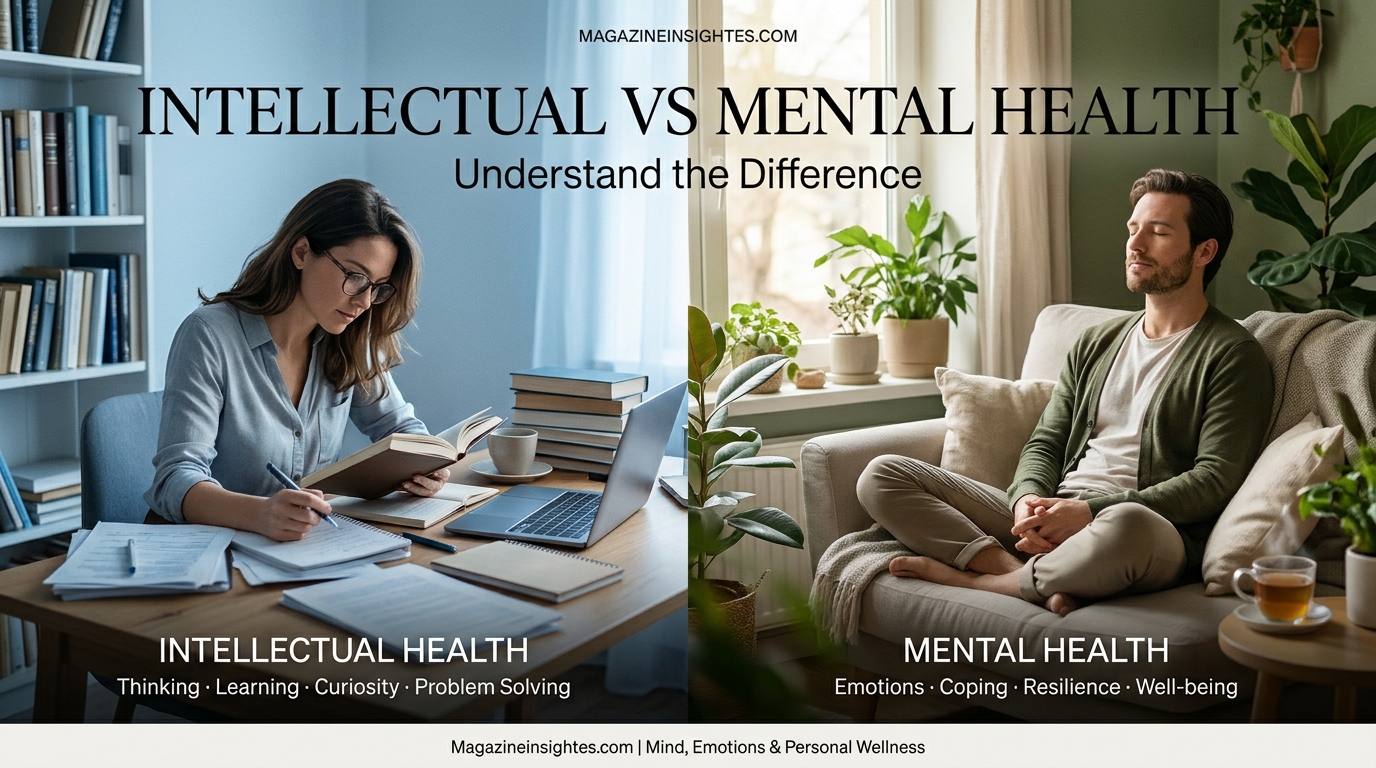
Intellectual health and mental health sound similar, and many people use them as synonyms. They are related, but they are not the same thing.
Mental health is about how a person feels, copes, and manages emotions. Intellectual health is about how a person thinks, learns, and solves problems.
A person can have strong intellectual health and poor mental health at the same time. A person can also have strong mental health and a stagnant intellectual life.
| Element | Intellectual health | Mental health |
|---|---|---|
| Core question | Am I learning and thinking clearly? | Am I coping and feeling well? |
| Key skills | Critical thinking, curiosity, problem solving | Emotional regulation, resilience, coping |
| Daily practice | Reading, learning, discussing, creating | Sleep, connection, stress management, therapy |
| Signs of strength | Curiosity, open-mindedness, good decisions | Stable mood, resilience, satisfying relationships |
| Signs of trouble | Closed-mindedness, mental stagnation, no curiosity | Anxiety, low mood, withdrawal, overwhelm |
| Professional help | Teachers, coaches, courses, mentors | Therapists, counselors, doctors, crisis lines |
Why people confuse them
People confuse them because both live in the mind, and both use the word “mental”. The confusion is understandable, but it has a cost.
When the two are confused, a person with a learning problem gets told to relax, and a person with a mental health problem gets told to read more. Neither suggestion fits.
The two dimensions support each other, but they do not replace each other. Learning can lift mood, and good mood can help learning, but neither one cures the other.
For the color that represents mental health, the guide to what color represents mental health explains why green became the general answer.
When to seek professional help
Intellectual health habits do not treat mental illness. If low mood, anxiety, or overwhelm lasts more than two weeks, or interferes with work, sleep, or relationships, talk to a doctor or a mental health professional.
If you are in crisis in the United States, call or text 988 to reach the Suicide and Crisis Lifeline. It is free, confidential, and available 24 hours a day.
For the career path itself, the guide to how to become a mental health therapist covers the education, licensing, and costs.
Intellectual Health vs IQ
IQ measures a narrow set of cognitive abilities at one moment in time. Intellectual health measures how a person uses the mind across a lifetime.
IQ is often treated as a fixed trait. Intellectual health is cultivable, which means it grows with practice and fades with neglect.
A high IQ does not guarantee good intellectual health. A person with a high score who never reads, never questions assumptions, and never learns anything new is intellectually stagnant.
A modest IQ does not prevent good intellectual health either. Curiosity, persistence, and daily learning matter more than a single test score.
The distinction matters because it puts control back in the reader’s hands. A test score cannot be changed easily, but a daily reading habit can start today.
The 6, 7, 8, 9, and 10 Dimensions Compared
Wellness frameworks disagree about how many dimensions exist. The disagreement is honest, and each framework counts differently, so the numbers must never be merged into one list.
| Framework | Count | Dimensions | Source |
|---|---|---|---|
| Hettler and NWI | 6 | Physical, emotional, intellectual, social, spiritual, occupational | Hettler, 1976 |
| Textbook variant | 6 | Physical, emotional, mental or intellectual, social, spiritual, environmental | Health textbooks |
| Seven dimensions | 7 | Hettler six plus environmental | Illinois State SEVEN program uses vocational instead of occupational |
| SAMHSA | 8 | Emotional, environmental, financial, intellectual, occupational, physical, social, spiritual | Swarbrick, 2006; SAMHSA, 2011 and 2016 |
| Nine dimensions | 9 | SAMHSA eight plus cultural | Later expansions |
| Dr Prem | 10 | Physical, mental, emotional, occupational, intellectual, financial, social, cultural, spiritual, environmental | Dr Prem framework |
The two six-dimension lists are the most common source of confusion. Hettler’s list includes occupational and leaves out environmental, while the textbook list includes environmental and leaves out occupational.
Both lists are real, and both are used. Hettler’s list is the primary one here, and the textbook variant is named separately, never merged.
Illinois State University runs a program called SEVEN that uses seven dimensions: emotional, environmental, intellectual, physical, social, spiritual, and vocational. Vocational replaces occupational in that version, which shows how the names shift between programs.
The Core Components of Intellectual Health
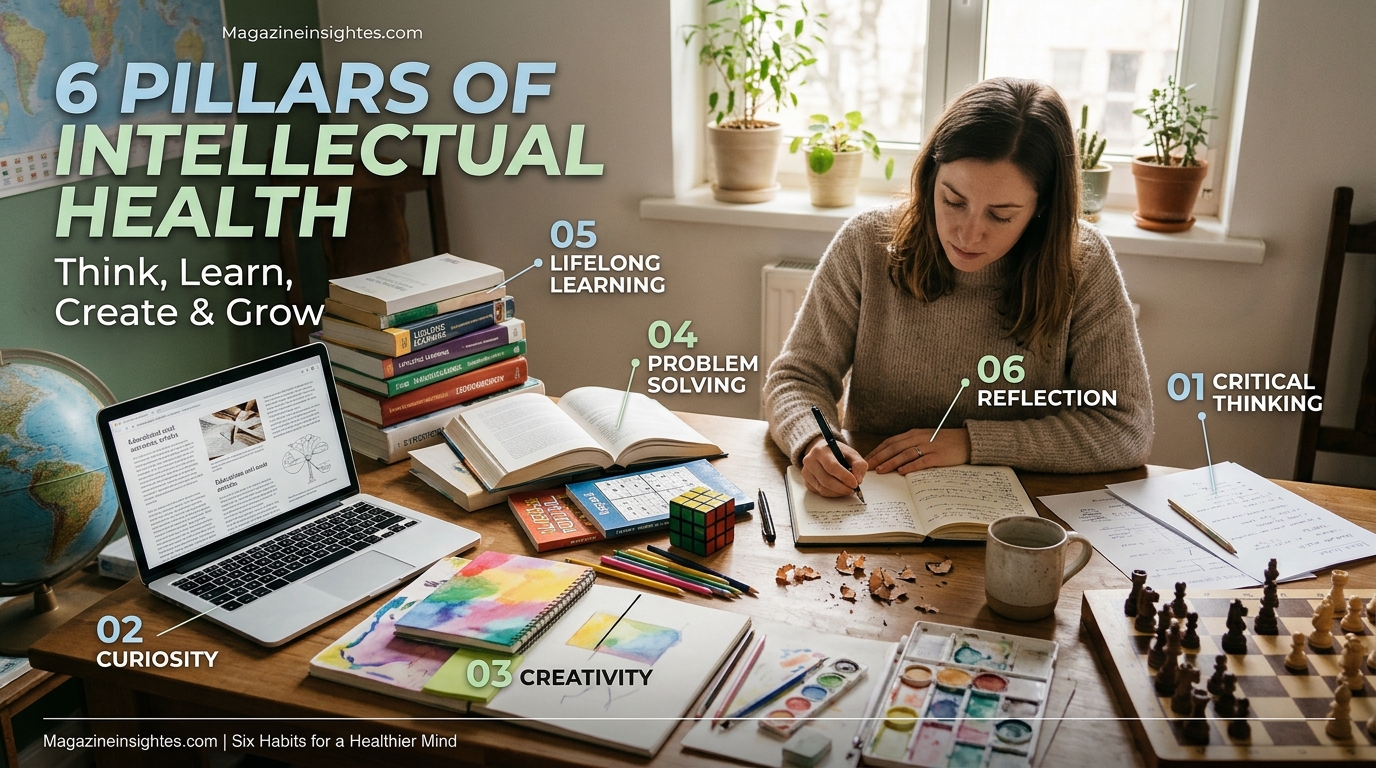
Six components make up intellectual health. Each one can be practiced on its own, and together they form the whole.
| Component | What it means | Daily example |
|---|---|---|
| Critical thinking | Analyzing, synthesizing, and evaluating information | Checking a claim before sharing it |
| Curiosity | Wanting to know more, asking why and how | Reading about a topic you know nothing about |
| Creativity | Making new connections and new things | Writing, drawing, cooking a new recipe |
| Problem solving | Finding a way through a difficulty | Fixing a broken process at work |
| Lifelong learning | Learning beyond formal schooling | Taking an online course or learning a language |
| Reflection | Thinking about what you think and why | Journaling after a hard decision |
Critical thinking
Critical thinking is the disciplined process of actively analyzing, synthesizing, and evaluating information. It is the skill that separates learning from memorizing.
It matters more in 2026 than ever before, because misinformation is cheap and fast. A person who checks sources, looks for evidence, and asks who benefits from a claim is practicing critical thinking.
The habit starts small. Before sharing a post, check the source. Before accepting a claim, ask what evidence supports it. Before deciding, look for the strongest argument on the other side.
Curiosity and open-mindedness
Curiosity is the engine of intellectual health. Without it, no habit sticks, because the mind has no reason to engage.
Open-mindedness is curiosity aimed at other people. It means being willing to hear an idea that contradicts a belief, and to change a belief when the evidence changes.
The two work together. Curiosity asks the question, and open-mindedness lets the answer in, even when the answer is uncomfortable.
Creativity
Creativity is one of the components of intellectual health, because a creative approach to solving life problems makes a person healthy. That idea comes from academic writing on the topic, and it is worth keeping.
Creativity is not only art. It is also finding a new way to do a routine task, or combining two old ideas into a new one.
Creative expression also helps the mind recover. Drawing, writing, music, and craft give the brain a different kind of work, and that variety keeps it flexible.
Problem solving
Problem solving is the practical side of intellectual health. It turns knowledge into action, and it is the skill employers value most.
Good problem solving starts with defining the problem clearly. A vague problem gets a vague solution, while a clear problem can be broken into parts.
Puzzles and games train the same skill in a low-stakes setting. Crosswords, Sudoku, chess, and strategy games all reward patience and pattern recognition.
Lifelong learning
Lifelong learning is the commitment to keep learning beyond formal schooling. It is the habit that most directly builds intellectual health.
It does not need a classroom. A course, a book, a podcast, a lecture, or a new skill all count, as long as the learning is real and sustained.
Learning something new and complex over a period of time is ideal for the mind. That finding comes from Illinois State University, and it matches what the research on cognitive reserve suggests.
Reflection and self-knowledge
Reflection is thinking about what you think, and why. It turns experience into knowledge, and knowledge into judgment.
Self-knowledge means knowing your own biases, your own patterns of thinking, and your own inner dialogue. Waterloo names this explicitly as part of intellectual well-being.
Journaling is the simplest reflection habit. Writing down thoughts after a hard decision, or free writing for ten minutes, gives the mind a record to learn from.
Signs of Good Intellectual Health
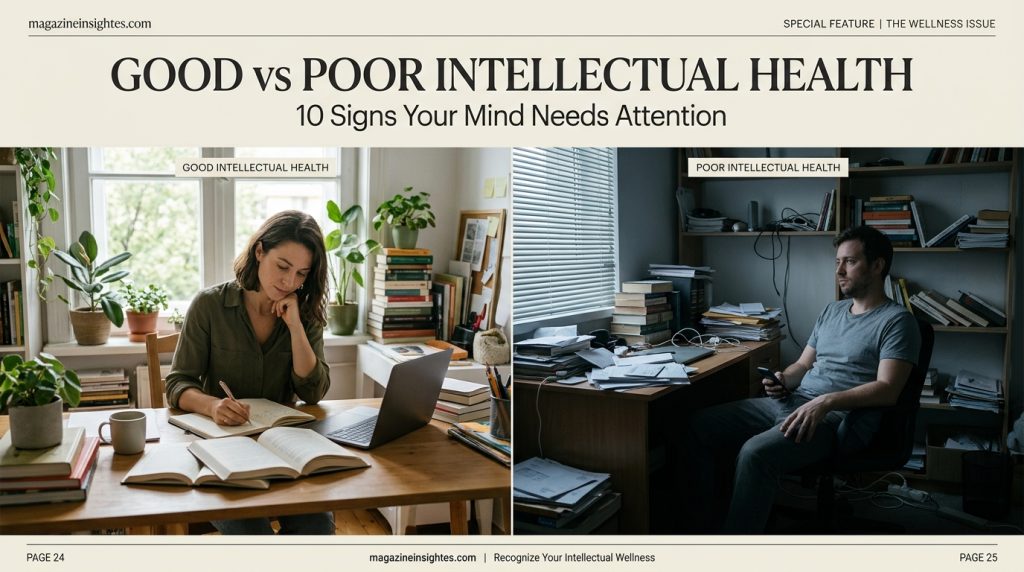
Good intellectual health shows in daily behavior, not in test scores. The signs are ordinary and easy to spot.
A person with good intellectual health enjoys learning, thinks critically, stays open-minded, and solves problems effectively. Those four signs appear in nearly every definition of the topic.
Curiosity is the clearest sign. A curious person asks questions, explores new topics, and finds joy in learning, even when the topic has no immediate use.
Other signs include reading regularly, seeking out new ideas, challenging assumptions, and sharing knowledge with others. Teaching what you know is one of the strongest signs of all.
Adaptability is another sign. A person with good intellectual health adjusts when information changes, instead of clinging to an old belief.
Signs of Poor Intellectual Health
Poor intellectual health also shows in daily behavior. The signs are quiet at first, and they grow if nothing changes.
Mental stagnation is the first sign. The same routines, the same opinions, and the same conversations repeat, and nothing new enters the picture.
Closed-mindedness is the second sign. New ideas are rejected without examination, and disagreement feels like a personal attack rather than information.
Avoiding challenge is the third sign. Hard books are skipped, difficult conversations are avoided, and new skills are dismissed as too late to learn.
Believing misinformation is the fourth sign. Claims are accepted because they feel right, or because they came from a trusted source, without checking the evidence.
No curiosity is the fifth sign. Nothing sparks interest anymore, and learning feels like a chore rather than a pleasure.
| Sign | Good intellectual health | Poor intellectual health |
|---|---|---|
| Curiosity | Asks questions, explores new topics | Nothing sparks interest |
| Open-mindedness | Considers opposing views | Rejects new ideas without examination |
| Learning | Reads, takes courses, learns skills | Avoids challenge, stopped learning |
| Thinking | Checks sources, weighs evidence | Believes claims that feel right |
| Adaptability | Changes beliefs when evidence changes | Clings to old beliefs |
| Sharing | Teaches and discusses ideas | Keeps ideas private, avoids discussion |
Why Intellectual Health Matters
Intellectual health matters because it shapes every decision a person makes. Health choices, money choices, work choices, and civic choices all run through the mind.
It also matters because it is the one dimension of wellness that can improve at any age, with no equipment and no cost. A library card and a curious mind are enough to start.
The research on cognitive reserve gives the strongest reason. Mentally stimulating activities help the brain build resilience against age-related changes, and that resilience matters most in later life.
Better decisions
People with strong intellectual health tend to make better decisions, adapt faster to change, and maintain higher life satisfaction.
That finding is reported by a student publication citing the American Psychological Association in 2024, and it is labelled here as competitor-reported, not verified on the original source.
Better decisions come from better thinking, not from more information. A person who weighs evidence, considers alternatives, and checks biases will decide better than a person who collects facts without judging them.
Adaptability
Adaptability is the ability to shift thinking strategies when new information arrives. It is also called cognitive flexibility, and it is one of the core components of intellectual health.
Change is constant, and the people who adapt best are the ones who keep learning. A new tool, a new job, or a new health fact all demand the same skill.
Cognitive reserve and aging
Cognitive reserve is the idea that mentally stimulating activities help the brain build resilience against age-related changes.
The concept comes from research on aging, and it is the most cited reason to keep learning in later life.
A large study tracked cognitive function over time, and the result was clear.
Older adults in any later-life learning scored higher on cognitive tests than those who never learned, whether they attended a course monthly or less often.
That finding is reported by Biology Insights and is labelled here as competitor-reported, not verified on the original study.
Multilingualism research offers a striking illustration.
A study of middle-aged adults found that people who actively used multiple languages showed greater white matter deterioration than monolinguals at the same cognitive level, which researchers read as evidence of reserve.
That finding is also competitor-reported and should be verified on the original study before being quoted as fact.
Reading fiction may help too. Research using brain imaging has found that reading fiction activates the brain’s default network, the same network involved in imagining hypothetical situations and understanding other people.
That finding is competitor-reported as well.
None of this means brain games prevent dementia. No activity guarantees protection against cognitive decline, and any page that promises that is overstating the evidence.
Career and learning
Intellectual health drives career growth. Learning new skills, understanding new tools, and solving new problems are what promotion and reinvention require.
Employers value the same skills: critical thinking, problem solving, adaptability, and communication. Those skills are portable across jobs and industries.
For readers planning a career in health, the guide to what you can do with a masters in public health shows one path where learning never stops.
How to Improve Intellectual Health
Improving intellectual health takes minutes a day, not hours. The research and the university guides agree on the same point: a few minutes, several days a week, is enough to start.
The habits below are the ones every competitor recommends, plus the ones only the university pages mention. Each one works on its own, and together they cover the whole definition.
Read every day
Reading is one of the simplest yet most powerful ways to improve intellectual health. Books, articles, and reports expose the mind to new ideas, different perspectives, and valuable information.
Fiction and non-fiction both help, in different ways. Fiction builds empathy and imagination, while non-fiction builds knowledge and vocabulary.
Illinois State University reported in 2017 that 28 percent of Americans had not read a book in the past year.
That figure is reported by the university article, not verified on the original survey here, and it shows how common the reading gap is.
Read for fun first. Reading something enjoyable stretches the mind to think about things it normally does not think about, and enjoyment is what keeps the habit alive.
Learn a new skill
Learning a new skill is the most direct path to intellectual health. Taking up a new sport, learning a musical instrument, or learning to code all challenge the brain in new ways.
Studies show that learning something new and complex over a period of time is ideal for the mind. The key words are new and complex, not easy and familiar.
Pick one skill and give it three months. A language, an instrument, a craft, or a programming language all work, as long as the learning is real.
Solve puzzles and play brain games
Brain exercises like crosswords, Sudoku, logic puzzles, and memory games are fun ways to boost thinking skills. Chess and strategy board games like Clue, Risk, and Pandemic work too.
The Illinois State seven strategies include testing recall, creating word pictures, and drawing a map from memory after visiting a new place. Each one is a small, free exercise.
Online brain games exist on sites like BrainBashers and Braingle, which Illinois State names in its activities list. Lumosity and mindgames.com appear in the same university guides.
Games help, but they are not magic. They train specific skills, and they work best as part of a wider habit of learning, not as a replacement for it.
Have meaningful discussions
Talking with others about a wide range of topics pushes the mind to think deeply and consider viewpoints it might not have thought about before.
Debate an issue with a friend, but choose the viewpoint opposite the one you hold. Focusing on information that differs from your beliefs can improve intellectual wellness, and that exercise comes from Illinois State University.
Share ideas and engage in topic-specific discussions with peers. Teaching an idea to someone else is the fastest way to find out whether you really understand it.
Ask questions and stay curious
Curiosity drives intellectual growth. Asking why or how leads to exploring new ideas, finding answers, and discovering different viewpoints.
If you hear something new, research it instead of ignoring it. A five-minute search can turn a passing claim into real knowledge.
Explore current events, attend a lecture, or watch an educational show. Each one adds a new thread to the mind, and the threads connect over time.
Write and journal
Writing down thoughts or journaling frequently helps anyone trying to make sense of what they are feeling inside. It also turns vague ideas into clear ones.
Free writing is the simplest form. Set a timer for ten minutes, write without stopping, and do not edit. The point is the thinking, not the prose.
The University of Pittsburgh lists free writing and journaling among its five tips for intellectual well-being, alongside reading and watching documentaries.
Learn a new language
Learning a new language expands the mind and makes a person more receptive to new knowledge and new ways of thinking.
That is the finding in the Illinois State guides, and it is one of the most repeated claims in this field.
A language also gives the brain a daily workout. Vocabulary, grammar, listening, and speaking all use different parts of the mind at once.
Start with ten minutes a day. An app, a podcast, or a textbook all work, as long as the practice is daily and the difficulty grows.
Explore new ideas and places
Take a different route to work or school. Because minds favor patterns, the same route causes the mind to stop paying attention, and a new route lets fresh information in.
Travel somewhere new, even a nearby town.
After returning home from visiting a new place, try to draw a map of the area from memory, and repeat the exercise each time you visit a new location.
Challenge your taste buds too. When eating, try to identify individual ingredients in a meal, including subtle herbs and spices. It is a small exercise, and it trains attention.
The 10-Minute Daily Routine
Ten minutes a day is enough to start. The routine below uses the habits every source recommends, in the smallest useful dose.
| Minutes | Activity | What it trains |
|---|---|---|
| 4 | Read a book or an article | Knowledge, vocabulary, curiosity |
| 2 | Do a puzzle or a memory exercise | Problem solving, recall |
| 2 | Write down one new idea or question | Reflection, self-knowledge |
| 2 | Ask one question and look up the answer | Curiosity, critical thinking |
The routine works because it is small. A habit that takes ten minutes survives a busy day, and a habit that survives is a habit that grows.
For a morning version, the guide to healthy morning habits shows how to build a routine that sticks.
The 7-Day Starter Plan
Seven days is enough to feel the difference. Each day adds one new habit, and by day seven the full routine is in place.
| Day | Task | Time |
|---|---|---|
| 1 | Read for fun for 20 minutes | 20 min |
| 2 | Do a crossword or Sudoku puzzle | 15 min |
| 3 | Watch a documentary or listen to an educational podcast | 30 min |
| 4 | Write in a journal for 10 minutes | 10 min |
| 5 | Learn 10 words in a new language | 10 min |
| 6 | Debate an issue with a friend, taking the opposite view | 20 min |
| 7 | Take a different route and draw a map of a new place from memory | 20 min |
The plan comes from the Illinois State seven strategies and eight steps, combined into one week. Each task is drawn from a university guide, not invented here.
Intellectual Health Self-Assessment
No validated scale exists for intellectual health itself. The checklist below is a self-assessment, not a diagnosis, and it shows where the gaps are.
Answer each question honestly. Count the yes answers, and read the band that matches your score.
| # | Question | Yes | No |
|---|---|---|---|
| 1 | Did I read something for pleasure this week? | ||
| 2 | Did I learn something new in the last month? | ||
| 3 | Do I ask questions when I do not understand something? | ||
| 4 | Can I name a viewpoint I disagree with and explain it fairly? | ||
| 5 | Do I check sources before sharing a claim? | ||
| 6 | Do I have a hobby that challenges my mind? | ||
| 7 | Do I discuss ideas with other people regularly? | ||
| 8 | Do I write down my thoughts or journal? | ||
| 9 | Am I learning a new skill right now? | ||
| 10 | Do I change my mind when the evidence changes? |
Score 8 to 10 and the mind is in good shape. Keep the habits going, and add one new challenge each month.
Score 5 to 7 and the foundation is there, but the practice is patchy. Pick the two no answers that are easiest to fix, and start there.
Score 0 to 4 and the mind is running on routine. Start with the 10-minute daily routine above, and retake the checklist in a month.
Intellectual Health at Work
Work is where most adults spend their thinking hours, and it can build or drain intellectual health. The difference is whether the work challenges the mind.
Learning on the job counts. A new tool, a new process, or a new client problem all train the same skills as a course, and they pay at the same time.
Meeting overload is the main threat. Back-to-back meetings leave no time for deep work, and deep work is where real thinking happens.
Protect one hour a day for focused work with no meetings and no notifications. Use it for the hardest problem on the list, not the easiest.
Teach what you know. Mentoring a colleague, writing a guide, or giving a short talk all force the mind to organize what it knows, and that organization is learning.
Intellectual Health for Students
Students have a head start on intellectual health, because school is built for learning. The risk is that the learning stays shallow, aimed at exams rather than understanding.
Study skills matter more than study hours. Spaced repetition, self-testing, and explaining ideas in your own words all beat re-reading notes.
Time management matters too. The University of Rochester lists improving time management alongside improving study skills and critical thinking, and the three belong together.
Explore what motivates you. Rochester lists that as a tip, and it is the one that keeps students learning after the exam is over.
For the health of young people more broadly, the guide to how social media affects teens mental health covers the screen side of the same question.
Intellectual Health as You Age
Intellectual health matters most as people age, because the brain changes and the habits that protected it become more important, not less.
Later-life learning is the strongest habit.
The study reported by Biology Insights found that older adults in any later-life learning scored higher on cognitive tests, and that finding is competitor-reported, not verified on the original study.
Social learning helps too. A book club, a class, or a discussion group adds social contact to the mental work, and social contact supports the brain in its own right.
Learning a language in later life is a strong choice. It uses memory, attention, and sound at the same time, and it gives a visible sense of progress.
Memory problems are different from normal aging. If memory loss interferes with daily life, or gets worse over months, see a doctor. That is a medical question, not a wellness question.
The Brain Health Foundation: Sleep, Exercise, Diet, Social Life
Intellectual habits sit on a physical foundation. Sleep, exercise, diet, and social life do not replace learning, but learning works poorly without them.
Sleep consolidates learning. The brain files new memories during sleep, and a short night erases more than it saves.
Aerobic exercise supports mental agility. Exercise is vital for mental agility, and the evidence for it is stronger than the evidence for any single brain game.
Diet matters too. Foods high in saturated fats, like cakes, biscuits, pastry, or sausages, can speed mental decline, while oranges, green leafy vegetables, oily fish, and soya are good for the brain.
That claim comes from a business news clone of an older health article, and it is labelled here as competitor-reported, not verified on a primary source.
Social activity rounds out the foundation. Joining a choir, a gardening club, or a volunteer group keeps the mind engaged through other people, and social contact helps memory and concentration.
How to Measure Intellectual Health
There is no single validated scale for intellectual health. No blood test, no brain scan, and no questionnaire measures it directly.
Cognitive tests measure related functions, not intellectual health itself. They test memory, attention, and reasoning at one moment, and they say nothing about curiosity, creativity, or lifelong learning.
The National Institute on Aging lists brief cognitive assessment tools, including the Mini-Cog, the AD8, and the NIH Toolbox. Those tools detect early cognitive changes, and they belong in a clinic, not in a self-assessment.
The honest measure is behavior. The self-assessment checklist above, retaken monthly, shows whether the habits are growing or fading, and that is the most useful number available.
Common Myths About Intellectual Health
| Myth | Reality |
|---|---|
| You need a high IQ | Curiosity and daily learning matter more than a test score |
| Brain games prevent dementia | No activity guarantees protection; games train specific skills only |
| Learning stops after school | Learning can improve at any age, and later-life learning is well documented |
| Reading anything counts | Reading for fun counts, but challenging material builds more |
| Intellectual health is only for students | It matters for workers, parents, and retirees just as much |
| You need expensive courses | A library card, free podcasts, and a journal are enough to start |
The most harmful myth is the first one. Believing that intellectual health requires a high IQ stops people from starting, and the belief itself is false.
The second myth is the most expensive one. Brain training apps sell a promise the evidence does not support, and the money is better spent on books and courses.
Mistakes That Hurt Intellectual Health
Treating learning as a chore is the first mistake. A habit that feels like punishment will not survive a busy week, so the habit must be enjoyable first.
Only consuming, never creating, is the second mistake. Watching, reading, and listening build knowledge, but writing, making, and teaching build understanding.
Staying in an echo chamber is the third mistake. When every source agrees, the mind stops working, and the first disagreement feels like an attack.
Multitasking through learning is the fourth mistake. A podcast at double speed while answering email is not learning, it is noise, and nothing sticks.
Waiting for the perfect time is the fifth mistake. The right course, the right book, and the right moment never arrive together, and ten minutes today beats a perfect plan next month.
Key Takeaways
- Intellectual health is the ongoing capacity to think critically, learn new concepts, solve problems, and adapt to changing information.
- It comes from the wellness movement: Hettler’s six dimensions in 1976, Swarbrick’s eight in 2006, and SAMHSA’s adoption in 2011 and 2016.
- It is not IQ, not academic success, and not mental health, though it supports all three.
- The six components are critical thinking, curiosity, creativity, problem solving, lifelong learning, and reflection.
- Good signs are curiosity, open-mindedness, regular reading, and sharing ideas; poor signs are stagnation, closed-mindedness, and no curiosity.
- Cognitive reserve is the research idea behind the habits, and later-life learning is the strongest single habit in the aging research.
- Ten minutes a day is enough to start, and the 7-day plan turns the habits into a routine.
- There is no validated scale for intellectual health; the honest measure is behavior, retaken monthly.
- The foundation is sleep, exercise, diet, and social life, and the habits sit on top of that foundation.
Frequently Asked Questions
What is intellectual health?
Intellectual health is the ongoing capacity to think critically, learn new concepts, solve problems, and adapt to changing information.
What is the definition of intellectual health?
It is the ability to learn, experience, and use intellectual capacities through creative and stimulating mental activities, with the goal of expanding knowledge and skills.
What are examples of intellectual health?
Reading daily, learning a new language, solving puzzles, debating ideas, taking courses, journaling, and teaching what you know are all examples.
What are the signs of good intellectual health?
Enjoying learning, thinking critically, staying open-minded, solving problems effectively, and sharing ideas with others are the main signs.
What are the signs of poor intellectual health?
Mental stagnation, closed-mindedness, avoiding challenge, believing misinformation, and no curiosity are the main signs.
How can I improve my intellectual health?
Read every day, learn a new skill, solve puzzles, have meaningful discussions, ask questions, write, learn a language, and explore new ideas and places.
Why is intellectual health important?
It shapes every decision, from health and money to work and civic life, and it builds cognitive reserve that helps the brain age well.
What is the difference between intellectual health and mental health?
Intellectual health is about thinking, learning, and solving problems, while mental health is about feeling, coping, and managing emotions.
Is intellectual health the same as IQ?
No. IQ is often treated as a fixed trait, while intellectual health is cultivable and grows with daily practice at any age.
Is intellectual health the same as cognitive health?
No. Cognitive health is a medical concept about brain function, while intellectual health is a wellness concept about how the mind is used daily.
What is intellectual wellness?
Intellectual wellness is the same idea as intellectual health, framed as a dimension of wellness. The two terms are used interchangeably.
What are the 6 dimensions of wellness?
Hettler’s six are physical, emotional, intellectual, social, spiritual, and occupational. A textbook variant swaps occupational for environmental.
What are the 8 dimensions of wellness?
SAMHSA’s eight are emotional, environmental, financial, intellectual, occupational, physical, social, and spiritual.
Who created the dimensions of wellness?
Dr. Bill Hettler created the six dimensions model in 1976 at the University of Wisconsin-Stevens Point, building on Halbert Dunn’s earlier work on high-level wellness.
How do you measure intellectual health?
There is no validated scale for it. Cognitive tests measure related functions, and the honest measure is behavior, tracked with a self-assessment checklist.
Can intellectual health decline with age?
Yes, if the mind is not used, but it can also improve at any age. Later-life learning is associated with higher cognitive test scores in older adults.
Can you improve intellectual health at any age?
Yes. The brain keeps its ability to learn throughout life, and the habits work for students, workers, and retirees alike.
What happens if you neglect intellectual health?
The mind stagnates, curiosity fades, beliefs harden, and adapting to change gets harder. The decline is gradual and easy to miss.
What activities improve intellectual health?
Reading, learning new skills, puzzles, discussions, journaling, language learning, courses, lectures, travel, and creative hobbies all help.
Does reading improve intellectual health?
Yes. Reading exposes the mind to new ideas and perspectives, and reading fiction may activate the brain’s default network, according to competitor-reported imaging research.
Do brain games improve intellectual health?
They train specific skills like recall and pattern recognition, but they are not magic and do not guarantee protection against cognitive decline.
Does learning a new language help intellectual health?
Yes. It uses memory, attention, and sound at the same time, and multilingualism research links it to cognitive reserve, though that finding is competitor-reported.
What is cognitive reserve?
Cognitive reserve is the idea that mentally stimulating activities help the brain build resilience against age-related changes.
What is neuroplasticity?
Neuroplasticity is the brain’s ability to form new connections and reorganize itself in response to learning and experience, throughout life.
How does intellectual health affect career success?
It builds the skills employers value most: critical thinking, problem solving, adaptability, and communication, all portable across jobs.
Conclusion
What is intellectual health? It is a curious, engaged mind that stays open to new ideas, learns every day, and adapts when the evidence changes.
The idea is fifty years old, and it has not changed. Hettler named it in 1976, Swarbrick expanded it in 2006, and SAMHSA adopted it, and the core has stayed the same.
The habits are small and the payoff is large. Ten minutes a day, a book, a question, a puzzle, and a conversation are enough to start.
Start today with the 7-day plan. By day seven, the routine is in place, and the mind has already begun to change.